
A 2026 study of 1,000 companies found that 63.5% of leads never receive a response at all. It’s a quiet, systemic leak that drains your marketing ROI before a single conversation even begins. If a prospect reaches out and meets silence, they don’t wait; they simply move to the next name on the list. Implementing a sophisticated automated lead response system transforms this operational friction into a mathematical certainty of engagement, ensuring that every high-intent inquiry is met with immediate action.
You’ve likely felt the exhaustion of trying to be available 24/7. It’s a heavy burden to balance human limits with a market that expects instant gratification. This guide will show you how to eliminate lead decay and maximize ROI by shifting your response time from minutes to milliseconds. We’ll explore the strategic shift toward AI-powered virtual receptionists, the nuances of 2026 TCPA compliance, and the tactical steps required to ensure your business remains perpetually open without the burnout or high cost of traditional manual oversight.
Key Takeaways
- Understand why modern consumers equate even minor delays with disinterest and how to quantify the hidden financial impact of “leaky bucket” lead management.
- Transition from passive auto-replies to an intelligent automated lead response ecosystem that facilitates high-intent engagement across voice and digital channels.
- Learn why the traditional 10-minute response rule has been replaced by a sub-60-second standard to meet 2026’s competitive conversion benchmarks.
- Apply a strategic four-step framework to audit operational friction and define the logic required for an AI Voice Receptionist to handle routing and scheduling.
- Discover how to maintain 24/7 availability and move prospects from initial inquiry to a booked appointment without the overhead of manual answering services.
The Crisis of the Leaky Bucket: Why Manual Lead Response is Your Biggest Liability
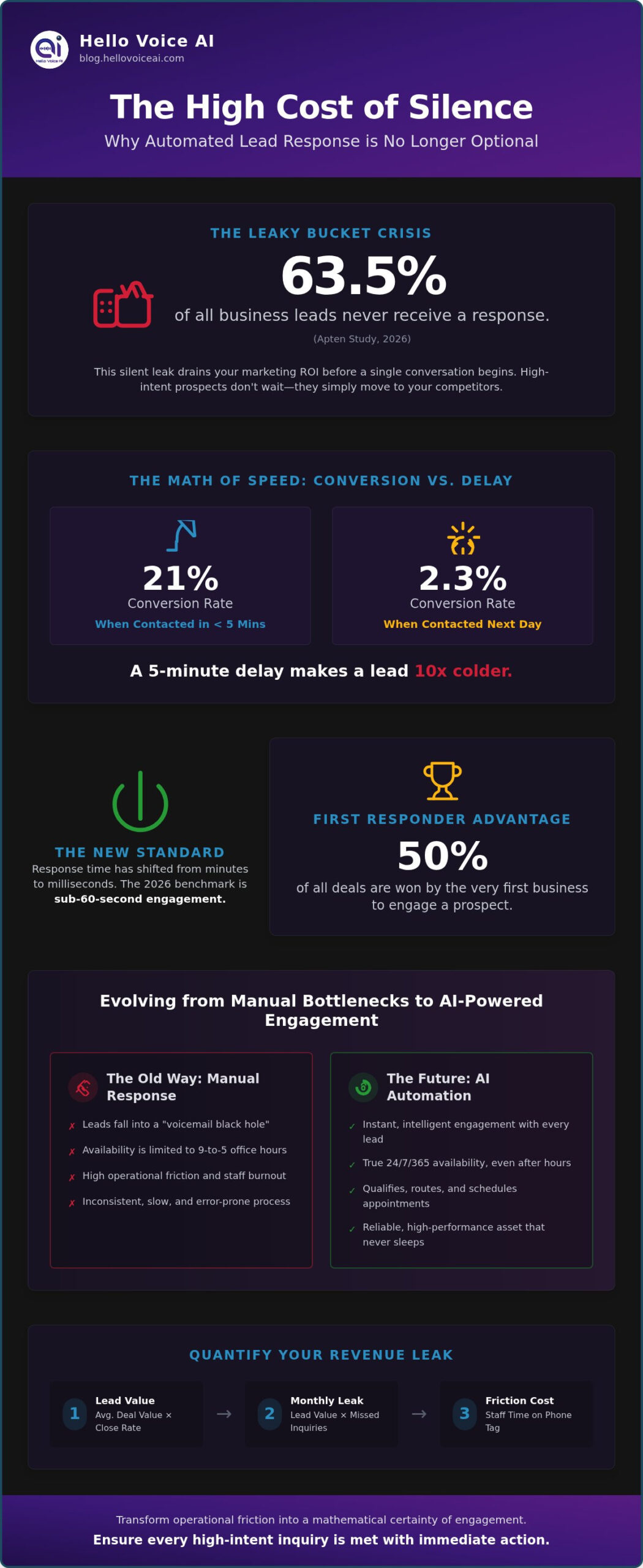
Potential clients don’t wait. In the current market, 63.5% of leads never receive a response at all, according to a 2026 Apten study. This isn’t just an administrative oversight; it’s a direct hit to your bottom line. Relying solely on manual processes creates a bottleneck that high-intent prospects won’t tolerate. If your response time is measured in hours rather than seconds, you’re essentially handing market share to more agile competitors. Business growth depends on momentum, and manual workflows are the primary friction point slowing you down.
The Psychology of the Modern Buyer
In 2026, speed is the primary indicator of professional competence. Customers equate a delay with a lack of interest in their business. Research from Perspective AI shows that leads contacted within five minutes convert at a rate of 21%, while next-day replies drop to a staggering 2.3%. A five-minute delay makes a lead ten times colder. The “First Responder” advantage is a documented reality; the first business to engage a prospect typically wins 50% of the deals. An automated lead response strategy ensures you’re always the first to the table, regardless of when the inquiry arrives.
Quantifying the Revenue Leak
Every missed call has a tangible price tag. To calculate your specific loss, you can follow this logical framework:
- Lead Value: Average Deal Value multiplied by your Close Rate.
- Monthly Leak: Lead Value multiplied by the number of missed calls or unanswered inquiries per month.
- Operational Friction: The cost of staff time spent playing “phone tag” with cold leads.
Modern lead management systems are designed to prevent this attrition, yet many firms still force prospects into a “voicemail black hole.” When a lead is forced to leave a message, the attrition rate spikes immediately. Your “silent” competitors are those who answer when you’re at lunch or after hours. They aren’t necessarily offering a better service; they’re simply more available.
Human-only teams are structurally incapable of 24/7 perfection. Burnout is inevitable when staff try to bridge the gap between standard office hours and global demand. This silence after 5:00 PM doesn’t just lose a single sale; it erodes brand authority. It suggests your operations are outdated and unresponsive. Transitioning to an automated lead response model removes these human limitations, turning a variable, fragile process into a reliable, high-performance asset that works while you sleep. If your current automated phone system is routing callers into circular menus rather than capturing intent, it may be the primary source of your lead attrition. Deploying a virtual phone assistant designed to qualify leads and book appointments ensures your front desk remains a revenue-generating asset around the clock.
The Architecture of Instant Engagement: How Automated Lead Response Works
Speed is the foundation. Automated lead response is no longer a simple “thank you” email triggered by a form submission. It is a sophisticated, AI-driven engagement layer that interacts with prospects across voice, SMS, and email in real time. This architecture replaces the static auto-reply with intelligent interaction, where the system doesn’t just acknowledge the lead but begins the qualification process immediately. It is the difference between a digital receipt and a meaningful conversation.
Natural Language Processing (NLP) serves as the brain of this operation. By analyzing the specific vocabulary and tone a prospect uses during an initial call or text, the system identifies intent instantly. If a caller asks about emergency pricing versus general information, the AI recognizes the urgency and adjusts its logic accordingly. It bridges the gap between a digital inquiry and a human connection by providing a conversational interface that feels personal, not robotic. This technology ensures that no lead is left to guess about the next steps in their journey.
Beyond the Generic Auto-Responder
A generic “we’ll get back to you” message is often interpreted as a brush-off. In 2026, high-value leads expect a solution, not a receipt. Businesses that move beyond the auto-responder to engage in meaningful dialogue are seven times more likely to qualify the lead than those that wait even an hour. Modern AI Voice Receptionists identify high-value opportunities during that very first touch, moving from simple data capture to immediate problem-solving. If a prospect is ready to book, the system facilitates it on the spot.
The Multi-Channel Response Loop
True efficiency requires a synchronized ecosystem. When a prospect calls, the system captures the voice data, logs it in your CRM, and can trigger a follow-up SMS to confirm details. This multi-channel approach ensures a consistent brand voice across every touchpoint, whether the interaction is spoken or typed. By utilizing real-time data enrichment and API integrations, your automated lead response system acts as a central nervous system for your sales team. If you want to see how this logic applies to your specific industry, you can explore the latest AI voice workflows to optimize your own setup. This technical stack ensures that your front desk is never a bottleneck, but a gateway to growth.
The Math of Speed-to-Lead: Benchmarking 2026 Performance Standards
The old “10-minute rule” for lead follow-up is officially obsolete. In 2026, the market has moved to a sub-60-second standard where every tick of the clock represents a measurable loss in potential revenue. Responding within one minute can increase conversions by 391% compared to waiting even five minutes. While a landmark Harvard Business Review study previously established that firms were seven times more likely to qualify a lead within the first hour, modern consumer expectations have compressed that window into seconds. Implementing an automated lead response system is no longer an optional upgrade; it’s a requirement for maintaining a competitive Lead-to-Opportunity ratio.
The performance gap between AI and human teams is stark. Companies utilizing AI-driven engagement are 60% more likely to meet the 15-minute response standard than manual teams. In high-stakes sectors like Legal, Medical, and Professional Services, the “first responder” almost always wins the contract. If a prospect doesn’t receive an immediate answer, they simply click the next result in their search. This reality makes the median B2B response time of 42 hours look like an invitation for your competitors to take your business.
Lead Decay: A Time-Series Analysis
Lead quality doesn’t just decline; it evaporates. Every 60 seconds of silence from your front desk results in a steep drop-off in engagement. This decay is most aggressive during “after-hours” windows. Data suggests that after-hours leads are three times more likely to convert if they are met with an instant AI response rather than waiting for a human to return the call the next business day. By utilizing automated lead response, you capture the prospect at the peak of their intent, preventing the lead from “going cold” before you’ve even had a chance to speak.
The Persistence Factor
Success in 2026 requires more than a single touchpoint. It typically takes 6 to 8 touches to qualify a lead, yet a staggering 63.5% of leads never receive a response at all. This creates a “persistence paradox” where human teams, prone to burnout and administrative friction, abandon leads too early. Automation ensures that no lead is forgotten after the first attempt. A structured, automated loop maintains a consistent cadence of follow-ups, balancing professional persistence with empathy. For organizations looking to bridge the gap between automated capture and a closed deal, Virtual Sales Limited offers the B2B telemarketing expertise necessary to maintain that momentum. It ensures your brand remains the primary solution in the prospect’s mind without the high operational cost of manual tracking.
Designing Your Response Ecosystem: A 4-Step Implementation Framework
Strategic success is rarely accidental. To transition from a reactive posture to a proactive conversion engine, you must treat your front-desk operations as a scalable system. An effective automated lead response ecosystem isn’t built on a single tool; it’s an integrated framework that aligns your technology with the specific needs of your high-intent prospects. By following a structured roadmap, you can eliminate operational friction and ensure that every interaction moves the needle toward revenue.
Auditing Your Communication Gaps
Data tells the story that your team might miss. Step one requires a rigorous audit of your current “First Touch” friction points. You must identify exactly when and where you are losing leads, whether it’s during the lunch hour or at 2:00 AM on a Sunday. Mapping the “Happy Path” for a new caller allows you to visualize the ideal journey from the initial “hello” to a confirmed booking. Interaction friction is the cumulative psychological and technical resistance a prospect encounters when attempting to engage with your business. If your audit reveals that callers are forced into a voicemail loop, you’ve identified a primary barrier to growth. Building a modern automated phone system designed around intent capture rather than call routing is often the most impactful structural change you can make at this stage.
Setting the Rules of Engagement
Step two involves defining the logic that governs your AI Receptionist. This isn’t just about answering calls; it’s about intelligent routing and screening. You must configure the system to handle common FAQs and screen leads based on your specific qualification criteria. Establishing escalation protocols for high-priority VIP leads ensures that your top-tier opportunities receive immediate attention from a human representative if necessary. During this phase, it’s vital to ensure the AI tone aligns with your brand personality, maintaining a balance of professional empathy and authoritative confidence. You can learn how to customize your AI voice personality to match your firm’s unique identity.
Integration is the third pillar of this framework. Your automated lead response system must communicate seamlessly with your existing CRM and scheduling tools. If the AI schedules an appointment, that data should populate your calendar and lead database instantly without manual entry. Finally, step four focuses on continuous optimization. By monitoring interaction data, you can iterate on your routing rules and refine your AI’s responses based on real-world performance. This cyclical process ensures that your response ecosystem remains “future-ready” and continues to maximize your ROI as market dynamics shift. Understanding how a virtual phone assistant captures every revenue opportunity through automated lead qualification can help you set more precise performance benchmarks during this optimization phase.
Future-Proofing Lead Capture with Hello Voice AI
Scaling a business in 2026 requires more than just marketing spend; it requires an infrastructure that can absorb every ounce of demand you generate. Hello Voice AI serves as that critical infrastructure. By deploying an AI Voice Receptionist, you eliminate the overhead of traditional call centers while maintaining a presence that is perpetually available. This is the ultimate evolution of automated lead response, moving beyond simple message capture to active revenue generation. It’s the most strategic hire your business can make this year, providing a methodical solution to the systemic leaks that plague manual operations.
Think of this system as a methodical efficiency expert that never takes a sick day. It doesn’t just route calls; it enriches your data. When the AI interacts with a lead, it captures intent, contact details, and specific needs, feeding them directly into your CRM. This ensures that when your sales team does step in, they aren’t starting from zero. They are stepping into a qualified context where the heavy lifting of the “first touch” is already complete. You’re no longer just managing leads; you’re orchestrating a high-performance sales engine.
The 24/7 Virtual Receptionist Advantage
The 24/7 economy doesn’t pause at 5:00 PM. High-intent prospects often conduct their research during off-hours. If your front desk is dark, you’ve already lost the deal to a competitor who was ready to answer. Hello Voice AI captures the “Midnight Lead” by providing an immediate, sophisticated interaction that qualifies the prospect on the spot. This capability offloads the burden of repetitive inquiries from your human staff, effectively reducing front-desk burnout. It ensures your brand voice remains consistent and professional regardless of call volume or the time of day.
Driving ROI with Automated Scheduling
True ROI is realized when a lead transitions into a scheduled appointment without delay. Hello Voice AI facilitates this move in a single call, transforming a curious caller into a committed client. By integrating directly with your existing CRM and scheduling tools, the system updates your sales pipeline in real-time. This immediacy drives customer satisfaction scores higher because the prospect feels their problem is already being solved. Automated confirmations and reminders further protect your bottom line by reducing no-shows. If you’re ready to stop losing leads, it’s time to discover how Hello Voice AI transforms your response strategy and secures your competitive position in an instant-gratification market.
Securing Your Competitive Edge in a Sub-60-Second Market
Success in 2026 is no longer a matter of effort; it’s a matter of infrastructure. We’ve established that the “leaky bucket” of manual lead management is a liability your bottom line can’t afford. By adopting a sophisticated automated lead response system, you move from a reactive posture to a state of perpetual readiness. This transition ensures that high-intent prospects are met with instant engagement rather than a voicemail black hole, effectively turning speed into a permanent competitive advantage.
The path forward involves more than just faster replies. It requires a seamless ecosystem where 24/7 instant lead capture, automated appointment scheduling, and seamless CRM integration work in concert to maximize your marketing ROI. You’ve seen the math and the implementation framework; now it’s time to close the gap between inquiry and conversion. The technology exists to solve these logical puzzles for you, allowing your team to focus on high-value human connections while the AI handles the rest.
For organizations looking to bring in industry leaders to discuss the balance between AI and human expertise, you can learn more about how to find and book subject-matter experts for your next event.
Ready to eliminate operational friction and capture every opportunity? Start your 24/7 AI Receptionist trial today and transform your front desk into a tireless growth engine. Your future-ready business starts with a single, instant response.
Frequently Asked Questions
What is the ideal response time for a new lead in 2026?
The ideal response time for a new lead in 2026 is sub-60 seconds. While the old ten-minute rule was once the standard, modern consumers now equate speed with professional competence. Responding within one minute can increase your conversion rates by up to 391%. In a market where competitors are just a click away, hitting this benchmark ensures you capture high-intent prospects before they move on to the next option.
Can automated lead response systems handle complex customer questions?
Yes, modern systems handle complex questions through Natural Language Processing (NLP). These automated lead response tools analyze caller intent in real time, allowing them to distinguish between basic inquiries and high-value requests. If a prospect asks about specific service availability or pricing structures, the AI can provide accurate, logic-driven answers based on your pre-defined knowledge base. It transforms a simple interaction into a sophisticated consultation.
Will an AI voice receptionist sound natural to my customers?
An AI voice receptionist sounds remarkably natural due to advanced synthetic speech technology. You can customize the tone, pitch, and cadence to align with your specific brand personality. Most customers won’t distinguish it from a human representative, especially since it avoids the robotic delays of older systems. It maintains a consistent, professional empathy that builds trust during the very first interaction, ensuring your brand authority remains intact.
How does automated lead response integrate with my existing CRM?
Integration occurs via real-time API connections that sync your communication data instantly. When an automated lead response is triggered, the system logs the prospect’s contact details, intent, and call transcript directly into your CRM. This eliminates manual data entry and ensures your sales pipeline is always current. It allows your human team to step into a conversation with full context, significantly reducing the friction between capture and conversion.
Is automated lead response only for large enterprises?
No, this technology is designed to be scalable for businesses of all sizes. Small to mid-sized firms often benefit the most because they lack the budget for a 24/7 human answering service. Automation provides a level playing field, allowing smaller teams to compete with enterprise-level response times without the massive overhead. It’s a strategic tool for any business looking to maximize marketing ROI through efficiency and speed.
What happens if the AI cannot answer a specific lead inquiry?
If the AI encounters an inquiry it cannot resolve, it follows a pre-defined escalation protocol. This typically involves routing the call to a human team member or capturing a detailed message for immediate follow-up. The system ensures the prospect feels heard rather than ignored. By identifying these gaps, you can also iterate on your AI’s logic to handle similar questions more effectively in the future, improving your overall ecosystem.
Does automated lead response work for after-hours calls?
Yes, these systems provide comprehensive 24/7 coverage. Since AI doesn’t experience burnout or require sleep, it can manage inquiries at 2:00 AM with the same precision as 2:00 PM. Capturing midnight leads is a major growth driver, as these prospects are often highly motivated. Instead of hitting a voicemail, they receive an immediate response and can even schedule an appointment while your competitors are offline and unresponsive.
How much revenue can I expect to recover by automating my lead response?
Revenue recovery depends on your average deal value and current lead attrition rate. With 63.5% of leads currently going unanswered across many industries, the potential for recovery is substantial. By ensuring every inquiry is met with an instant response, you can potentially double your lead-to-opportunity ratio. You’re effectively stopping the revenue leak caused by missed calls and slow follow-ups, turning wasted marketing spend into a predictable stream of closed deals.






One Comment