
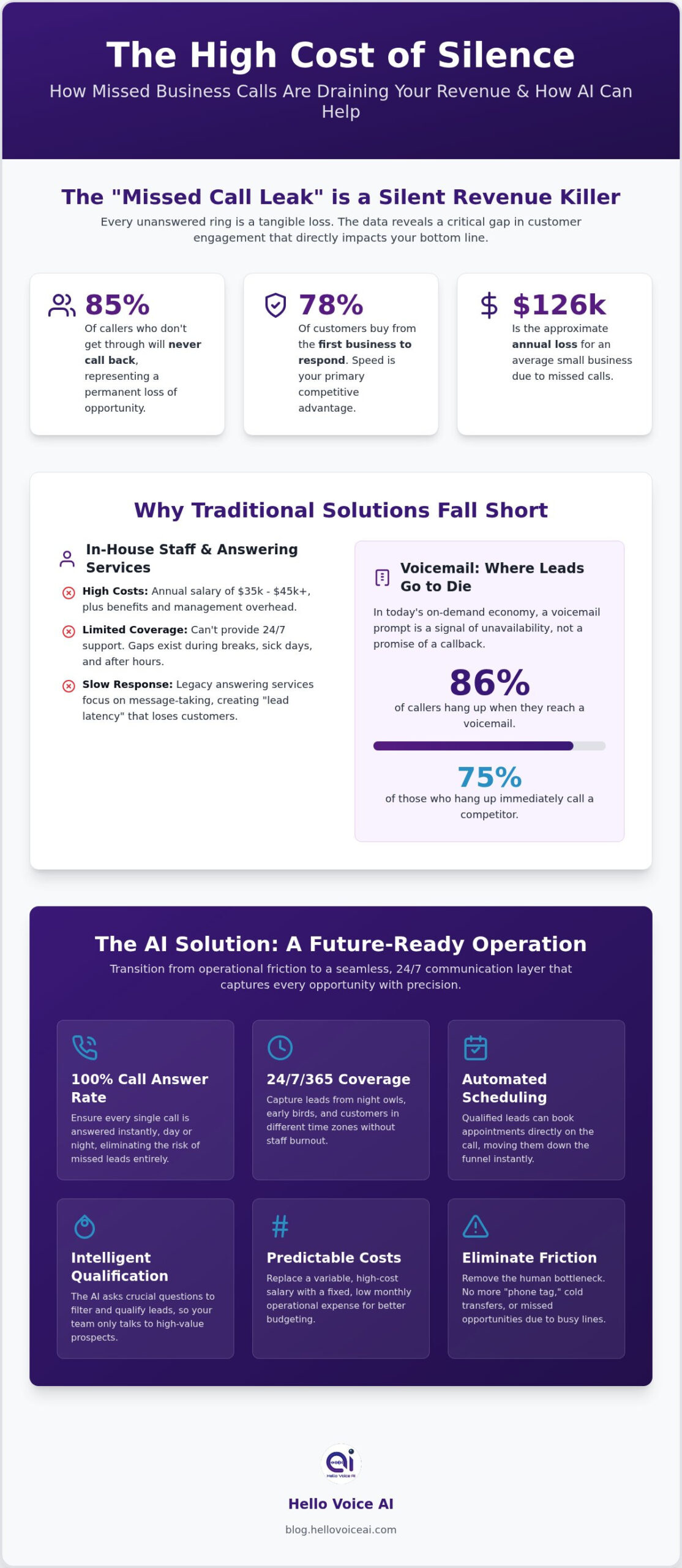
The average small business loses approximately $126,000 every year to the sound of silence. It’s the sound of a phone ringing out, a potential client hanging up, and a competitor gaining a new lead. Statistics show that 85% of callers who don’t get through will never call you back. If you are wondering how to stop missing business calls, you aren’t just looking for a better phone system. You’re looking to plug a systemic revenue leak that’s draining your growth while you sleep or focus on the technical work that actually drives your company forward.
You know the frustration of checking a generic voicemail only to find it leads to a dead end. You’ve likely felt the burnout of trying to answer every inquiry after hours, sacrificing your personal time for a lead that might not even convert. It’s an exhausting, manual cycle that creates operational friction. This guide reveals how to eliminate that friction by implementing a 24/7 AI-driven communication layer to ensure a 100% call answer rate. We’ll examine the transition from traditional reception to automated appointment scheduling and predictable lead management. You’ll discover a roadmap for a future-ready operation that captures every high-value opportunity with methodical precision.
Key Takeaways
- Understand the “first-to-answer” rule of 2026, where 78% of customers buy from the first business to respond, making speed your primary competitive advantage.
- Discover how to stop missing business calls by implementing a zero-latency AI communication layer that eliminates the human bottleneck and operational friction.
- Identify the hidden financial impact of the “Missed Call Leak,” which accounts for both immediate lost revenue and the long-term lifetime value of high-quality leads.
- Follow a five-step strategic audit to map your existing call flow and build a comprehensive knowledge base for automated lead qualification.
- Transition to a modern infrastructure that provides 24/7 coverage and automated appointment scheduling with predictable monthly costs.
The Silent Revenue Killer: Calculating the True Cost of Missed Calls
Every unanswered ring is a line item on a balance sheet you never see. Most business owners view a missed call as a minor inconvenience, but it’s actually a systemic failure known as the “Missed Call Leak.” This leak compounds the loss of immediate revenue with the total lifetime value of a client you never even met. If you’re looking for how to stop missing business calls, you’re essentially trying to patch a sieve that’s draining your growth potential one ring at a time.
Speed is the new currency. Research indicates that 78% of customers buy from the business that responds first. In a market where your competitor is just one thumb-swipe away, a second ring is often a signal for the caller to move on. Beyond the immediate cash loss, there’s a heavy reputational cost. When calls go unanswered, it seeds a narrative of neglect, often manifesting as negative reviews that permanently stain your digital footprint. For a national brand or a community-focused system like US American Miss, maintaining a reputation for responsiveness and professionalism is essential to long-term success. Then there’s the mental tax. The constant anxiety of “phone tag” creates a cognitive load that prevents you from doing the high-level strategic work your company actually needs.
The Hidden Math of Lead Latency
The numbers are sobering. If your business misses just one $500 lead per week, you’re effectively burning $26,000 in annual revenue. Lead Latency is the time elapsed between a customer’s intent and a business’s engagement. Every minute that passes increases the likelihood that your marketing dollars, spent specifically to generate that call, are completely wasted. You’re paying for the lead, then paying again by losing it. Historically, an Automated attendant was the standard fix for routing, but today’s market demands a more sophisticated, immediate response to maintain a positive ROI on your advertising spend.
Why Voicemail is Where Leads Go to Die
By 2026, consumer behavior has shifted entirely away from patience. A “leave a message” prompt is no longer a call to action; it’s a polite way of saying you’re too busy to help. Statistics show that 86% of callers hang up when they reach a voicemail, and 75% of those people immediately call a competitor. Contrast this with “Instant Engagement.” When a caller is greeted immediately, it builds a metric of trust that a recording simply cannot replicate. The impact of missed calls on customer loyalty extends far beyond a single lost sale, driving long-term churn that compounds over time. Learning how to stop missing business calls requires replacing that dead-end recording with a responsive solution that captures intent the moment it’s voiced.
Why Traditional Solutions Fail to Stop Missing Business Calls
Hiring more staff isn’t always the solution. Often, it’s the start of a new problem. While adding a human receptionist seems like a logical fix, it frequently introduces more management friction than it solves. Traditional receptionists are becoming a luxury for small firms, with annual costs now ranging between $35,000 and $45,000 plus benefits. This creates a cost-of-labor crisis that forces business owners to choose between financial health and lead response. If you’re struggling with how to stop missing business calls, you’ve likely realized that human teams can’t provide 24/7 coverage without massive overhead. The 24/7 delusion assumes that a small team can remain alert and responsive at 3:00 AM or during a holiday weekend, but the reality is usually an expensive, inconsistent patchwork of coverage.
Legacy answering services also fall short in the modern “on-demand” economy. These services typically focus on basic message taking, which is far too slow for today’s buyers. A study by the NJBIA quantifies the cost of poor customer service, highlighting how businesses lose revenue when they fail to provide immediate, high-quality engagement. When a lead has to wait hours for a callback, they’ve already moved on to your competitor. Relying on outdated methods is a strategic risk that compromises your growth metrics and ignores the shift toward instantaneous digital communication. Building a true instant response customer service strategy is no longer optional for businesses that want to compete in 2026.
The Limitations of Live Answering Services
Live answering services often suffer from the “Cold Transfer” problem. Callers feel passed around and disconnected, which erodes trust before the first real conversation happens. Human receptionists also face unavoidable inconsistencies during peak hours, lunch breaks, or sick days. These gaps make a consistent virtual receptionist ROI harder to achieve when using human-only models. If the person answering the phone doesn’t have the specific knowledge to qualify a lead, they’re just an expensive gatekeeper rather than a strategic asset.
The Failure of IVR and “Press 1” Systems
Traditional “phone trees” or IVR systems are notorious for frustrating callers. High abandonment rates occur because these systems prioritize “filtering” a caller over “engaging” them. In 2026, the standard for professional phone systems has shifted toward natural language processing. Instead of forcing a lead through a rigid menu, modern businesses use conversational interfaces to understand intent immediately. To truly master how to stop missing business calls, you must move beyond these legacy barriers. Adopting an AI Voice Receptionist allows you to engage every caller with the speed and precision that modern commerce demands.
The Rise of the AI Virtual Receptionist: A 2026 Trend Analysis
Technology moves fast. What was once restricted to Fortune 500 boardrooms is now available to the local contractor, medical clinic, or boutique law firm. This democratization of enterprise-grade AI is the defining trend of 2026. If you’re investigating how to stop missing business calls, the answer lies in zero-latency response. AI ensures every call is answered on the first ring. Every single time. This isn’t the clunky, robotic voice of five years ago. Modern voice synthesis has evolved to be indistinguishable from a human professional, removing the “uncanny valley” stigma that once plagued automated systems. Before committing to any platform, reviewing a comprehensive best AI receptionist services buyer’s guide for 2026 can help you identify the right solution for your specific workflow and industry needs.
Contextual intelligence is the new standard. Instead of listening for specific keywords, these systems understand the nuances of human intent. They can distinguish between an urgent pricing inquiry and a routine technical support request, routing the conversation with surgical precision. This shift from simple automation to sophisticated engagement is why AI adoption has tripled since 2024. Businesses are moving away from passive recording and toward active, intelligent participation in every customer interaction. For healthcare providers in particular, dental practice call management has become a critical area where AI voice receptionists are eliminating the costly gap between a ringing phone and a booked appointment.
24/7 Availability as a Competitive Moat
Your competitors are likely sleeping at 9:00 PM. You shouldn’t be. Capturing after-hours leads creates a competitive moat that’s nearly impossible to cross with traditional staffing. For firms operating in globalized markets or multiple time zones, ai voice receptionists act as a bridge, ensuring reliability is a core brand promise rather than just a goal. Positioning your business as “always-on” signals a level of professional commitment that wins high-value contracts before the work even begins.
The Shift from Answering to Executing
The true power of modern AI isn’t just picking up the phone. It’s about execution. These systems now handle complex scheduling, resolve common FAQs, and qualify leads before they ever reach your desk. By integrating directly with tools like Google Calendar, Calendly, or your CRM, they eliminate the back-and-forth of administrative tasks. This creates an “Efficiency Dividend.” Businesses using these integrated tools report a 27% increase in booked appointments. When you’re no longer handling low-value administrative calls, you’re free to focus on the strategic work that actually generates revenue. This is the definitive strategy for how to stop missing business calls while simultaneously scaling your operational capacity.
Strategic Implementation: How to Stop Missing Calls in 5 Steps
Data precedes decisions. To understand how to stop missing business calls, you must first map the exact points of failure in your current workflow. Implementation isn’t about simply “turning on” a new tool. It’s a methodical process of replacing manual friction with automated precision. By following a structured five-step rollout, you can transition from a leaky bucket to a streamlined lead-capture machine that operates with surgical efficiency.
Step 1: The Call Audit
Logs don’t lie. Start by analyzing your phone logs to identify your “peak miss” times. You’ll likely find that calls are dropping during lunch hours, after 5:00 PM, or when your team is already engaged in high-value work. When sorting through these logs, you can use whocalledusa.com to identify unknown numbers and determine which missed opportunities require an immediate callback. Categorize these missed calls into three buckets: New Leads, Support, and Admin. This allows you to prioritize routing logic. The 80/20 rule of business communication suggests that 80% of your incoming inquiries are driven by just 20% of your most frequent questions. Identifying these patterns is the first step toward building a responsive knowledge base.
Your AI voice is the first touchpoint of your brand. You must choose a tone that aligns with your market position, whether that is “Professional Urgent” for a legal firm or “Friendly Helpful” for a local service business. Scripting the first 10 seconds is critical. This window is where you build immediate trust by acknowledging the caller’s intent and providing an instant path forward. Define clear boundaries for the system: the AI should handle routine scheduling and qualification, while complex, high-stakes negotiations require human intervention.
Once the persona is set, you must integrate the system into your existing tech stack. Connecting your phone system to your CRM and calendar software, such as Google Calendar or Calendly, ensures that data flows without manual entry. This creates a closed-loop system where a call becomes an appointment, and an appointment becomes a record in your database. Finally, monitor and iterate. Use call transcripts to refine your AI’s response logic, ensuring the system grows more intelligent with every interaction. To begin your transition to a zero-latency operation, explore how an AI Voice Receptionist can scale your business today.
Intelligent routing is the final piece of the puzzle. You must decide when a call should be handled by the AI and when it should trigger a live transfer to a human expert. This ensures that while you capture 100% of calls, the most critical opportunities always receive personal attention. By automating the administrative “noise,” you protect your team’s time and focus on the work that actually moves the needle.
Hello Voice AI: The Definitive Solution for Missed Business Calls
Hello Voice AI isn’t just a software tool; it’s your most reliable strategic hire. While traditional staffing models struggle with rising labor costs and human limitations, our AI Voice Receptionist provides 24/7 coverage at a fraction of the expense. If you have been searching for how to stop missing business calls, this is the modern fix that replaces systemic friction with automated precision. Every inquiry is met with an instant response, ensuring that no potential customer ever experiences the frustration of a long dial tone or a dead-end voicemail again.
Seamless appointment scheduling is where the AI Voice Receptionist truly differentiates itself. It doesn’t just take a name and number; it executes the next step in your sales funnel by turning a phone call directly into a booked meeting on your calendar. By integrating with your existing tools, it eliminates the manual back-and-forth that often kills a lead’s momentum. This level of execution ensures that your high-value leads are captured and committed before they have a chance to call a competitor.
Operational continuity is often the first casualty of business growth. When you’re overwhelmed, the phone is the first thing to be ignored. Hello Voice AI acts as a permanent, scalable front desk that never takes a sick day. It provides a consistent, professional face for your brand regardless of your internal workload or the time of day. This ensures your business remains responsive through holidays, growth spurts, and off-peak hours without requiring you to manage additional human staff.
The Hello Voice AI Advantage
The transition to a sophisticated communication layer is frictionless. You can move from missing high-value leads to a fully automated reception system in minutes. This is a future-ready promise. As communication trends shift, the platform evolves, keeping your business ahead of the curve. Internal data shows a direct correlation between 100% answer rates and increased ROI, with businesses often seeing a 27% lift in booked appointments shortly after deployment. By removing the human bottleneck, you’re free to focus on the high-level work that actually moves the needle.
Taking the Next Step Toward 100% Connectivity
Stop viewing phone automation as a mere utility. It is a growth lever that allows you to scale without increasing your management overhead. We invite you to audit your current missed call volume using the logic provided in this guide. Once you see the revenue leak, the path forward is clear. To truly master how to stop missing business calls, you need a system that is as ambitious as your business goals. Stop losing leads and start growing with Hello Voice AI today.
Securing Your Future-Ready Communication Layer
The “Missed Call Leak” is an operational friction that no modern firm can afford to ignore. By now, the logic is clear: traditional human-only models create bottlenecks that lead to lost revenue and reputational decay. Understanding how to stop missing business calls is the first step toward building a more resilient, scalable enterprise. You’ve seen how a 24/7 AI-driven communication layer ensures every lead is met with an immediate, professional response, effectively turning your phone system into a strategic asset rather than a source of anxiety. It’s a fundamental shift from passive answering to active execution.
The transition from manual processes to an automated future-state is a solvable logical puzzle. By implementing a system that offers 24/7 instant response and automated appointment scheduling, you reclaim your time while maximizing ROI through SaaS efficiency. It’s about moving from a “leaky bucket” to a streamlined engine of growth. Take the definitive step toward operational continuity and professional excellence today. Eliminate missed calls and capture every lead with Hello Voice AI. Your future-ready operation is ready to scale whenever you are.
Frequently Asked Questions
How does an AI virtual receptionist actually stop me from missing calls?
An AI virtual receptionist acts as an always-on first-touch layer that answers every call on the first ring. Unlike human staff, AI doesn’t take breaks or handle only one call at a time. It provides a 24/7 safety net that captures every lead, ensuring that your business is responsive even during peak hours or after the office closes. This zero-latency response is the definitive answer to how to stop missing business calls in a competitive market.
Can an AI receptionist really handle my specific industry questions?
Yes, modern systems use a custom knowledge base tailored to your specific operational needs. You provide the data, such as pricing, service areas, and common procedures, and the AI uses contextual intelligence to deliver accurate answers. It doesn’t just scan for keywords; it understands the intent behind a customer’s inquiry. This allows the system to qualify leads and resolve FAQs with the same precision as a trained human professional.
Will my customers be frustrated talking to an AI instead of a human?
Consumers are generally more frustrated by silence or voicemail than by a helpful, natural-sounding AI. In 2026, voice synthesis has evolved to eliminate the robotic stigma of the past. Callers appreciate immediate engagement and the ability to get answers without waiting for a callback. As long as the AI provides a clear path to a resolution or a scheduled meeting, the friction of automated interaction is virtually non-existent for the modern caller.
How much revenue am I actually losing to missed business calls?
Small businesses often lose significant revenue due to unanswered rings, frequently reaching into the six-figure range annually. While the exact number varies by industry, the loss includes the immediate value of the lead plus their long-term customer value. When you consider that most callers who reach voicemail will call a competitor instead, the “leaky bucket” effect becomes a critical financial risk. Plugging this leak is an essential strategy for maintaining healthy growth.
Is an AI phone system difficult to integrate with my existing business number?
Integration is typically a streamlined process that takes only a few minutes. Most systems work via simple call forwarding or SIP trunking, meaning you don’t have to change your established business number. The system sits as an intelligent layer on top of your existing infrastructure. This allows you to maintain your brand identity while instantly upgrading your capacity to handle 100% of incoming traffic. It’s a simple fix for how to stop missing business calls.
Can an AI virtual receptionist schedule appointments directly into my calendar?
Direct calendar integration is a core feature of modern AI communication tools. The system can check your real-time availability through tools like Google Calendar or Calendly and book meetings on the spot. This eliminates the back-and-forth of administrative emails and ensures that a lead is committed before they hang up. It transforms your phone system from a passive message-taker into an active tool for sales execution and lead management.
What happens if the AI receptionist gets a question it cannot answer?
The system is designed with intelligent routing logic to handle edge cases gracefully. If a caller asks a complex question outside the defined knowledge base, the AI can trigger a live transfer to a human expert or capture a detailed message for a priority callback. This ensures that the caller feels heard and supported while protecting your team from the high volume of routine inquiries that usually cause significant operational bottlenecks.
How does the cost of an AI receptionist compare to a traditional answering service?
AI receptionists offer a more predictable and cost-effective model than traditional human-operated services. While live services often charge per minute or have high overhead for 24/7 coverage, an AI solution provides unlimited availability at a fraction of the cost. This SaaS model allows for better scalability, as you don’t need to hire more staff to handle growth spurts. For a detailed comparison of top-rated platforms, consult a dedicated guide to the best AI receptionist services available in 2026 to find the right fit for your budget and operational needs. It’s a methodical way to reduce operational friction while maximizing your total ROI.





2 Comments