
Your most valuable lead is currently trapped in a digital maze, repeating their account number for the third time to a representative who can’t help them. It’s a silent revenue killer. You likely understand that manual transfers and high abandonment rates are not just minor inconveniences; they are systemic leaks in your customer experience. It’s frustrating to watch operational friction erode the trust you worked hard to build. Traditional phone systems often fail because they treat every caller like a generic ticket rather than a unique business opportunity.
Solving this logic puzzle requires a shift toward intelligent call routing. By implementing context-aware strategies, you can transform your communication stack from a simple switchboard into a strategic partner. This guide explores how to leverage sophisticated routing to achieve lower wait times and higher first-call resolution. You’ll learn how to create a seamless transition from AI voice receptionists to human agents, ensuring every interaction is purposeful. We’ll examine the mechanics of modern routing that eliminate the need for manual intervention and turn every dial-in into a streamlined path toward conversion.
Key Takeaways
- Replace the rigid, linear phone maze with a context-aware system that uses real-time data to anticipate customer needs and eliminate repetitive interactions.
- Master the data-driven process of intelligent call routing to ensure every caller is identified and connected based on their specific historical value and intent.
- Audit your current call flows to pinpoint where operational friction is causing lead loss and implement a priority logic that fast-tracks your most critical business opportunities.
- Learn how to bridge the gap between AI receptionists and human staff to create a frictionless experience that manages both routing and resolution simultaneously.
- Discover how modern routing strategies act as a strategic partner that captures leads and schedules appointments 24/7 without the limitations of traditional systems.
The Evolution of Call Routing: Moving Beyond the Phone Maze
The phone rings. A high-value prospect waits on the other end, ready to commit. Instead of a solution, they encounter a rigid, pre-recorded menu that hasn’t changed in years. This is where most businesses lose the race before it even starts. Traditional systems act as a static barrier, but intelligent call routing functions as a dynamic logic engine. It uses AI and real-time data to understand who is calling and why they need help before the connection is even made.
Modern communication has moved far beyond the foundational Automatic Call Distributor (ACD) technology of the past. While those early systems were designed to simply spread calls across a pool of agents, today’s standards require context. If your system cannot distinguish between a new sales lead and a billing inquiry from an existing VIP, you’re dealing with a systemic leak. This operational failure doesn’t just slow things down; it actively drives customers toward your competitors who have already solved this puzzle.
The Friction of Traditional Call Forwarding
Simple “if-then” logic belongs to a slower era of commerce. When a caller is trapped in a loop of manual transfers, they experience a mounting sense of invisibility. They repeat their account number. They explain their problem to three different people. Eventually, they hang up. This friction is a direct result of relying on basic forwarding that lacks situational awareness. For a deeper look at the tools shaping this space, consult our 2026 Business Call Management Software Guide. Without a strategic upgrade, your phone system remains a cost center rather than a growth engine.
Why 2026 Demands Strategic Intent Recognition
Customer patience has reached an all-time low. In a market where AI provides instant answers, a three-minute hold time feels like an eternity. This reality creates a state of enlightened concern for business owners. You know the leads are there, but the “leaky bucket” of poor routing is draining your ROI. Integrating an AI voice receptionist allows your business to recognize intent immediately. By 2026, the ability to route calls based on real-time data isn’t a luxury. It’s a competitive necessity for any brand that values its reputation and its bottom line.
How Intelligent Call Routing Works: The Data-Driven Mechanism
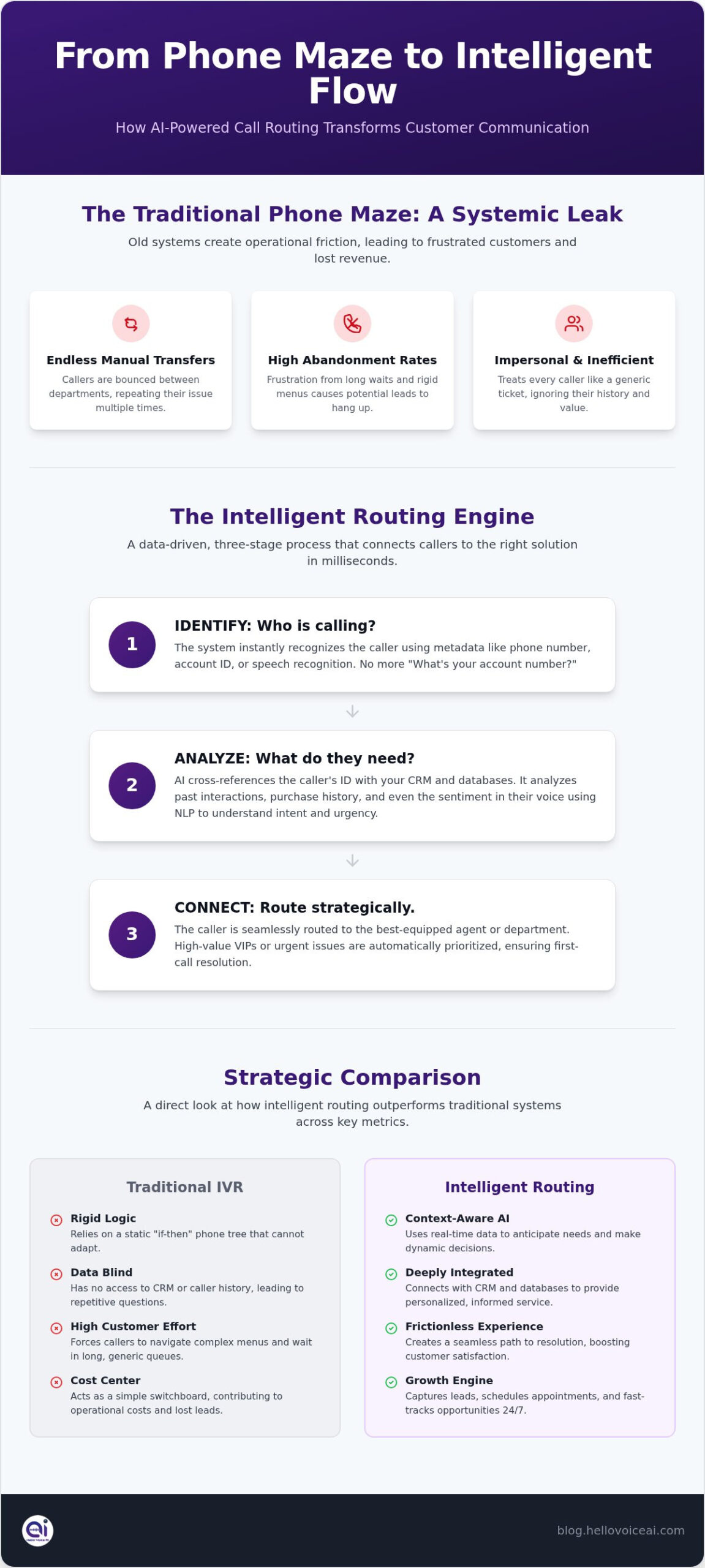
The mechanics of intelligent call routing operate as a sophisticated three-stage engine. First, the system identifies the caller through metadata like phone numbers, account IDs, or speech recognition. Second, it initiates a real-time data analysis, cross-referencing this identity against your internal databases and CRM records. Finally, it executes a strategic connection, placing the caller with the specific resource best equipped to resolve their query. This automated sequence happens in milliseconds, ensuring the caller never feels the weight of the underlying complexity. It’s a transition from the blind transfers of the past to a context-aware future-state.
Moving beyond simple identification, the system evaluates the historical data layer. It looks at previous interactions, open tickets, and purchase history to determine the caller’s status. If a high-value VIP calls, the logic doesn’t treat them like a first-time prospect. It prioritizes their position in the queue or routes them to a specialized retention team. This methodical approach ensures that every connection is backed by evidence rather than guesswork.
The Role of NLP and Sentiment Analysis
Natural Language Processing (NLP) is the computational processing of human language that allows a system to interpret meaning, intent, and linguistic nuance from spoken words. It deciphers the “why” behind a call. Modern systems “feel” the urgency of a caller through tone and specific keyword clusters. If a caller sounds frustrated or uses high-stakes language like “cancel my account,” the logic shifts. Routing an agitated customer to a senior manager immediately can salvage a relationship before a human agent even picks up the phone. This level of intent recognition turns a standard call into a solvable logical puzzle.
Integrating External Data Sources (CRM & Database)
The routing engine queries your database before the first “Hello” is even uttered. It scans records to find the most relevant destination for that specific caller. Imagine a returning client dials your office. Instead of enduring a series of questions about their account, the system recognizes their number and routes them directly to their dedicated account manager. This eliminates the need for manual transfers and significantly reduces operational friction for your staff. By aligning caller history with routing logic, you create a seamless experience that feels both personal and professional. If you are looking to implement this level of precision, exploring an AI voice receptionist is a logical next step for your communication strategy.
Intelligent Routing vs. Traditional IVR: A Strategic Comparison
Traditional IVR systems are the digital equivalent of a “Keep Out” sign. They force callers into a rigid, pre-defined hierarchy that prioritizes the business’s convenience over the customer’s time. In contrast, intelligent call routing functions as a strategic hire. It’s an active participant in the conversation that understands intent and context. Many business owners dismiss modern systems as “fancy voicemail,” but that’s a costly misunderstanding. Voicemail is where leads go to die. Intelligent routing is where they go to get scheduled, sold, or supported. It’s the difference between a gatekeeper and a concierge.
The fundamental flaw of traditional IVR is that it presents a logical puzzle to an already frustrated caller. It asks them to categorize their own problems before they’ve even spoken to a human. This creates a friction point that modern consumers won’t tolerate. By shifting to a system that listens and acts, you move from a reactive model to a proactive one. This transition isn’t just about technology. It’s about demonstrating professional respect for the person on the other end of the line.
Static Paths vs. Dynamic Decisions
Static paths are predictable and painful. “Press 1 for sales” is a relic that assumes every sales inquiry has the same weight and urgency. Dynamic decisions, however, allow the system to ask, “How can I help you today?” and route based on the response. This approach significantly boosts First Call Resolution (FCR) because the caller reaches the exact person or automated resource they need on the first attempt. When you analyze the Virtual Receptionist Cost Guide, it’s clear that the ROI isn’t just in saved labor. It’s in the salvaged revenue of callers who actually get what they came for. Efficiency pays for itself.
The Cost of “Bad” Routing Logic
Every time a high-value lead hangs up because they’re stuck in a menu, your ROI takes a direct hit. This is a silent revenue killer. Bad routing logic doesn’t just lose a single sale; it damages your brand’s reputation for professional respect. If your business feels like a maze, customers will assume your service is equally disorganized. Modern routing serves as a definitive fix for churn by ensuring every interaction feels purposeful. It’s not just about moving a call from point A to point B. It’s about proving that you value the caller’s time as much as their business. A seamless connection is the first step toward a long-term client relationship.
Step-by-Step: Implementing an Intelligent Routing Strategy
Stop guessing where your revenue is going. You must audit your current call flow to identify exactly where the leaks are occurring. If a prospect hangs up after thirty seconds of hold music, that’s a systemic failure. Identifying these friction points allows you to build a logic that prioritizes high-value interactions over routine inquiries. Defining your Priority Logic is the next critical phase. You need to decide which calls are most critical for revenue and ensure they receive the fastest path to resolution. This isn’t just about answering phones; it’s about engineering a path for growth. Understanding how to handle business calls with a bulletproof system is the foundation of this entire process.
Once you’ve identified the leaks, select a routing hub that integrates with your existing business tools. Your phone system shouldn’t live on an island. It needs to communicate with your CRM to recognize returning clients and provide the context-aware experience modern buyers expect. After deployment, the work isn’t over. You must test and refine the logic using real caller feedback and performance metrics. If you’re ready to plug these leaks, you can start by deploying a virtual receptionist service that handles the heavy lifting of routing and lead capture.
Mapping the Customer Journey and Personas
Think of your callers as distinct personas rather than a monolithic queue. A New Lead needs immediate validation. A Support caller needs technical precision. A Billing caller needs speed. You can set specific rules for each persona to ensure they reach the right destination without delay. For example, you might set a rule where any number not recognized in your database bypasses the standard menu and goes directly to a sales specialist. This proactive guidance ensures the caller feels like a priority, not just another ticket in the system.
Defining Skill-Based Destinations
Modern intelligent call routing allows you to tag destinations with specific attributes. Whether it’s a Spanish-speaking agent or a technical support module, the system matches the caller’s intent to the specific skill set required. Adopting a future-ready mindset involves using an AI receptionist as your primary filter. It triages every call, resolves simple requests, and routes complex issues to the right human expert. Every implementation requires a robust fail-safe. If no one is available to take the call, the logic must automatically pivot to a secondary backup or an automated scheduling tool to ensure the lead is never lost to silence. A comprehensive disaster recovery for business communications plan ensures your routing logic remains operational even when your physical office goes dark.
Scaling Your Business with AI-Powered Intelligent Routing
Growth requires more than just more staff. It demands a smarter architecture. If your scaling strategy relies on adding more human layers to handle basic transfers, you’re building on a foundation of friction. Hello Voice AI functions as the ultimate engine for intelligent call routing, acting as a strategic hire that never sleeps and never takes a holiday. This 24/7 advantage ensures that your business remains accessible even when your physical office is closed. You’re moving away from the limitations of manual processes toward a future-ready state of automated growth.
Traditional phone systems often struggle to keep pace with rapid expansion. When call volumes spike, wait times increase and customer satisfaction plummets. An AI-powered system handles these surges without breaking a sweat, ensuring that every caller is routed with the same precision whether they’re the first or the five-hundredth person to dial in. This reliability is the cornerstone of a professional reputation. By removing the bottleneck of manual call handling, you free your team to focus on the high-impact tasks that actually drive your bottom line.
Beyond Routing: Automated Resolutions
Connecting a caller to the right department is a start, but resolving their need on the first ring is the goal. Hello Voice AI captures lead information and schedules appointments directly into your workflow. It handles the “routing” and the “resolution” in one seamless motion. This capability removes the operational burden of a human needing to “catch” the routed call to perform basic administrative tasks. As a strategic partner, this system provides the freedom to focus on high-level decision-making while the routine logistics are handled with surgical precision. It’s not just a pass-through; it’s a closer.
Future-Proofing Your Front Desk
The operational friction of the past is a solvable logical puzzle. By integrating intelligent call routing into your communication stack, you transform your front desk from a cost center into a performance driver. This technology ensures that no call goes to voicemail and no revenue is left on the table. It’s a definitive fix for the systemic leaks that plague traditional systems. You’ve identified the problem and now you have the modern path forward. Stop the cycle of missed-call revenue loss today. Explore a demo of the AI Voice Receptionist to see how automated resolution can redefine your customer experience.
Transform Your Communication into a Strategic Growth Asset
You’ve identified the systemic leak in your communication strategy. Transitioning from a static phone maze to a dynamic, data-driven architecture is no longer optional; it’s a competitive necessity. By leveraging intelligent call routing, you ensure that every caller is met with professional respect and immediate resolution rather than a digital dead end. This isn’t just about answering phones; it’s about engineering a path for sustainable growth that respects both your team’s time and your customer’s intent.
The modern fix is within reach. With 24/7 AI-powered lead capture and seamless appointment scheduling integration, you can eliminate operational friction and ensure no high-value opportunity is lost to silence. It’s time to replace manual transfers with a future-ready system that acts as your most reliable strategic partner. Stop losing leads to voicemail and start routing with intelligence today. Your business deserves a front desk that never sleeps and always delivers. Take the first step toward a more efficient, revenue-focused future.
Frequently Asked Questions
What is the difference between call routing and call forwarding?
Static relays are a relic. Call forwarding is a simple point A to point B transfer, but intelligent call routing is a strategic decision engine. Forwarding doesn’t care who is calling; it just pushes the signal to a pre-set number. Routing analyzes caller data and intent to find the most logical destination. It’s the difference between a basic extension cord and a smart grid. Businesses use routing to eliminate the manual friction of hand-off errors.
How does intelligent call routing improve customer satisfaction (CSAT)?
Customer frustration vanishes when you eliminate the need for callers to repeat their details. Intelligent systems use historical data to recognize the caller and their likely needs immediately. This context reduces friction and lowers average handle times. When a caller reaches the right expert on the first attempt, your first-call resolution metrics soar. It’s a methodical way to prove you value their time as much as their business, which directly drives higher satisfaction scores.
Can small businesses afford intelligent call routing systems in 2026?
Cloud-based technology has democratized access to sophisticated logic. In 2026, small businesses can deploy these tools without investing in expensive on-site hardware. The shift to software-as-a-service models means you only pay for the capacity you use. It’s a strategic hire that scales with your growth. This allows smaller teams to compete with larger corporations on the quality of their customer experience without the traditional enterprise price tag or complex maintenance requirements.
Does intelligent call routing require a specialized business phone number?
You typically don’t need a new number. Most intelligent call routing systems integrate directly with your existing business lines or VoIP providers. The logic sits as a layer between the incoming signal and your team. This means you can keep your established brand identity while upgrading the underlying intelligence. If you need to verify these new integrations or manage account security during setup, RentalNumbers.com offers an efficient way to handle SMS verification. You won’t need to reprint business cards or update your website contact information just to make your communications significantly smarter.
AI-powered routing never takes a holiday. When a call comes in at midnight, the system identifies the intent and executes a pre-defined path. It might schedule an appointment or capture a detailed lead. It ensures your front desk remains active 24/7 without the overhead of a night shift. By handling these interactions automatically, the system prevents revenue loss from missed calls and ensures a follow-up is already queued for the next business morning.
What data does an intelligent routing system use to direct calls?
The system leverages a combination of real-time metadata and historical records. This includes the caller’s phone number, geographic location, and existing data stored in your CRM. Advanced platforms also use Natural Language Processing to decipher the caller’s spoken intent during the initial interaction. By combining these data points, the engine solves the logic puzzle of where the call should go. It connects them to a human agent or an automated resolution module.
Is it possible to integrate my CRM with a call routing service?
Is it possible to integrate my CRM with a call routing service?
Integration is a core requirement for a context-aware system. Most routing engines are designed to sync with popular CRM platforms to pull account history in real time. This connection allows the system to recognize a VIP client or an open support ticket before the call is answered. It’s the definitive fix for operational friction. It ensures your staff has all the necessary information the moment they pick up the phone to help a customer. To explore how large organizations unify this type of complex data into an actionable format, you can visit Syntes AI.
You can certainly combine these services to create a high-touch experience. The intelligent system acts as the primary filter, handling routine inquiries and lead capture via an AI voice receptionist. If a call requires a human touch or complex empathy, the system routes it to your virtual receptionist service or internal team. This hybrid approach ensures efficiency for simple tasks. It reserves your human resources for the high-stakes interactions that drive long-term customer loyalty.