
What if your most expensive business leak isn’t a line item on a spreadsheet, but the silence that follows a missed call at 6:00 PM? Every time a potential client hits a voicemail or gets trapped in a circular “Press 1” menu, your brand loses more than just a conversation. You lose a conversion. You’ve likely felt the sting of seeing high-intent leads evaporate because your team couldn’t get to the phone, or perhaps you’re tired of the soaring costs associated with scaling a human front desk.
It’s clear that the traditional automated phone system is no longer a tool for efficiency; it has become a bottleneck for modern commerce. This guide promises a clear path forward, moving you away from frustrating legacy menus toward a high-conversion AI voice automation strategy. We will break down how to implement a 24/7 virtual receptionist that doesn’t just route calls, but actively captures leads and schedules appointments. By the end of this strategic briefing, you’ll understand how to build a phone system that acts as a revenue-capture platform, ensuring your business never misses an opportunity to grow.
Key Takeaways
- Identify the critical shift from hardware-based routing to cloud-based intelligence, transforming your phone system into a strategic revenue-capture platform.
- Analyze the financial impact of operational friction and learn how a modern automated phone system eliminates the high cost of missed leads and after-hours voicemail.
- Compare the user experience of static IVR menus against dynamic AI voice receptionists to understand how natural conversation drives higher customer retention.
- Follow a systematic 5-step framework to audit your existing call flows and transition to a 24/7 front desk that scales effortlessly.
- Discover how to leverage AI-powered scheduling to secure appointments instantly, removing the manual bottlenecks that slow down your core team.
What is a Modern Automated Phone System in 2026?
Your phone system is no longer a utility. It’s your digital lobby. In 2026, an automated phone system isn’t just a way to route calls; it’s a strategic gateway for lead capture. We’ve moved past the era of clunky, hardware-based PBX systems that lived in a server closet. Today, the infrastructure is entirely cloud-based, powered by AI receptionists that act as sophisticated, future-ready members of your team. This transition ensures your brand maintains authority even when your human staff is offline. It’s a methodical shift from seeing the phone as a cost center to viewing it as a revenue-capture platform.
The Evolution from IVR to Voice AI
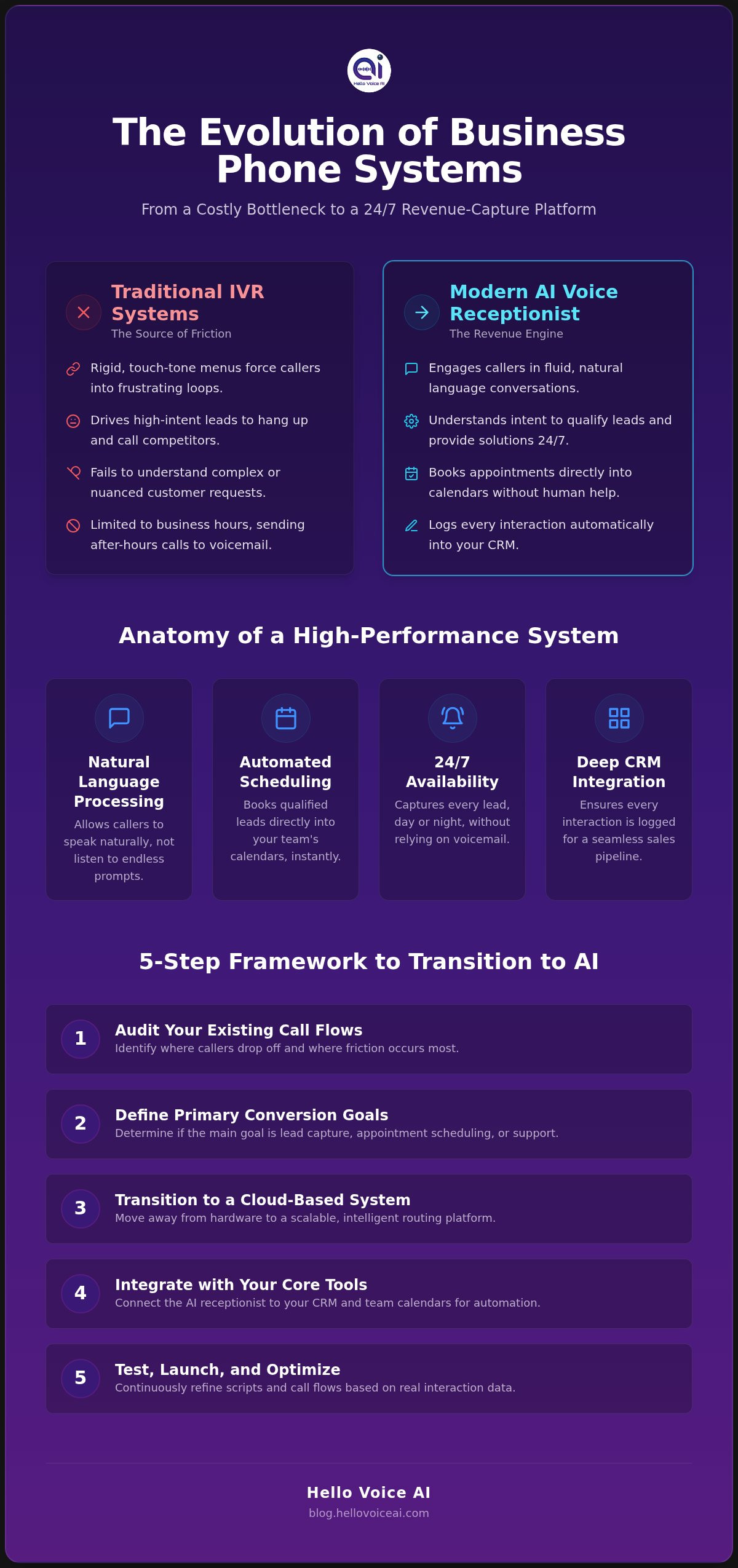
For decades, businesses relied on Interactive Voice Response (IVR) to manage call volumes. These systems were built on rigid, touch-tone menus that often forced callers into frustrating logical loops. If a customer had a complex request, the system failed. By 2026, this technology has matured into conversational AI. Modern systems don’t just listen for keywords; they understand intent. They recognize the difference between a frustrated customer needing support and a hot lead ready to book an appointment. Customers now expect this level of fluid, human-like interaction. If you force them through a “Press 1” maze, you’re signaling that your brand is stuck in the past.
Key Components of a Modern Setup
Building a high-performance system requires more than just a virtual number. It starts with cloud routing that ensures global accessibility without latency. The core interface is the AI Voice Receptionist, which serves as the primary point of contact. This isn’t a bot in the traditional sense; it’s a sophisticated virtual receptionist service designed to capture every lead. To function as a strategic hire, your setup must include several critical layers:
- Cloud-based virtual numbers: These allow for instant scalability across multiple regions without physical hardware.
- Natural Language Processing: This enables fluid dialogue, allowing callers to speak naturally rather than waiting for prompts.
- Deep CRM Integration: Automatic data logging ensures that every interaction is captured in your existing sales pipeline.
- Automated Scheduling: Direct links to calendars allow for instant appointment booking without human intervention.
When these components work in harmony, the operational friction of manual call handling vanishes. Your team can focus on high-value tasks while the automated phone system secures the perimeter. It’s about creating a big picture strategy where technology handles the volume and humans handle the nuance. For organizations looking to extend this intelligence across language barriers, Ubestream – AI Translation Service Provider offers the semantic expertise needed to maintain this precision. This move doesn’t just lower costs; it builds a professional brand image that scales effortlessly.
The Anatomy of Automation: IVR vs. AI Voice Receptionists
Static menus are a brand liability. While a traditional automated phone system relies on rigid decision trees, modern AI voice receptionists operate through dynamic intent recognition. This isn’t just a technical upgrade. It’s a fundamental shift from forcing customers to adapt to your machine to having your machine adapt to your customers. The choice you make here defines your brand’s accessibility and your team’s ability to focus on high-value work.
Why Traditional IVR Kills Customer Satisfaction
We’ve all been there. Trapped in “Menu Hell” while a monotone voice lists options that don’t apply to our problem. This friction creates an immediate disconnect. When a customer is in a hurry, they don’t want a history lesson; they want a solution. Rigid systems fail because they cannot process nuance. If a caller has an urgent request that falls outside of a standard prompt, a legacy IVR simply loops them back to the start. This failure drives leads directly to your competitors. For a deeper dive into modern alternatives, see What is a Virtual Receptionist? The Strategic Guide for 2026.
The AI Advantage: Intelligence at the Front Desk
Modern Voice AI changes the math. It handles hundreds of calls simultaneously without a single second of lag. There is no “on hold” music. The capacity is virtually infinite. Beyond simple routing, these systems qualify leads by asking targeted questions and can book appointments directly into your calendar. AI voice reception acts as the bridge between human empathy and machine efficiency. It ensures your front desk is never overwhelmed, regardless of call volume spikes. By removing the robotic stigma of the past, you create a fluid experience that feels like a premium service rather than a barrier.
Choosing between these systems depends on your growth objectives. A basic IVR might suffice for a small office with low call volume, but it won’t scale as your lead volume increases. The long-term lead retention offered by an intelligent automated phone system far outweighs the initial setup logic. You aren’t just buying software. You are installing a 24/7 revenue-capture engine. This allows your human team to focus on closing deals rather than answering basic FAQ. If you want to see how this transition impacts your bottom line, exploring modern voice automation is the logical next step.
Calculating the Friction: Why Your Current System is Losing Money
Every missed call is a silent subtraction from your bottom line. It’s not just a minor inconvenience. If your marketing budget successfully drives traffic but your intake process fails at the finish line, you’re essentially subsidizing your competitors’ growth. Most businesses don’t track the “dark data” of abandoned calls, yet this is exactly where the most significant operational friction lives. To stay competitive, you must treat your phone line as a high-stakes financial funnel rather than a simple utility.
The Cost of the “Leave a Message” Culture
Silence is a rejection. Industry research indicates that approximately 67% of customers will hang up immediately if they reach a voicemail greeting. In a world where the next service provider is just one thumb-swipe away, callers won’t wait for a callback. They move to the next Google result. This “after-hours leak” is where your customer acquisition cost skyrockets because you’re paying for leads you never actually engage. Implementing a modern 24/7 front desk ensures that your marketing spend translates into actual conversations, regardless of the time of day. If you aren’t capturing the lead the moment they feel the urge to call, you’ve likely lost them forever.
Staff Burnout vs. Automated Efficiency
Consider the mental load on your current team. If your office manager spends three hours a day answering basic questions about your location or pricing, they aren’t focusing on high-value strategy. This repetitive work leads to burnout and creates a ceiling on your growth. You can’t simply hire your way out of call volume spikes without drastically increasing your overhead. A sophisticated automated phone system provides the scalability needed to handle fifty calls as easily as five. It allows your “A-player” employees to stay focused on closing complex deals while the technology manages the perimeter—much like how Vibestrate enables developers to orchestrate AI coding agents to handle routine programming tasks.
Benchmarking your business against 2026 standards requires a cold look at your current metrics. If your response time is measured in hours rather than seconds, your system is failing. A modern automated phone system removes the human bottleneck, ensuring that every inquiry is met with professional, immediate attention. This isn’t just about saving time; it’s about protecting the brand authority you’ve worked hard to build. When you eliminate the friction of manual call handling, you create a path for effortless, scalable growth. Deploying a virtual phone assistant is one of the most direct ways to ensure every revenue opportunity is captured before it slips away.
How to Set Up Your Automated Phone System: A 5-Step Guide
Stop treating your intake process like a guessing game. Building a modern automated phone system is a methodical exercise in identifying where your revenue is leaking and plugging those holes with logic. It isn’t a months-long IT project. It’s a strategic realignment of your front desk that prioritizes lead capture over simple call routing. When you approach setup with a focus on outcomes rather than just tools, you create a system that grows with your business.
- Step 1: Audit your call flows. Review your last 100 calls to categorize them. Are they new leads, existing clients, or basic FAQ inquiries? This data tells you exactly what to automate first.
- Step 2: Select your solution. Determine if your volume requires a live virtual receptionist service or the 24/7 scalability of an AI-powered voice assistant. High-growth firms usually favor AI for its infinite capacity.
- Step 3: Script for intent. Move away from rigid menus. Design conversational prompts that encourage callers to speak naturally, such as “How can I help you grow your business today?”
- Step 4: Sync your ecosystem. Integrate your CRM and calendar. This ensures every lead is logged and every appointment is booked without manual data entry from your team.
- Step 5: Test the friction. Call your own line from a customer’s perspective. Identify any points of hesitation or confusion in the dialogue and refine the phrasing accordingly.
Mapping Your Ideal Caller Journey
Every caller has a specific goal. Your system must recognize the “Fast Track” for high-priority sales leads, offering them immediate scheduling rather than a generic hold queue. For routine inquiries, such as checking office hours or location, the system should resolve the issue instantly without human intervention. A robust fallback plan is essential; if a caller presents a complex problem the AI can’t solve, it must route to a human team member to maintain brand authority. This logical hierarchy ensures that your most valuable opportunities are never ignored.
Technical Integration and Launch
Implementation is surprisingly lean. You simply connect your business phone number to the AI platform through cloud forwarding or porting. Enhance the experience by setting up automated SMS follow-ups for every completed call. This ensures the customer has a written record of their interaction immediately, which builds trust. In 2026, a full automated phone system setup takes hours, not weeks. If you’re ready to modernize your intake, start building your 24/7 front desk today.
Future-Proofing Your Business with Hello Voice AI
The market doesn’t wait for your team to clock in. In 2026, the competitive gap between “AI-first” companies and legacy firms is widening into a canyon. An automated phone system should be your most reliable employee. It shouldn’t be a barrier that callers have to tolerate. By adopting a sophisticated AI voice receptionist, you move beyond the robotic stigma of the past. You’re installing a system that sounds like a member of your staff, captures every high-intent lead, and ensures your brand authority remains intact at 3:00 AM.
Beyond Answering: A Strategic Partner for Growth
Hello Voice AI functions as a high-level filter for your operations. It doesn’t just answer the phone; it qualifies the caller. If a lead is ready to buy, the system moves them directly into your calendar. If a caller has a routine question, the AI resolves it instantly. This ensures that when your human team picks up the phone, they’re only speaking to qualified opportunities. It’s a front desk that never takes a sick day, never misses a holiday, and never gets overwhelmed by a sudden spike in call volume.
The math of this transition is simple. If you retain just two leads per month that would have otherwise hung up on a voicemail, the system has already paid for itself. This reliability allows you to scale your marketing efforts with confidence. You don’t have to worry if your intake team can handle the influx. You’ve already solved the scalability problem by making your automated phone system the foundation of your lead capture strategy.
The Hello Voice AI Difference
Most callers won’t even realize they’re speaking to an AI. The natural language processing is designed to handle the cadence and nuance of human conversation. It recognizes intent and provides fluid, helpful responses that build trust from the first second. This isn’t a standalone tool that creates more work for your team. It’s a seamless extension of your existing ecosystem. Key advantages include:
- Instant CRM Sync: Every interaction is logged automatically, providing a full transcript of the caller’s needs.
- Slack and Email Alerts: Your team gets real-time notifications for every booked appointment or urgent inquiry.
- Direct Calendar Integration: Leads can secure a spot in your schedule without a single back-and-forth email.
Reducing operational overhead shouldn’t mean sacrificing professional credibility. With a modern virtual receptionist service, you get the best of both worlds: lower costs and a more responsive brand. You’re no longer just managing calls; you’re managing a growth engine. Transform your front desk with Hello Voice AI today.
Scaling Your Front Desk for a New Era of Commerce
The era of the “Press 1” menu is over. We’ve identified that a modern automated phone system is no longer a simple routing tool; it is a sophisticated revenue-capture engine. By auditing your call flows and choosing AI-driven intelligence over static hardware, you eliminate the operational friction that stalls growth. Every missed call at midnight or during a peak rush represents a tangible loss in market share that your competitors are eager to claim.
Transitioning to a smarter intake process ensures your brand authority remains constant. With Hello Voice AI, you gain 24/7 AI-powered lead capture and automated appointment scheduling that provides an instant response to every caller. It’s time to stop treating your phone line as a liability and start seeing it as a strategic hire. Stop losing leads and automate your front desk with Hello Voice AI. Your business is ready to scale; ensure your communication infrastructure is ready to meet the demand. You’ve built the brand; now let’s build the system that protects it.
Frequently Asked Questions
What is an automated phone system for a small business?
It’s a technology-driven interface that handles incoming calls without human intervention. In 2026, this means moving beyond simple routing to using an AI Voice Receptionist that can qualify leads and manage inquiries 24/7. It acts as a digital front desk that ensures no caller is left waiting. This setup allows smaller teams to maintain a professional brand image that scales effortlessly as call volume increases.
How much does it cost to set up an automated phone system in 2026?
Costs vary depending on your specific call volume and the level of intelligence required for your workflows. Most modern platforms operate on a subscription model based on usage or feature tiers. While industry averages fluctuate, you should focus on the return on investment through retained leads rather than just the monthly line item. Detailed pricing is typically determined after auditing your current call volume and integration needs.
Will an automated phone system frustrate my customers?
Modern systems eliminate frustration by replacing rigid “Press 1” menus with natural language understanding. If the system understands intent and provides immediate solutions, customers feel heard rather than ignored. Frustration only occurs when systems are poorly scripted or trap callers in loops. Using an AI Voice Receptionist ensures fluid dialogue that mimics human interaction, which increases satisfaction by providing instant 24/7 support.
Can I use my existing business phone number with an AI receptionist?
Yes, you can typically keep your current number through a process called porting or by setting up simple call forwarding. This ensures business continuity without needing to update your marketing materials or business cards. Most cloud-based platforms are designed to sit on top of your existing infrastructure. This allows for a seamless transition where the AI begins intercepting calls the moment you activate the service.
What is the difference between an automated system and an answering service?
A traditional answering service often relies on human operators who take messages, whereas an automated phone system uses technology to resolve inquiries in real-time. Human-operated services can be slower and more expensive to scale. In contrast, an AI-driven system can book appointments, sync data with your CRM, and handle hundreds of calls simultaneously. It’s a shift from simple message-taking to active, autonomous problem-solving.
How does an automated phone system handle appointments?
The system integrates directly with your digital calendar to identify available time slots and book them instantly. When a caller expresses interest in a consultation or service, the AI checks your real-time availability and confirms the booking. This removes the manual back-and-forth of scheduling. Once the appointment is set, the system can even send automated SMS or email confirmations to both you and the client.
Is an AI-powered system better than a traditional IVR?
AI-powered systems are superior because they offer dynamic intent recognition rather than static touch-tone menus. Traditional IVR systems are rigid and often lead to “menu hell” for the caller. An AI receptionist understands natural speech, allowing for a much more sophisticated and empathetic user experience. This technology ensures that complex queries are handled correctly or routed to the right human team member without friction.
Do I need special hardware to install an automated phone system?
No physical hardware is required for a modern, cloud-based automated phone system. You don’t need server racks, specialized desk phones, or complex wiring in your office. The entire system lives in the cloud and is managed through a web-based dashboard. This means you can deploy a professional front desk from anywhere, allowing your team to remain mobile while the AI handles the intake process.




2 Comments