
85% of your missed callers will never call back. They don’t leave voicemails; they simply dial your competitor. This silent revenue leak is the hidden tax on your growth in 2026. You likely understand the friction of choosing between constant phone interruptions and the high cost of a full-time hire. If you’re asking what is a virtual receptionist and how it fits into a modern scale strategy, you’ve identified a critical operational pivot. It’s a logical puzzle that many businesses fail to solve, leading to lost leads and a fragmented brand image.
Discover how these services have evolved from simple answering tools into strategic, AI-powered growth engines. You know that 24/7 availability is no longer optional, yet the payroll for a round-the-clock team is often prohibitive. This guide explores the transition from manual call handling to automated efficiency. We’ll show you how to capture every lead, schedule appointments seamlessly, and maintain a professional edge while you focus on high-level strategy. It’s time to move past traditional answering services and adopt a future-ready solution that treats every caller as a priority.
Key Takeaways
- Understand what is a virtual receptionist in 2026 by viewing it as a strategic interface rather than a simple answering tool.
- Explore the technical backbone of SIP trunking and cloud routing that ensures your callers experience a seamless, professional transition.
- Identify the psychology behind why modern callers reject voicemail and how instant engagement prevents significant revenue leakage.
- Recognize the essential features to demand in the current market, including advanced Natural Language Processing and multi-language support for diverse callers.
- Learn how to position an AI Voice Receptionist as a strategic hire that automates lead capture while protecting your focus and operational health.
Defining the Virtual Receptionist in the Modern Business Landscape
Execution is everything. Understanding what is a virtual receptionist requires looking past the phone lines to the business logic beneath. At its core, it is a professional service or technology that manages incoming communication from a remote environment. It isn’t just a person sitting in a call center miles away. In 2026, it represents a fusion of high-level human empathy and sophisticated AI logic. If you’re asking what is a virtual receptionist, don’t think of it as a luxury; think of it as a strategic interface that bridges the gap between your brand and your next customer.
The “virtual” aspect provides a distinct operational advantage. You gain the ability to scale your availability without the friction of physical office constraints or the heavy tax of a full-time in-house salary. This setup ensures that your business remains an agile, “always-on” entity. It positions your receptionist as the critical first touchpoint, setting the tone for your entire brand identity before a client even speaks to your core team.
The Evolution of Virtual Reception: From Pagers to AI
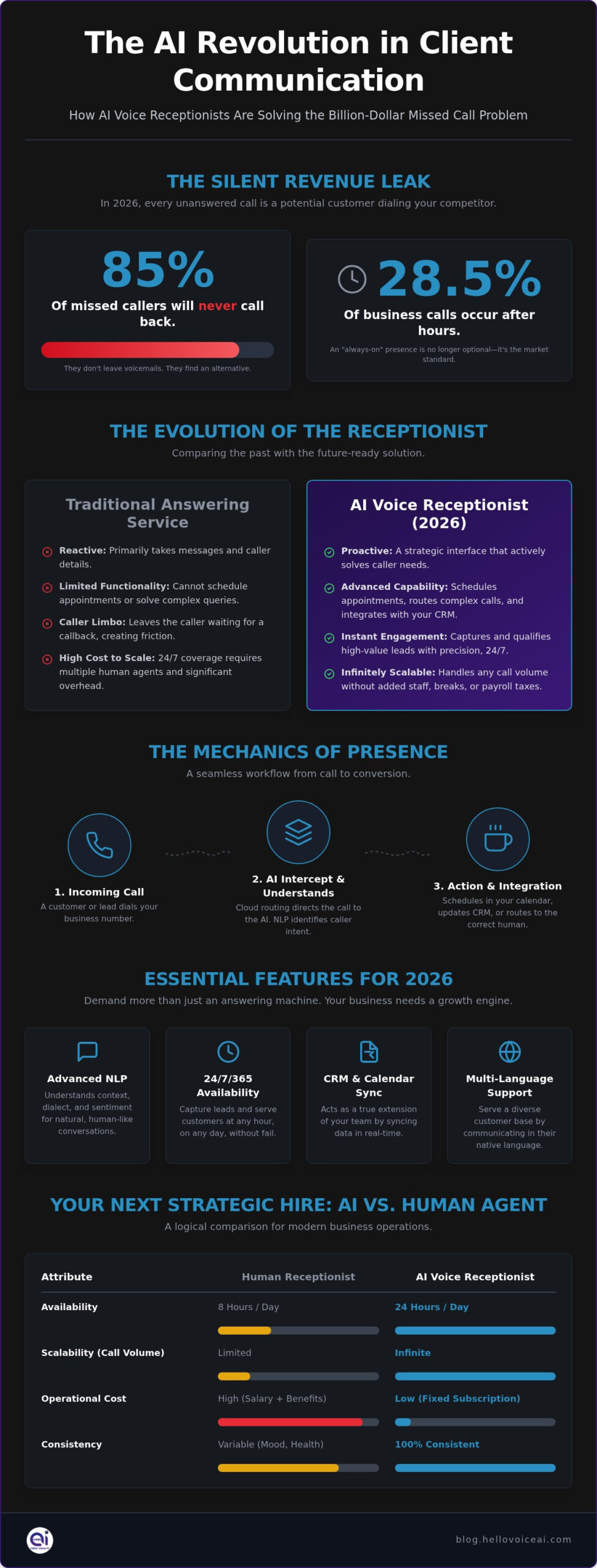
Call centers once relied on basic pagers and rigid scripts. Today, the landscape has shifted toward seamless digital integration. By 2026, technology has blurred the lines between human and digital interaction, making it difficult for callers to distinguish between the two. This evolution responds to a modern reality where 28.5% of business calls occur after traditional hours. An “always-on” expectation is now the market standard; failing to meet it is a logical failure that costs revenue.
Receptionist vs. Answering Service: What’s the Difference?
Clarity is vital here. A traditional answering service is reactive; it exists to take a name and number, often leaving the caller in a state of limbo. While the traditional receptionist role was once tethered to a physical front desk, the virtual version is proactive. It handles depth. It solves problems, routes complex calls, and schedules appointments directly into your calendar. The modern virtual receptionist acts as a strategic gatekeeper, filtering operational noise while ensuring that every high-value lead is captured and processed with precision.
The Mechanics of Presence: How Virtual Receptionists Operate
Presence is a technical achievement. While the core duties of a receptionist remain consistent across industries, the delivery method has been completely re-engineered for the digital age. Modern systems rely on a sophisticated stack of VoIP (Voice over Internet Protocol), cloud routing, and SIP trunking. These technologies allow calls to be intercepted and managed on a virtual platform without the caller ever detecting a handoff. It’s an invisible bridge. When someone dials your number, the system routes the signal instantly to a remote interface, ensuring that the distance between your office and the receptionist is functionally zero.
Integration is the second half of the equation. A standalone phone service is a silo; a strategic virtual receptionist is a node in your tech stack. By syncing with your CRM and digital calendars, the service doesn’t just talk; it acts. It captures data, updates lead records, and checks availability in real-time. If you are still trying to figure out what is a virtual receptionist in a practical sense, look at your calendar. If it’s filling up with qualified meetings while you sleep, you’re seeing the mechanics in action. This level of connectivity ensures that the service feels like an internal department rather than an external vendor.
Live Virtual Receptionists vs. AI Voice Receptionists
Workflow Integration: Scheduling and Routing
Efficiency depends on intent. Modern systems use Natural Language Processing to identify why a person is calling. Instead of a blind transfer, the system routes the caller to the specific department or individual best suited to help. It goes beyond simple message taking. Automated appointment booking syncs directly with your team’s live schedule, removing the friction of back-and-forth emails. Every interaction concludes with data capture, where call notes and lead details move directly into your management system. This ensures no detail is lost in transition. To see how these workflows can transform your operations, you can explore more about modern communication strategies.
The Business Case: Why Voicemail is a Strategic Failure
Voicemail is a graveyard for leads. It represents a systemic failure in a market where 80% of callers hang up the moment they hear a recorded prompt. If you’re investigating what is a virtual receptionist, you’re likely feeling the weight of these missed opportunities. Every unanswered call is a logical puzzle with a negative outcome: the caller dials your competitor. Defining what is a virtual receptionist isn’t just about the technology; it’s about the revenue it protects. The “Hidden Math” is simple but devastating. If a single lead is worth $500 and you miss three calls a week, you’re losing $78,000 annually. This isn’t just a minor leak. It’s a structural flaw in your growth engine. Pairing your virtual receptionist with a robust automated lead response system ensures that every inquiry is met with immediate action before it reaches your competitor.
Operational friction adds another layer of hidden cost. When your internal team has to pivot from deep work to answer basic inquiries, productivity collapses. A dedicated interface eliminates this noise. Beyond efficiency, 24/7 availability provides a massive competitive advantage. Being the only business in your niche that answers a query at 2 AM transforms you from a local option into a reliable partner. It signals to the market that your business is responsive, organized, and ready to solve problems on the customer’s timeline.
Protecting the Customer Experience
Trust is built in seconds. Reducing your “Time-to-First-Response” to near zero creates an immediate sense of authority. Many business owners worry about authenticity, fearing a digital voice might feel cold. However, modern 2026 technology ensures the interaction feels personal and brand-aligned. Much like hiring a virtual assistant to manage your inbox, a virtual receptionist manages your verbal identity with professional precision. It ensures every caller feels heard, not ignored, which is the foundation of long-term client retention.
Scaling Without Increasing Payroll
The financial logic is undeniable. Transitioning to a SaaS model allows you to bypass the massive overhead of a full-time salary, benefits, and office space. You eliminate the recurring costs of training and the logistical headache of managing a physical front desk. It’s a shift from a fixed, high-risk expense to a scalable, performance-based investment. By leveraging this technology, a one-person shop can project the professional authority and operational scale of a Fortune 500 company without the associated payroll burden.
Navigating the 2026 Market: Key Features to Demand
Precision defines the market. Choosing a service based on price alone is a tactical error that often leads to a hollow customer experience. In 2026, the true definition of what is a virtual receptionist hinges on the sophistication of its Natural Language Processing (NLP). You should demand a system that interprets intent, not just isolated keywords. If a caller expresses frustration or urgency, the technology must pivot its tone and priority immediately. This level of situational awareness is what separates a strategic asset from a basic automated menu. Businesses looking to move beyond legacy menus should review how to build a modern automated phone system that actively captures leads rather than simply routing calls.
Security and data transparency are equally non-negotiable. For medical or legal practices, HIPAA and SOC2 compliance are the baseline for operational safety. Beyond protection, you need visibility. Real-time dashboarding allows you to track lead sources and call volumes with granular detail. If you can’t measure the performance of your front desk, you can’t optimize your growth strategy. Multi-language support further ensures you aren’t leaving revenue on the table in a globalized market. Defining what is a virtual receptionist in the current era requires a focus on results, not just connectivity.
Customization and Brand Voice
Identity matters. Your receptionist shouldn’t sound like a generic recording; it should sound like your office. This requires deep customization of scripts and the ability to handle complex FAQs without human intervention. When auditing a service, look for “conversational fluidness.” If the interaction feels staggered or robotic, your brand authority will suffer. A fluid interface builds instant rapport, answering questions about your specific services or pricing structures with the same confidence as your top performer.
Beyond the Call: Omnichannel Integration
The conversation doesn’t end when the caller hangs up. Modern virtual receptionists bridge the gap between phone, SMS, and email. Post-call automation is a critical feature; sending an immediate “thank you” text or a link to your booking page keeps the momentum alive. This omnichannel approach ensures your business phone number remains your most valuable brand asset. To ensure you’re leveraging the best technology for your team, compare the latest AI voice receptionist features to see what fits your specific workflow.
Implementing Your Virtual Office: Why AI is the Next Strategic Hire
Growth requires delegation. If you’re still answering every ring while trying to scale, you’ve hit an artificial ceiling. The transition from manual friction to automated efficiency is a logical necessity for modern teams. It starts with a mindset shift. You aren’t just installing software; you’re onboarding a strategic hire that never sleeps. Understanding what is a virtual receptionist in an operational context means recognizing it as the definitive fix for a systemic leak. By mapping your business logic into a comprehensive infrastructure like LifeOS™ by Venturis 13, you ensure that every caller receives the same level of precision they’d get from your top performer while aligning your communication with your broader venture goals.
Privacy is a performance metric. Sophisticated call forwarding rules allow you to reclaim your personal time without sacrificing lead capture. You can route calls based on the time of day, caller intent, or specific project phases. This ensures your deep work remains uninterrupted while the AI handles the frontline engagement. Training your AI Voice Receptionist on your unique service nuances ensures the interaction feels authentic. Success isn’t a vague feeling; it’s measured through concrete data like conversion rates and customer satisfaction scores. When you treat your communication stack with the same rigor as your financial department, the ROI becomes undeniable.
The Hello Voice AI Advantage
Missed calls are missed revenue. Our AI Voice Receptionist solves this leak by providing 24/7 availability that matches the pace of the global economy. The setup is designed for speed. You can move from sign-up to a live, functioning front desk in minutes rather than weeks. We’ve built the platform to be a strategic partner for your growth, handling complex routing and appointment scheduling with zero downtime. It’s a future-ready solution that allows you to focus on the big picture while we secure your leads.
Taking the First Step
Audit your current call logs today. How many leads did you lose last week while you were in meetings or after hours? If you’re still wondering what is a virtual receptionist and if it’s worth the investment, the answer is in your missed opportunities. If you identify even a few lost inquiries, the logic for automation is clear. Schedule a demo to hear the conversational fluidness of the technology in action. It’s time to stop the leak and start scaling with confidence. Audit your missed call revenue with Hello Voice AI to see the logical path to a more efficient future.
Securing Your Competitive Edge in the 24/7 Economy
The logical next step for your operation is the transition from manual friction to automated precision. We’ve explored what is a virtual receptionist in the context of 2026, identifying it as a strategic hire that protects your revenue and your personal time. By integrating sophisticated AI into your communication stack, you solve the puzzle of scalability without the weight of traditional payroll. You gain a professional brand voice that remains active around the clock, ensuring every caller receives an instant, authoritative response regardless of the hour.
It’s time to stop the silent leak in your growth engine. You can eliminate 100% of missed calls and maintain 24/7 availability with zero overtime pay by leveraging technology that mirrors your unique brand identity. The path to a future-ready operation is clear, and the tools are ready to deploy. Stop losing leads to voicemail-start your 24/7 AI Receptionist today. Your business is ready to scale; ensure your front desk is ready to capture that momentum.
Frequently Asked Questions
Is a virtual receptionist a real person?
A virtual receptionist can be either a remote human agent or a digital AI voice. In 2026, the definition of what is a virtual receptionist increasingly leans toward AI-driven interfaces. These systems offer immediate response times and zero downtime. While human-operated services still exist for high-touch interactions, the strategic shift for most modern teams is toward automated voice agents that handle the bulk of operational routing.
How much does a virtual receptionist service cost in 2026?
Pricing varies based on the delivery model and call volume. While we don’t quote specific internal rates, industry data suggests that AI-powered solutions typically operate on a flat-fee subscription model. In contrast, human-operated services often charge per minute or per call. This makes AI a more predictable line item for businesses looking to scale without the risk of overage charges or the high tax of a full-time in-house salary.
Can a virtual receptionist schedule appointments in my calendar?
Yes, modern systems integrate directly with your digital calendars to book meetings in real-time. By identifying the caller’s intent and checking your live availability, the system eliminates the friction of back-and-forth emails. This ensures that your lead capture is proactive. It moves prospects from a simple inquiry to a confirmed appointment without any manual intervention from your core team, protecting your focus and your schedule.
What happens if the virtual receptionist can’t answer a question?
The system follows a logical escalation path that you define. If a query exceeds the receptionist’s programmed logic, it can instantly route the call to a specific team member or capture a detailed message for priority follow-up. This prevents operational dead-ends and ensures that complex inquiries are handled with the appropriate level of human expertise. The receptionist manages the routine front-line data while your experts handle the high-stakes exceptions.
Is an AI virtual receptionist better than a live one?
It depends on whether you prioritize human empathy or operational scale. AI provides 24/7 reliability and consistent brand alignment at a lower cost. If your goal is to eliminate the 28.5% of leads lost after hours, an AI-powered interface is the logical choice. It offers infinite scalability without the management overhead or training requirements associated with human staff. This makes it a more sustainable strategic hire for businesses focused on rapid growth.
How do I set up call forwarding to a virtual receptionist?
Setup is typically a matter of adjusting your existing phone settings through your provider. You can choose to forward all calls, only those that go unanswered, or calls received after business hours. Most platforms provide a unique routing number that connects your business line to the virtual interface seamlessly. This transition is invisible to the caller, ensuring your brand presence remains consistent while you protect your deep work from constant interruptions.
Will my customers know they are talking to a virtual assistant?
In 2026, the conversational fluidness of AI makes it difficult to distinguish from a human interaction. When asking what is a virtual receptionist, the focus should be on the quality of the interaction. If the system answers questions accurately and schedules appointments efficiently, the caller’s sentiment remains positive. Most customers value an instant, professional solution over the delay of a traditional voicemail, regardless of whether the voice is human or digital.
Can I use my existing business phone number?
Absolutely, your primary phone number remains your most valuable brand asset. The virtual receptionist acts as an intelligent layer on top of your existing line. By using SIP trunking or standard call forwarding, the service manages your incoming traffic without requiring you to change your contact information. This ensures continuity for your established clients while modernizing your front-desk logic and securing your leads with automated efficiency.