
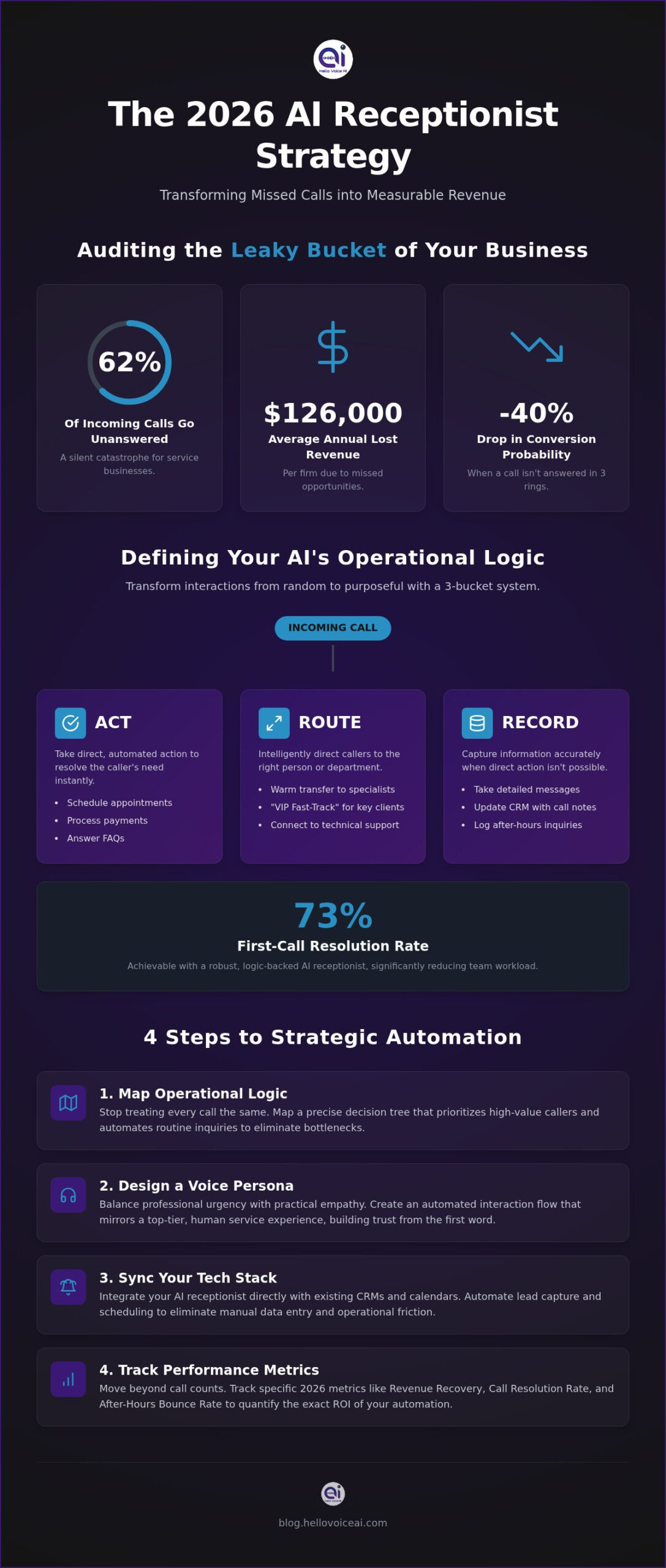
Sixty-two percent of incoming calls to service businesses go unanswered. It’s a quiet catastrophe. For the average firm, this silence translates to $126,000 in lost revenue every single year. You’ve likely felt the pressure of high-value leads slipping into the void of after-hours voicemail or the mounting costs of traditional answering services that struggle to scale. It’s a logical puzzle that manual processes simply cannot solve. Implementing a sophisticated ai receptionist is no longer a futuristic experiment; it’s a strategic necessity for any organization that refuses to let operational friction dictate its growth.
We understand the stakes of modern commerce where speed is the only currency that matters. You need a 24/7 automated front desk that feels human and handles complex scheduling without constant oversight. This guide provides the definitive 2026 strategy to master the step-by-step process of deploying a high-performance system that captures every lead. We’ll move beyond simple software installation to focus on strategic persona design and logic mapping. By the end, you’ll have a clear path to eliminating missed calls and measurably increasing your lead conversion rates.
Key Takeaways
- Identify and stop revenue leaks by mapping a precise operational logic that prioritizes high-value callers instead of treating every inquiry the same.
- Design a voice persona that balances professional urgency with practical empathy so every automated interaction mirrors a high-tier service experience.
- Sync your ai receptionist with existing CRMs and calendars to automate lead capture and eliminate the friction of manual scheduling.
- Track specific 2026 performance metrics like Revenue Recovery and Call Resolution to quantify the exact ROI of your strategic automation.
Auditing the Leaky Bucket: Quantifying the Cost of Missed Calls
Every unanswered call is a silent withdrawal from your business’s bank account. In 2026, the stakes are higher than ever. Research indicates that 62% of incoming calls to small service businesses go unanswered, leading to an average annual revenue loss of $126,000. This isn’t just a minor operational hiccup; it’s a systemic leak that undermines every marketing dollar you spend. When a high-value lead reaches a voicemail greeting, they don’t wait for a callback. They simply move to the next name on the search results page. Voicemail has become the graveyard of modern leads, especially as the “Instant Gratification” mindset of 2026 consumers demands immediate, intelligent interaction.
Relying on traditional methods often creates a massive human bottleneck. Your front-desk team might be exceptional, but they are tethered to the physical limitations of one-call-at-a-time processing. If three prospects call simultaneously, two are guaranteed to have a negative experience. While some businesses attempt to bridge this gap with human-operated answering services, these often fail to scale effectively. The high cost of these services, combined with the “answering service fatigue” where callers feel they are speaking to a detached third party, often results in poor lead conversion. This is where a strategic ai receptionist transforms a liability into a competitive advantage.
The Math of a Missed Opportunity
Lead decay is nearly instantaneous; a call that isn’t answered within three rings sees a 40% drop in conversion probability. To understand your specific “After-Hours” bounce rate, you must audit your phone logs to see how many calls occur between 6:00 PM and 8:00 AM. If your average lifetime value (LTV) of a client is $5,000 and you miss just two of these calls a week, you’re losing over half a million dollars in potential revenue annually. Before the sophisticated ai receptionist systems of today, businesses were forced to accept this loss as the cost of doing business. Now, it’s a solvable logical puzzle.
Operational Friction vs. Strategic Flow
Mapping the journey of a call from “Ring” to “Resolution” often reveals significant friction. In a manual setup, a staff member must stop their high-value work to handle basic routing or scheduling, creating a “Human Bottleneck” that slows down the entire team. The technology has evolved far beyond the rigid, frustrating automated attendant systems of the past. By moving from manual answering to strategic oversight, your team can focus on complex tasks while the AI handles the high-volume, repetitive interactions. This transition ensures that your operational flow remains uninterrupted, even during peak call times or after business hours.
Defining Your AI Receptionist’s Operational Logic
Logic is the engine of efficiency. Without a clearly defined operational framework, even the most advanced voice technology is merely a digital answering machine. To eliminate operational friction, you must map a decision tree that categorizes every incoming interaction into one of three buckets: Act, Route, or Record. This isn’t just about answering a phone; it’s about transforming how businesses and customers connect by ensuring every caller is met with a purposeful response. When an ai receptionist is backed by robust conditional logic, it can achieve a first-call resolution rate of 73%, significantly reducing the burden on your human team.
A sophisticated strategy also includes a “VIP Fast-Track.” By integrating caller ID data with your existing database, the system can identify high-value clients the moment they dial in. If a top-tier account holder calls during peak hours, the logic shouldn’t just place them in a queue. Instead, it should trigger a priority route that bypasses standard intake procedures. This level of personalization prevents high-stakes leads from feeling like just another number in a spreadsheet. Balancing this 24/7 availability matrix requires adjusting logic based on the time of day. While your ai receptionist might handle full scheduling at 2:00 AM, it might switch to a “Warm Transfer” protocol during business hours when your specialists are available to close a deal.
Categorizing Intent with Precision
Success begins with identifying why people are reaching out. You must first isolate the top five reasons customers call, such as scheduling, billing inquiries, or technical support. Once these are identified, assign a specific success outcome for each. For a scheduling call, the outcome is a confirmed calendar event; for billing, it’s a secure payment link or a status update. Finally, build a “Fallback Logic” for complex or emotional inquiries. If the system detects frustration or a request that falls outside the top five categories, it must have a clear path to a graceful human handoff or a detailed message capture that preserves the caller’s context.
The Seamless Transfer Framework
The transition from AI to human must be invisible to the caller. We recommend “Warm Transfers” where the system provides a brief data summary to your team before the call connects. This ensures your staff doesn’t ask the caller to repeat information they’ve already provided. You should also define “Red Flag” keywords, such as “emergency,” “cancellation,” or “legal,” which trigger immediate human intervention regardless of the time. During the transition, maintain continuity by using a professional hold tone that reinforces your brand’s authoritative yet helpful persona. To see more examples of how these logic maps are built for specific industries, explore our detailed guides on the Hello Voice AI blog.
Designing a Human-Centric Voice Persona and Interaction Flow
A strategic ai receptionist isn’t just a piece of software; it’s a digital extension of your brand’s authority. If the voice sounds hollow or the interaction feels rigid, you risk alienating the very leads you’ve worked so hard to capture. In 2026, the “Anti-IVR” approach is the definitive standard. Callers no longer tolerate the “Press 1 for sales” trap. They expect natural language processing that understands intent and nuance. Fine-tuning your “Acoustic Brand” involves selecting a pitch, pace, and accent that resonates with your specific market. This ensures the interaction feels like a conversation with a competent professional rather than a playback from a server. You’re not just installing a tool; you’re making a strategic hire that must reflect your brand’s professional urgency.
Scripting for empathy is the subtle art of acknowledging a caller’s needs before jumping into a solution. It’s about recognizing that a caller might be stressed or in a hurry. When your ai receptionist uses prompts that validate the inquiry, it builds immediate trust. This sophisticated interaction flow removes the robotic friction that historically plagued automated systems. By prioritizing a “Strategic Partner” persona, you position your business as a modern, tech-forward leader that values the caller’s time as much as its own operational efficiency.
Crafting the Opening Gambit
The first three seconds are the crucible of the call. This “Opening Gambit” determines whether a caller engages or hangs up in frustration. Robotic scripts that lead with generic platitudes are transparently insincere and drive lead abandonment. Instead, use empathetic openers that establish immediate competence. A matter-of-fact professional greeting might sound like: “Hello, you’ve reached [Company Name], and I’m here to get your request to the right specialist immediately; what can I help you with today?” This short, punchy opening creates situational awareness and signals that the business is ready to act.
Maintaining Narrative Movement
Conversation is a dynamic exchange, not a static broadcast. To maintain narrative movement, your system must use “Verbal Nods”—brief affirmations like “I see” or “Understood”—to confirm it’s processing the information in real-time. This prevents the awkward silence that often leads callers to ask if the line is still active. Graceful interruption handling is equally critical. If a caller corrects a detail mid-sentence, the logic must pivot without breaking the flow. Finally, every interaction must close the loop. Ensure every call ends with a clear next step, such as a calendar confirmation or a specific timeline for a human follow-up, so the caller feels the “Resolution” is already in motion.
Integrating Voice AI into Your Existing Tech Stack
Integration is the final step in transforming a voice tool into a strategic asset. If your ai receptionist operates in a vacuum, you’ve merely moved the bottleneck from the phone line to your data entry team. A high-performance deployment ensures that every word spoken by a caller is captured, analyzed, and mapped directly into your existing infrastructure. This seamless synchronization eliminates the operational friction that typically occurs when human staff must manually transcribe notes or update lead statuses. By the time your team reviews a lead, the heavy lifting of data collection is already complete.
The CRM connection is the heartbeat of this ecosystem. Platforms like HubSpot, Salesforce, and Zoho are no longer just repositories; they become active participants in the call. When a lead provides their details, the system doesn’t just record a voice note. It extracts intent and populates specific fields in real-time. Calendar synchronization is equally critical. By enabling the system to book, reschedule, and confirm appointments directly within your team’s schedule, you ensure that high-value opportunities are locked in without manual intervention. The logic prevents double-booking by checking real-time availability across all synced calendars. Finally, telephony integration allows you to maintain brand continuity by porting your existing business number. It maintains your established identity while upgrading the underlying intelligence of your phone lines.
Automating the Data Handshake
Data is only as valuable as its accessibility. The AI identifies “Intent Data”—whether a caller is ready to buy or just seeking information—and maps it to the appropriate CRM fields. This eliminates the tedious manual entry that often leads to data decay and human error. When your sales team opens a record, they see a clean, structured summary of the caller’s needs. For a deeper look at optimizing this process, see our How to Stop Missing Business Calls: 2026 AI Reception Guide.
The Multi-Channel Response Loop
A successful interaction doesn’t end when the line goes dead. By setting up a multi-channel response loop, you ensure your front-desk and marketing stacks are in constant communication. Call outcomes can trigger specific post-call emails or text messages, keeping the lead warm with immediate confirmation links. For urgent “Human-Required” attempts, the system can fire off immediate Slack or email alerts to your team. This ensures that while the AI handles the bulk of the work, your specialists are notified the second their expertise is needed. If you’re ready to see how these connections can scale your business, check out our integration blueprints for a detailed technical roadmap.
Measuring Success: ROI and Performance Metrics for 2026
Implementation is merely the first phase of a sophisticated communication strategy. To truly eliminate operational friction, you must move beyond the novelty of the technology and focus on the cold, hard metrics of performance. In 2026, measuring the success of an ai receptionist requires a shift from simple call counts to high-level outcome analysis. If your system is merely recording messages without resolving inquiries, you haven’t solved the logic puzzle; you’ve simply automated the bottleneck. By tracking the right Key Performance Indicators (KPIs), you can move from a state of enlightened concern to one of absolute logical confidence in your front-desk operations.
The “Revenue Recovery Metric” is the most critical figure in your arsenal. It closes the loop on the “Leaky Bucket” audit we conducted in the opening stages of this strategy. By comparing your lead conversion rates before and after deployment, you can quantify the exact financial impact of capturing those previously lost after-hours calls. Customer Satisfaction (CSAT) also takes on a new dimension. In the AI era, callers don’t just want a human voice; they want a fast resolution. Surveying your callers on the ease of their interaction provides the qualitative data needed to ensure your “Strategic Partner” persona is hitting the mark.
The Strategic ROI Dashboard
Your dashboard should prioritize “Cost Per Resolved Call” as its primary anchor. Traditional human staffing or manual answering services often carry significant overhead, whereas an AI-driven approach can reduce these specific operational costs by 87% to 97%. This isn’t just about saving money; it’s about reallocating human capital to higher-value tasks that drive growth. Monitoring “Time to Resolution” for common inquiries, such as appointment booking or basic FAQs, allows you to see exactly where the logic is streamlined and where it might be lagging. For a deeper dive into these financial benchmarks, consult our Virtual Receptionist ROI Guide for Small Businesses 2026.
Iterating for Perfection
The most successful businesses treat their ai receptionist as a living system that requires periodic refinement. Conducting a “Monthly Logic Audit” is essential for identifying and fixing “Logic Gaps” where callers might be getting stuck or requesting transfers unnecessarily. You should leverage AI-generated summaries to identify emerging customer pain points that your current scripts might not address. If a new question begins to surface frequently in your call transcripts, you can update the logic in real-time to handle it, ensuring your system remains ahead of the curve. This continuous optimization ensures that your automated front desk doesn’t just function; it excels. Ready to secure your 24/7 front desk? Explore Hello Voice AI today.
Future-Proofing Your Front Desk Logic
The silence of a missed call is a solvable logical puzzle. By auditing your current lead decay and implementing a sophisticated ai receptionist, you transform your front desk from a cost center into a growth engine. We’ve mapped the path from designing a human-centric persona to achieving the 2026 industry benchmark of a 73% first-call resolution rate. This isn’t just about answering phones; it’s about 24/7 automated lead capture and seamless integration with HubSpot, Salesforce, and Google Calendar to ensure no opportunity is left to chance.
If you continue to rely on manual processes, the operational friction will eventually dictate your market position. The transition to a future-ready state is a strategic necessity that pays dividends in both recovered revenue and team efficiency. You now have the methodical framework to deploy a high-performance system that never sleeps. It’s time to stop the leak and start scaling with confidence. Eliminate missed calls and start your 24/7 AI Receptionist trial today. Your business deserves a front desk that matches the speed and sophistication of modern commerce.
Frequently Asked Questions
How does an AI receptionist handle complex customer questions?
An ai receptionist handles complexity by analyzing conversational intent rather than just searching for keywords. If a caller asks a nuanced question about specific service terms, the system references its integrated knowledge base to provide a precise answer. When the inquiry exceeds its programmed logic, the system doesn’t just hang up; it gracefully transitions the caller to a human specialist or captures the specific context needed for a professional follow-up. This ensures no lead is lost to confusion.
Can I keep my existing business phone number when switching to AI?
You can absolutely maintain your established brand identity by keeping your existing business phone number. Most implementations use call forwarding or direct number porting to ensure a seamless transition for your callers. This allows you to upgrade your front desk intelligence without the logistical friction of updating your marketing materials, business cards, or online listings. It’s a straightforward technical handshake that preserves your local or toll-free presence while enhancing your operational capabilities through modern automation.
Is an AI receptionist compliant with data privacy regulations like GDPR or HIPAA?
Data privacy is a foundational requirement for any modern communication tool. In 2026, compliance with the EU AI Act and GDPR requires that the system identifies itself as virtual and handles personal data according to strict encryption standards. For healthcare providers, it’s essential to verify that the vendor provides a Business Associate Agreement to ensure HIPAA compliance. These safeguards protect your business from regulatory risks while maintaining caller trust during every single automated interaction you facilitate.
Will my customers know they are talking to an AI receptionist?
Transparency is increasingly becoming a legal and ethical standard in 2026. While some jurisdictions mandate disclosure, many businesses choose to identify the ai receptionist as a virtual assistant to set clear expectations. Modern voice synthesis is so natural that callers may not immediately realize they are speaking with an automated system. However, providing a brief disclosure at the start of the call often improves the overall user experience and ensures compliance with state-level transparency regulations across the country.
How long does it take to fully implement an AI voice receptionist?
The technical setup of a virtual receptionist service can often be completed in a few business days. However, the strategic phase of implementation, which includes mapping your decision trees and fine-tuning your brand’s voice persona, typically requires a more methodical approach. Most firms can move from initial audit to a fully functional, integrated system within two weeks. This timeline ensures the logic is robust enough to handle your specific call volume and customer intent profiles effectively from day one.
Can the AI receptionist handle multiple calls at the same time?
The ability to handle unlimited simultaneous calls is one of the most significant advantages of automation. Unlike a human front desk that is limited by staff count, an AI system can answer dozens of callers at once without anyone being placed on hold. This eliminates the “Ring-to-Resolution” friction that often leads to lead abandonment. Every prospect receives an immediate, high-quality interaction regardless of how many other people are calling your business at that exact moment in time.
What happens if the AI receptionist cannot answer a caller’s question?
When a caller presents a scenario that falls outside the defined success outcomes, the system triggers a “Fallback Logic” protocol. This usually involves a warm transfer to a human team member during business hours or a detailed message capture for after-hours inquiries. The AI ensures that no call ends in a dead end. By providing the human team with a summary of the interaction, the subsequent follow-up is faster and more contextually relevant for everyone involved in the process.
Does an AI receptionist work for small businesses with low call volume?
Low call volume doesn’t mean low stakes. For a small business, a single missed high-value lead can represent a significant percentage of monthly revenue. This automated system provides the 24/7 availability of a full-time staff member at a fraction of the cost. It ensures that even if you only receive a few calls a week, each one is handled with professional urgency and logical precision, preventing potential clients from moving to a competitor’s service due to an unanswered ring.






One Comment