
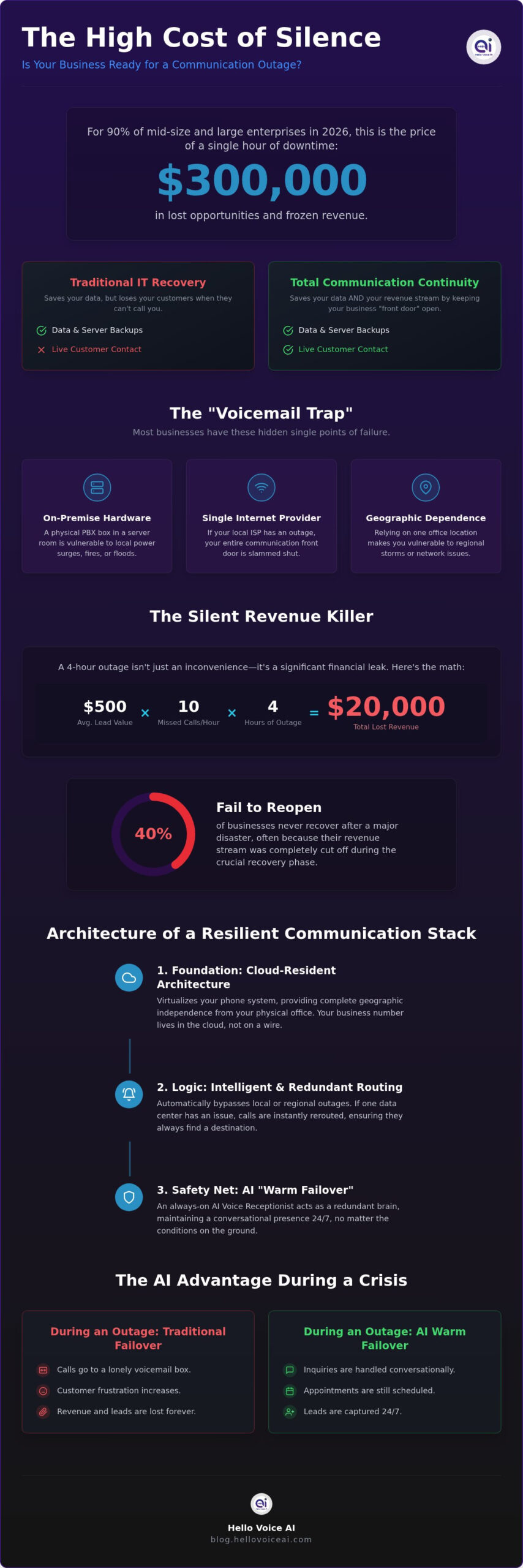
Imagine losing $300,000 in sixty minutes. For 90% of mid-size and large enterprises in 2026, that’s the literal price of a single hour of downtime. While most leaders have a plan to restore their servers, they often overlook the “voicemail trap” that silences their front desk when the power goes out. Effective disaster recovery for business communications isn’t just about backing up data. It’s about ensuring your revenue stream doesn’t freeze when your physical office does.
You likely recognize that every missed call is a lost opportunity, yet the high cost of traditional redundant answering services often feels like a financial burden. It’s frustrating to watch leads slip away because your IT recovery plan didn’t account for the human element of a phone call. This guide will show you how to build a communication stack that remains operational during any crisis, ensuring you never lose a lead to downtime. We’ll explore a clear framework for continuity and how AI Voice Receptionists bridge the gap to maintain 24/7 availability, no matter what happens on the ground.
Key Takeaways
- Learn why standard IT backups fail to protect your business “front door” and how to redefine your strategy for total operational continuity.
- Discover how a cloud-resident architecture provides the foundation for disaster recovery for business communications, ensuring geographic independence.
- Identify the “voicemail trap” and other logical failures in traditional failovers that cause customer frustration and lost revenue during a crisis.
- Access a practical checklist to audit your communication flow for single points of failure and establish automated failover triggers.
- Understand how an AI Voice Receptionist acts as a crisis-proof safety net that maintains 24/7 lead capture regardless of local conditions.
Beyond IT: Redefining Disaster Recovery for Business Communications
Your servers are backed up. Your data is mirrored in the cloud. Your IT team feels confident. Yet, if a local storm knocks out your office fiber line, your customers are met with a busy signal or an endless ring. In the modern marketplace, disaster recovery for business communications is the art of maintaining your “front door” when the physical building is inaccessible. It’s a critical distinction that many leaders miss: IT recovery saves your data, but communication recovery saves your customers. Incorporating a dedicated status page from StatusPulse ensures that these customers are kept informed of your recovery progress, turning a potential frustration into a showcase of professional transparency.
Traditional strategies often focus on the “back-end” while leaving the “front-end” vulnerable. A minor ISP outage or a hardware failure in an on-premise PBX system creates a systemic leak. This isn’t just a technical glitch; it’s a breakdown in the primary bridge between your brand and your revenue. By integrating Communication Continuity into your broader resilience plan, you ensure that the logic of your business remains reachable, even if your physical location is dark.
Silence is expensive. When a prospect calls and receives no answer, they don’t wait for your power to return; they click the next link in the search results. Consider the math of a four-hour outage. If your average lead value is $500 and you miss ten calls an hour, that’s a $20,000 revenue leak. According to 2026 industry data, 40% of businesses fail to reopen after a major disaster, often because they lost the ability to capture new business during the recovery phase. This is the logic of the “Silent Revenue Killer.” Every unanswered call is an invitation for a competitor to step in and solve your customer’s problem. Understanding how to handle business calls with a bulletproof system is what separates businesses that survive a crisis from those that lose ground to competitors.
Identifying Communication Single Points of Failure
Most organizations suffer from hidden vulnerabilities. If your phone system relies on a physical box in a server room or a single local internet provider, you have a single point of failure. If that connection breaks, the system dies. Relying on a single geographic location for customer service is a gamble with your growth. A resilient stack utilizes intelligent call routing to act as a first line of defense. By decoupling your communication logic from your physical hardware, you create a system that can pivot instantly. Whether it’s a localized power failure or a regional network outage, your business remains a cohesive, reachable entity.
The Architecture of a Resilient Communication Stack
Physical hardware is a liability. If your communication system lives in a server closet, a single local power surge can decapitate your sales pipeline. Modern disaster recovery for business communications requires a fundamental shift. You must move from on-premise hardware to cloud-resident logic that exists independently of your physical office space.
Cloud VoIP provides this foundation. By virtualizing your phone lines, you achieve geographic independence. If a flood or fire hits your headquarters, your communication logic remains intact within a distributed network. Redundant routing then ensures that incoming calls always find a destination; whether that is a mobile app, a remote laptop, or an automated system.
Cloud Redundancy and Geographic Independence
Local internet failures shouldn’t paralyze your brand. Effective cloud systems bypass regional outages by utilizing multi-region data centers. If one node goes dark, another instantly picks up the traffic. This level of resilience is why your business call management software must be location-agnostic. It should function as a global layer above your local infrastructure. When your team can’t reach the office, your software ensures the office reaches them. This setup transforms a potential catastrophe into a manageable shift in workflow.
AI as the ‘Warm Failover’ for Your Front Desk
A warm failover is a backup system that stays synchronized and ready to take over the moment a primary system fails. In the context of your front desk, an AI Voice Receptionist is the ultimate warm failover. Unlike traditional call forwarding, which often leads to a lonely voicemail box, AI maintains a conversational presence. It handles inquiries, schedules appointments, and captures leads with the same brand voice your customers expect. This is critical during a crisis when your human staff might be displaced or occupied with recovery efforts. AI Voice Receptionists serve as the redundant brain of modern business connectivity, ensuring no call goes unanswered even when your team is offline. Implementing a sophisticated AI Voice Receptionist can turn your communication stack into a self-healing network that captures revenue 24/7.
The Voicemail Trap: Why Traditional Failovers Fail
Traditional failover methods are often built on a dangerous assumption: that a recorded greeting is a sufficient placeholder for a human conversation. When a disaster strikes, many businesses simply forward their main lines to a general voicemail box or a personal cell phone. This creates a logical puzzle that customers rarely care to solve. In the context of disaster recovery for business communications, these reactive measures don’t just fail; they actively repel your most valuable leads.
Forwarding calls to a personal mobile device during a crisis introduces immediate operational friction. One person cannot handle a surge in call volume, and without a centralized tracking system, follow-ups are forgotten in the chaos. You end up with a fragmented customer experience that makes your brand look disorganized exactly when it needs to project stability. If your team is displaced, expecting them to manage a high-stakes call queue on their personal devices is a recipe for burnout and missed revenue.
Lead Capture vs. Lead Loss
Industry data indicates that approximately 67% of customers hang up if they hear a voicemail greeting instead of a live voice. They don’t want to leave a message; they want a solution. There is a profound difference between “recording a message” and “scheduling an appointment” through an automated system. While a voicemail box is a passive storage unit, an AI Voice Receptionist is an active participant in your sales funnel. The matter-of-fact reality is simple: an unanswered call is a gift to your competitor. If you aren’t there to answer, someone else will be.
Live Answering Services: The Latency Problem
Many organizations rely on human-operated answering services as their backup. However, these services suffer from a significant latency problem during large-scale regional disasters. When a hurricane or major power outage hits a specific area, local call centers are often overwhelmed or offline themselves. Human agents can’t scale instantly to meet a 300% spike in volume. In contrast, AI systems offer immediate, infinite scalability without the high overhead of staffing. For a detailed breakdown of how these options compare financially, consult our Virtual Receptionist Cost: 2026 Small Business Price Guide. Choosing AI over traditional live services ensures your front desk remains operational even when the local labor market is disrupted.
Building Your Communication Continuity Checklist
A resilient strategy is built on preparation, not reaction. You’ve already identified the high stakes of silence and the limitations of traditional failovers. Now, it’s time to assemble the tactical components of your disaster recovery for business communications. This process requires a methodical look at your current infrastructure to eliminate the “single points of failure” that threaten your revenue during a crisis.
By integrating communication recovery into your broader business continuity strategy, you ensure that your front desk remains as durable as your data backups. Establish automated failover triggers for your phone lines; these are the logic gates that redirect traffic the moment a connection is lost. Regular testing of this “switch-over” is mandatory. A plan that hasn’t been verified in a simulated environment is merely a suggestion, not a safeguard.
Step 1: The Communication Audit
Begin by mapping every path a caller takes to reach your business. Trace the journey from the initial dial to the final resolution. Does the path break if your office internet fails? If the answer is yes, you have a systemic leak. Your ai voice receptionist must have direct access to your CRM and calendar to maintain operational flow. This integration allows the system to function as a redundant brain, capturing data and scheduling appointments even if your physical team is displaced. Without this connection, your recovery efforts will be hampered by manual data entry once the crisis passes. A comprehensive approach to professional business call management ensures every touchpoint in that caller journey is accounted for and protected against disruption.
Step 2: Scripting for Resilience
Crafting your messaging during a disruption should project calm, logical confidence. Don’t settle for a generic “we are closed” recording. Instead, use AI to provide real-time updates that demonstrate enlightened concern for your customers’ needs. A script that says, “We are currently managing a local power outage, but I can assist you with scheduling or basic inquiries right now,” transforms a negative event into a proof point for your reliability. This proactive approach reduces customer anxiety and prevents them from seeking out a competitor. You can start building this crisis-proof front desk today by learning how to deploy an AI Voice Receptionist tailored to your business logic.
Future-Proofing with Hello Voice AI: The Ultimate Safety Net
Hello Voice AI serves as the definitive fix for communication-based revenue leaks. It moves the strategic conversation from “how do we recover?” to “how do we remain operational?” by installing a permanent, crisis-proof front desk that exists entirely outside of local vulnerabilities. This is the cornerstone of modern disaster recovery for business communications. It ensures that while your competitors are scrambling to forward calls to personal cell phones, your business continues to capture leads and schedule appointments with automated precision. By removing the human bottleneck, you transform your communication stack into an asset that generates ROI even during a regional crisis.
The transition to an AI-powered system eliminates the paralyzing stress of “what if” scenarios for business owners. If your physical office is inaccessible, your business logic remains reachable. This setup provides the instant response and automated scheduling required in a future-ready marketplace. You aren’t just buying a tool; you’re investing in a redundant brain for your organization that protects your most valuable asset: your connection to the customer.
Always On, Regardless of Local Conditions
Localized disasters often paralyze traditional human-operated systems. If a regional storm knocks out power for an entire city, both your office and local human answering services may fail simultaneously. Hello Voice AI maintains a technical advantage by operating on a purely cloud-based architecture. It doesn’t just survive; it scales. Standard office lines often crash under the weight of high call volumes during a crisis, yet AI manages these surges effortlessly. This capability positions AI as a strategic partner in your growth, ensuring that operational friction never slows your momentum. It allows you to focus on physical recovery while your virtual receptionist handles the front-end logic with calm, logical confidence.
Getting Started: From Vulnerable to Resilient
Integrating Hello Voice AI into your existing business continuity strategy is a streamlined process. It doesn’t require a total overhaul of your IT infrastructure. Instead, it adds a layer of intelligent redundancy to your existing lines. If you are still relying on manual failovers and voicemail greetings, you are leaving your revenue exposed. Transitioning from manual processes to streamlined automation is the logical next step for any organization that values 24/7 availability. You can secure your sales pipeline today by choosing a solution that never sleeps and never disconnects. Resilience is a choice, not an accident. Visit Hello Voice AI to explore how to deploy your new safety net and ensure your business remains open, no matter what happens on the ground.
Securing Your Operational Future
Resilience in 2026 is no longer a luxury; it’s a structural necessity for any growing enterprise. We’ve explored how decoupling your front desk from physical hardware prevents the “voicemail trap” and ensures your revenue stream remains uninterrupted. By identifying single points of failure and deploying cloud-resident logic, you protect your brand from the silent cost of missed opportunities. This shift from reactive recovery to proactive continuity is what separates market leaders from those who struggle to reopen after a crisis.
Implementing a robust strategy for disaster recovery for business communications transforms a localized crisis into a manageable event rather than a financial catastrophe. It’s about maintaining a conversational presence when your physical team is displaced. You don’t have to wait for the next power outage to identify your vulnerabilities. Secure your business front desk with a 24/7 AI Voice Receptionist from Hello Voice AI to leverage zero-latency failover and cloud-based resilience. With these automated systems in place, you can lead your organization with the calm, logical confidence that your customers will always find an open door, regardless of local conditions.
Frequently Asked Questions
How does disaster recovery for communications differ from IT disaster recovery?
IT disaster recovery focuses on data restoration and server uptime to ensure your digital records remain safe. In contrast, disaster recovery for business communications prioritizes accessibility and customer engagement. While IT ensures your database is secure, communication recovery ensures your “front door” remains open to leads. It’s a strategic layer that prevents revenue leaks during the technical restoration process. One protects your records; the other protects your market position.
What are the most common business continuity strategies for small businesses?
Most resilient small businesses prioritize geographic diversification and cloud-based redundancy. Effective strategies include:
- Transitioning from on-premise PBX to cloud VoIP systems.
- Establishing automated call forwarding to mobile devices.
- Implementing AI-powered virtual receptionists for 24/7 coverage.
- Maintaining offline backups of critical contact lists.
Focusing on these areas creates a foundation that doesn’t depend on a single physical office location or a local internet provider.
Can an AI receptionist really handle calls if my office internet is down?
Yes, a purely cloud-based AI receptionist operates independently of your local infrastructure. Because the logic lives in multi-region data centers, the system answers calls before they ever reach your local fiber line. If your office loses power or internet, the AI continues to greet callers, answer questions, and capture leads. It functions as a redundant brain that keeps your business reachable even when your physical site is dark.
Is a virtual receptionist service more reliable than a human answering service during a disaster?
AI-powered virtual receptionists offer significantly higher reliability during regional crises. Human call centers are susceptible to the same local conditions as your business, such as power outages or staff displacement. AI doesn’t face these physical constraints and can scale instantly to handle massive call spikes that would overwhelm a human team. This ensures zero-latency failover and consistent brand empathy when a traditional service might be forced offline.
How much does it cost to implement a communication disaster recovery plan?
The cost varies based on the complexity of your stack and the level of automation required. Many organizations find that cloud-based disaster recovery for business communications reduces overall expenses by eliminating the need for expensive on-site hardware. While storage and data center usage are often consumption-based, the primary investment lies in software subscriptions and the initial setup of your automated failover logic and integrated CRM triggers.
What happens to my business phone number if my service provider has an outage?
If your primary carrier suffers a backbone outage, your number may become unreachable unless you have implemented carrier-grade redundancy. This involves using a service that can redirect traffic at the network level to a different carrier’s infrastructure. Most modern cloud systems include this logic. It allows your number to remain active by rerouting calls through an alternative path before the outage impacts your customer’s ability to connect with your brand.
Can an AI receptionist schedule appointments if my local system is offline?
Yes, provided your AI receptionist is integrated with a cloud-based calendar or CRM. Since these tools exist in the cloud, they remain accessible to the AI even if your local computers are offline. The system can check availability and confirm bookings in real-time, synchronizing the data once your local connection is restored. This prevents the administrative backlog that typically follows a disruption and keeps your sales pipeline moving forward.
How often should I test my business communication failover plan?
Industry standards recommend testing your failover plan at least twice a year. However, if you make significant changes to your software stack or team structure, you should conduct a test immediately. Frequent testing identifies operational friction and ensures that your automated triggers function as intended. A plan that remains untested is likely to fail in a real-world scenario. Regular simulations build the logical confidence needed to manage a crisis.