

Your phone line is no longer just a communication channel. In 2026, it’s a high-stakes revenue engine where every unanswered ring represents a calculated loss to your bottom line. You’ve likely felt the sting of checking call logs only to find a string of after-hours inquiries that went cold before you could even finish your morning coffee. It’s a common operational friction point, balancing the prohibitive cost of round-the-clock human staffing against the reality of losing thousands in potential sales to a silent voicemail box. Integrating a sophisticated ai voice receptionist into your workflow solves this logical puzzle by ensuring no prospect is left waiting.
This article is your strategic blueprint for eliminating that vulnerability. You’ll discover how modern automated systems use advanced logic to provide a front desk that never sleeps, ensuring you achieve a 100% lead capture rate while facilitating seamless appointment booking without human intervention. We’ll break down the shift from manual, inconsistent service to a future-ready model that transforms your phone system into a tireless growth driver. It’s time to stop leaking revenue and start optimizing every interaction for maximum performance.
Key Takeaways
- Identify the “Voicemail Death Spiral” and learn why 80% of missed calls never return, turning your phone line into a proactive revenue engine.
- Explore the transition from clunky “Press 1” menus to sophisticated Natural Language Understanding that enables seamless, human-like conversational flow.
- Evaluate the performance metrics of an ai voice receptionist against human staffing to overcome the scalability walls that limit high-volume growth.
- Master the deployment process by conducting a knowledge audit and mapping intent paths to ensure every caller reaches a successful outcome.
- Discover how to integrate 24/7 lead capture and automated scheduling into your existing workflow with zero operational friction.
The Silent Revenue Leak: Why Traditional Call Handling Fails in 2026
Silence is expensive. In the high-stakes environment of 2026, a missed call is a direct contribution to your competitor’s growth. Traditional automated attendant systems once sufficed for basic routing, but they lack the sophistication needed to capture modern intent. A modern ai voice receptionist isn’t merely a digital recording. It’s a sophisticated agent driven by Natural Language Understanding (NLU) that manages complex business logic, from qualification to direct scheduling, in real-time.
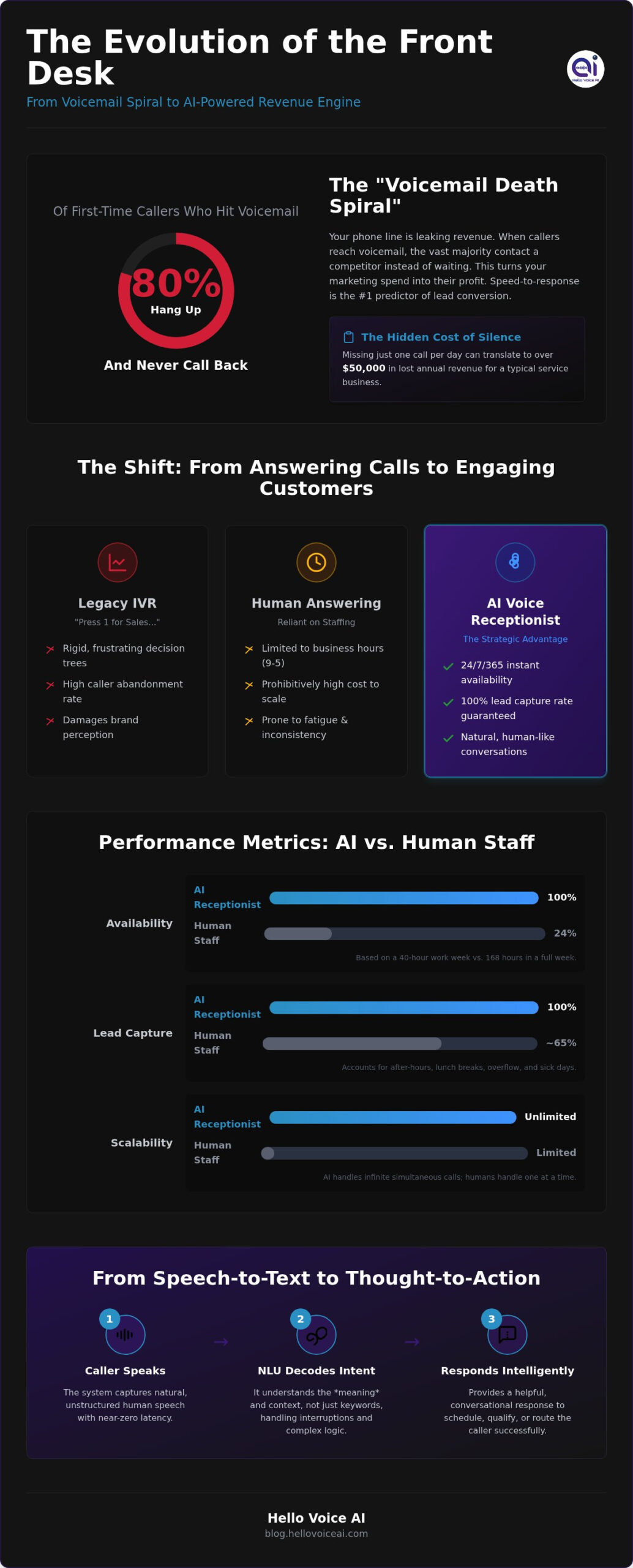
We call this the “Voicemail Death Spiral.” Industry observations suggest that approximately 80% of first-time callers will simply hang up rather than leave a message. They won’t call back. If your front desk isn’t active, your marketing budget is effectively subsidizing your competition. Moving from “Answering” to “Engaging” is a critical shift because speed-to-response is the primary predictor of lead conversion. Consider the “Cost of Silence.” For a service business with a modest lead value, missing just one call per day can translate to over $50,000 in lost annual revenue. It’s a solvable logical puzzle, yet many firms treat it as an unavoidable cost of doing business.
To solve this logical puzzle and improve lead capture, you can learn more about Answer Strong and their insights on how automated services support small business growth.
The Hidden Math of Missed Opportunities
To calculate your specific leak, multiply your average lead value by your historical conversion rate and the number of calls currently hitting voicemail. The result is often staggering. Many 9-to-5 operations fall into the “After-Hours Trap,” failing to realize that globalized markets and 24/7 consumer expectations don’t pause at sunset. Lead Decay Rate is the exponential speed at which a prospective caller’s interest diminishes and their likelihood of contacting a competitor increases. A robust automated lead response strategy is the most direct antidote to this decay, transforming every missed opportunity into an immediate, measurable engagement. To understand exactly how much revenue you’re leaving on the table, a structured virtual receptionist ROI calculation can give you a clear financial framework for making the switch.
The Psychological Shift: Why Callers Prefer AI to Voicemail
Modern callers value resolution over human contact. In an “Instant Gratification” economy, particularly among the Gen Z and Millennial workforce, waiting for a callback feels like an archaic friction point. Data indicates higher satisfaction when an ai voice receptionist provides immediate answers or bookings compared to the uncertainty of a human callback. By 2026, voice models have successfully crossed the “Uncanny Valley.” They provide genuine professional empathy and logical precision, ensuring the caller feels heard and helped without the fatigue that often plagues overwhelmed human staff.
Inside the Engine: Decoding the Intelligence of a Modern AI Receptionist
The era of “Press 1 for Sales” is dead. It was a linear hurdle that frustrated customers and killed conversion rates long before the call ever reached a human. Modern ai voice receptionist technology operates on a different plane entirely. Instead of rigid decision trees, these systems utilize Natural Language Understanding (NLU) to interpret the messy, unpredictable nature of human speech. This isn’t just about recognizing words; it’s about decoding intent and managing the complex business logic required to move a caller toward a specific goal.
Latency was once the primary barrier to adoption. In 2026, the revolution in edge computing has reduced response delays to near-zero, allowing for a conversational flow that feels indistinguishable from a human interaction. These agents can now handle “over-talking” and mid-sentence interruptions with grace, pivoting their logic in real-time based on new information provided by the caller. This fluid movement across topics is what separates a professional-grade agent from a basic automated tool.
From Speech-to-Text to Thought-to-Speech
Sophisticated transformer models allow the AI to understand the nuance behind a request. If a caller says, “I’m looking for a slot on Tuesday but only if it’s in the afternoon,” the system doesn’t just scan for the word “Tuesday.” It analyzes the conditional logic of the sentence to query your calendar for specific availability. Zero-shot learning allows the system to process and respond to queries it hasn’t specifically been trained on by applying high-level logic and contextual associations. This ensures that even the most obscure customer questions don’t result in a conversational dead end.
The Integration Ecosystem: Syncing with Your Tech Stack
A standalone AI is a data silo. To truly transform your customer experience, your ai voice receptionist must be deeply integrated with your CRM and scheduling software. This connectivity enables contextual awareness, allowing the agent to greet returning customers by name and reference their previous service history. It also ensures the AI has real-time access to your pricing and availability, even at 3 AM on a holiday weekend.
Security and reliability are paramount when handling sensitive customer data, which is why modern deployments often align with official government guidance on AI regarding transparency and data protection. While the AI handles the bulk of high-volume inquiries, a “Human-in-the-Loop” architecture remains essential for complex escalations or emergency routing. If you’re curious about how these integrations look in practice, you can explore our guide on modern front-desk automation to see the logic in action.
The Strategic Comparison: AI Voice vs. Human Answering vs. Legacy IVR
Choice is the architect of outcome. When you evaluate your front-desk strategy, you’re essentially choosing between three distinct operational models: the legacy IVR, the human answering service, and the modern ai voice receptionist. Each has a specific performance profile regarding speed, cost, and accuracy. While human staff provide high emotional resonance, they often struggle with the “Scalability Wall.” If you launch a high-volume marketing campaign, a human-operated service will eventually hit a ceiling where wait times spike and lead quality drops. An AI agent, by contrast, maintains perfect consistency regardless of call volume.
Consistency is a quiet but powerful brand asset. Humans have “bad days” and “rude tones” when they’re overwhelmed, but an automated agent never experiences fatigue. As we see in broader trends like AI adoption across the federal government, the move toward automated logic is becoming a standard for efficiency. The most successful businesses in 2026 use a “Hybrid Desk” model. They deploy AI as a first-line filter to handle routine inquiries and scheduling, reserving their elite human staff for high-value, complex consultations that require deep personal rapport.
Cost-Per-Interaction: The Brutal Economics
The financial logic is difficult to ignore. A dedicated human receptionist typically costs $2,500 or more per month, whereas an AI agent operates at a fraction of a cent per minute. Beyond the base salary, you must consider training time. A human takes weeks to learn your service pricing and FAQs; an AI is “fully trained” in hours by simply ingesting your documentation. This efficiency directly impacts your ROI by ensuring an instant lead response. Catching a prospect in the first 30 seconds of their inquiry is the single most effective way to prevent them from calling a competitor. Understanding the full mechanics of automated lead response and 24/7 conversion strategy reveals exactly how this speed advantage compounds into measurable revenue gains. For small business owners weighing their options, reviewing the precise virtual receptionist cost for small business across different service tiers is an essential step before committing to any model.
The Death of the Phone Tree
Customers loathe the traditional IVR because of the high cognitive load. Listening to a list of numbered menus is a friction point that modern callers no longer tolerate. An ai voice receptionist provides an “Open Prompt” experience, greeting the caller with a simple “How can I help you today?” This removes the guesswork and allows for immediate resolution. One small service business recently reported a 40% increase in total bookings simply by switching from a rigid IVR to a voice AI, proving that reducing friction is the fastest path to growth. If you’re still evaluating which model fits your business, understanding what is a virtual receptionist and how it has evolved into an AI-powered growth engine is an essential first step.
Architecture of Excellence: How to Deploy a High-Converting AI Front Desk
Precision is the difference between a tool and a teammate. Building a high-converting front desk requires more than just turning on a service; it demands a methodical strategic architecture. To ensure your ai voice receptionist operates at peak efficiency, you must approach the deployment as a five-step logical puzzle. If you treat the setup as a “set-and-forget” task, you risk leaving revenue on the table through missed nuances or misaligned brand tone.
- The Knowledge Audit: Feed your AI the definitive truth of your business. This includes your website content, current service pricing, and a robust library of FAQs to ensure every response is grounded in fact.
- Defining Intent Paths: Map out exactly what “success” looks like for every caller type. Whether it’s a high-value appointment booking or a simple billing inquiry, the AI must have a clear, logic-driven route to resolution.
- Persona Mapping: Select a voice and tone that mirrors your professional brand identity. In 2026, this means choosing between authoritative, empathetic, or energetic personas that resonate with your specific demographic.
- The Escalation Protocol: Establish rigid rules for human intervention. If a caller presents a complex emotional grievance or a high-stakes emergency, the system must trigger an immediate transfer to your elite human staff.
- The Feedback Loop: Use call transcriptions to audit performance. Reviewing these interactions weekly allows you to refine the AI’s logic and close any remaining “leaks” in your lead capture funnel.
Crafting the ‘Perfect’ Digital Employee
The core of a successful ai voice receptionist lies in the “System Prompt.” This set of foundational instructions prevents the AI from hallucinating or making unsupported promises to your customers. By 2026, sophisticated voice models have moved beyond robotic monotone to include regional accents and gender-neutral options that foster immediate rapport. Integrating subtle filler words and “small talk” capabilities makes the interaction feel natural, reducing the friction often associated with automated systems. If you’re ready to build your custom agent, start your strategic deployment today to see how logic-driven agents outperform traditional staffing.
Security and Compliance by Design
Data integrity isn’t optional. When handling voice recordings, your architecture must adhere to SOC2, HIPAA, and GDPR standards to protect sensitive customer information. Modern redaction technology automatically scrubs credit card numbers and personally identifiable information (PII) from transcriptions before they’re ever stored. This ensures your business remains compliant while maintaining full ownership of your existing business phone number through seamless routing. You aren’t just automating calls; you’re building a secure, future-ready infrastructure for sustainable growth.
Future-Proofing with Hello Voice AI: Your Next Strategic Hire
Hello Voice AI represents the definitive shift from reactive call handling to proactive revenue management. It’s not just a software implementation. It’s your next strategic hire. While traditional staffing models are inherently constrained by human fatigue and high overhead, an ai voice receptionist provides a consistent, high-performance interface that bridges the gap between your current phone system and an automated future. By transforming every verbal interaction into a searchable, actionable CRM record, we eliminate the data silos that traditionally plague front-desk operations. Each interaction is parsed for intent and sentiment, providing you with a high-level view of your customer’s journey that manual note-taking simply cannot match. Businesses that integrate this level of sophistication today aren’t just solving a current problem; they’re positioning themselves to dominate their local markets by 2027.
Beyond the Answer: Data-Driven Growth
Success in a fast-paced commerce environment requires more than just answering the phone. It requires insight. Hello Voice AI uses advanced call summaries to identify market trends and customer pain points that often go unnoticed in the chaos of daily operations. If a specific service request spikes after hours, you’ll see the pattern in your dashboard before it becomes a missed opportunity. We also ensure that no lead goes cold by triggering automated SMS or email follow-ups immediately after a call ends. This persistent engagement allows you to capture the 40% of leads that typically call outside of standard business hours, effectively expanding your market reach without increasing your headcount or physical footprint. Before scaling your investment, reviewing a comprehensive virtual receptionist ROI guide for small businesses will help you quantify exactly how much revenue this expanded coverage generates for your specific operation.
Getting Started with Hello Voice AI
The transition to an automated front desk shouldn’t be a source of operational friction. Our “Zero Friction” onboarding process allows for a 15-minute setup that takes you from a silent voicemail to a fully functioning, logic-driven agent. Whether you’re a boutique firm or an enterprise-grade call center, the platform scales effortlessly to meet your growth trajectory. You don’t need to overhaul your existing infrastructure to start seeing results; the system is designed to integrate seamlessly into your current workflow. It’s time to stop the “silent leak” and start optimizing your most critical communication channel. Audit your missed calls and start your 24/7 AI journey with Hello Voice AI to secure your competitive advantage and ensure no lead is ever left to a voicemail again.
Securing Your Competitive Advantage in 2026
The phone line is the front line of your business growth. We’ve explored how a modern ai voice receptionist eliminates the “voicemail death spiral” by providing 24/7 availability and sophisticated logic that captures every lead. By moving away from legacy IVRs and the high overhead of human staffing, you’re not just saving money; you’re building a scalable engine that turns every interaction into actionable data. This transition is no longer a luxury but a logical necessity for any brand that intends to thrive in a globalized, always-on economy.
With instant CRM integration and a 90% cost reduction compared to traditional human staff, the decision to automate is a clear strategic win. It’s time to stop letting potential revenue leak through your fingers and start optimizing for a future where no call goes unanswered. You have the tools to transform your front desk into a tireless growth driver that works while you sleep. Start capturing 100% of your leads with Hello Voice AI today. Your future-ready operation is only one deployment away.
Frequently Asked Questions
Does an AI voice receptionist sound like a robot?
Modern systems utilize high-fidelity neural speech synthesis that replicates human inflection and emotional tone with remarkable accuracy. By 2026, these voice models have successfully crossed the “Uncanny Valley,” incorporating natural breathing patterns and subtle filler words to ensure a comfortable conversational flow. Your callers won’t experience the stilted, robotic delivery of legacy systems. Instead, they interact with a sophisticated agent that maintains professional empathy throughout the entire engagement.
Can an AI receptionist actually book appointments in my specific calendar (like Google or Outlook)?
Seamless synchronization is a core feature of a high-performing ai voice receptionist. The system connects directly to your Google Calendar, Outlook, or industry-specific CRM—such as specialized gym management software for functional fitness—via secure API endpoints. When a caller requests a slot, the AI queries your real-time availability and writes the appointment directly into your schedule. This eliminates the back-and-forth friction of manual booking and ensures your calendar remains the single source of truth for your operations.
How does the AI handle angry or frustrated callers who want to speak to a person?
The system utilizes real-time sentiment analysis to detect frustration or urgency in a caller’s voice. If the AI identifies an emotional escalation it cannot resolve, it follows a predefined protocol to transfer the call to your human staff immediately. This “Human-in-the-Loop” architecture ensures that high-stakes situations receive the personal attention they require. It balances automated efficiency with the strategic necessity of human empathy for complex grievances.
Is my business too small to need an AI voice receptionist?
Small businesses often suffer the most from missed-call revenue loss because they lack dedicated front-desk staff. If you’re a solo operator or a small team, an ai voice receptionist acts as a force multiplier by ensuring 100% lead capture while you’re busy serving existing clients. It provides the professional image of a larger enterprise without the prohibitive cost of 24/7 human staffing, making it a vital tool for sustainable growth. Before making a decision, it helps to understand the full breakdown of virtual receptionist cost for small business so you can accurately compare it against your current overhead.
What happens if the AI doesn’t know the answer to a customer’s question?
If the system encounters a query outside its current knowledge base, it’s programmed for a graceful fallback. Rather than hallucinating an answer, the AI will honestly acknowledge the limitation and offer to capture a detailed message or route the query to a specialist. It then logs the interaction as a “knowledge gap” in your dashboard. This allows you to update your FAQs and refine the AI’s logic for future interactions.
How much does it cost compared to a traditional answering service?
Traditional human answering services often charge high monthly retainers plus per-minute fees that escalate quickly during busy periods. An AI-driven solution typically offers a 90% cost reduction compared to human staffing. You’re trading a fixed, high-overhead expense for a scalable model that only charges for the logic it executes. This shift transforms your front desk from a heavy cost center into a lean, performance-oriented revenue engine.
Do I need to change my existing business phone number to use Hello Voice AI?
You don’t need to abandon your established brand identity or change your phone number. Integration is achieved through simple call forwarding or SIP trunking, allowing your existing number to route calls through our AI servers seamlessly. This “Zero Friction” setup ensures that your customers continue to reach you exactly as they always have. The only difference they’ll notice is that their calls are now answered instantly, regardless of the time or day.
Is the data from my calls secure and private?
Security is baked into the architecture of modern voice systems. Data is protected by industry-standard encryption and complies with SOC2, HIPAA, and GDPR requirements to ensure caller privacy. Advanced redaction technology can automatically scrub sensitive information, such as credit card numbers or personal identifiers, from call transcriptions. You maintain full ownership of your data while benefiting from a secure, future-ready infrastructure that prioritizes the integrity of your customer interactions.





6 Comments