

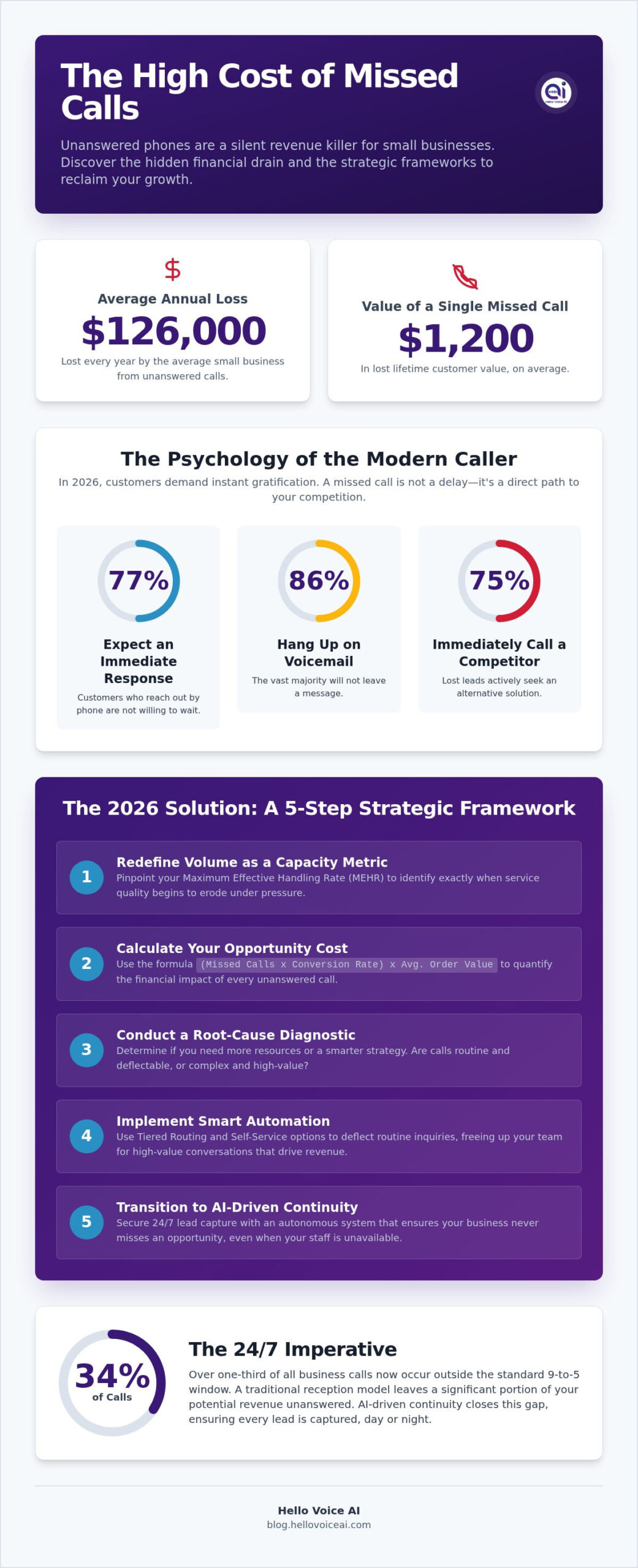
The average small business loses approximately $126,000 every year simply because the phone keeps ringing while no one is available to answer. It is a staggering leak in your revenue bucket, yet most owners view it as an inevitable byproduct of success. You know the feeling of the front desk being underwater, watching potential leads vanish into the void of a voicemail box that 86% of callers will never leave a message in. It is a scenario where growth ironically creates its own ceiling.
It’s exhausting to watch your staff burn out while trying to figure out how to manage high call volume in a small business without doubling your payroll. You shouldn’t have to choose between a quiet office and a profitable one. This 2026 strategic guide will show you how to master the frameworks and autonomous technologies needed to turn overwhelming call surges into streamlined growth opportunities. By the end of this article, you’ll understand how to achieve 24/7 coverage and ensure zero missed leads, all while maintaining a consistent customer experience that scales as fast as your ambition. We will explore the shift from manual friction to future-ready automation and the specific tools that provide a clear ROI on your communication strategy.
Key Takeaways
- Redefine volume as a capacity metric rather than a raw number to identify exactly when your service level begins to erode.
- Use the Opportunity Cost Formula to expose the “Silent Revenue Killer” and quantify the financial impact of every missed interaction.
- Conduct a root-cause diagnostic to determine if you need more resources or a better strategy for how to manage high call volume in a small business.
- Implement Tiered Routing and Self-Service Deflection to automate routine inquiries and reserve your team for high-value conversions.
- Transition to autonomous AI continuity to secure 24/7 lead capture and ensure your business never sleeps, even when your staff does.
Defining High Call Volume: Why It Is About Capacity, Not Just Numbers
High call volume is a relative term, not a fixed metric. For a solo practitioner, twelve calls in a single morning feels like a deluge. For a growing service team, the pressure typically mounts at the fifty-call-per-day mark. The true definition of high call volume is any influx that exceeds your team’s ability to provide an instant response. In the 2026 market, a busy signal or a ringing phone that goes unanswered isn’t just a delay; it’s the digital equivalent of hanging a “closed” sign on your front door while customers are standing on the sidewalk.
When you’re trying to figure out how to manage high call volume in a small business, you’re essentially solving a capacity puzzle. If your staff is tied up with complex queries, a sudden surge of three routine “where are you located?” calls can paralyze your operations. This friction point is where revenue begins to leak. While traditional call center operations rely on massive headcount to absorb these spikes, small businesses must be more surgical in their approach to maintaining professional continuity.
The Psychology of the Modern Caller
The 2026 consumer operates on a “now or never” timeline. Research shows that 77% of customers expect an immediate response when they reach out by phone. If they don’t get it, the consequences are immediate. Statistics confirm that 86% of callers who reach a voicemail will hang up without leaving a message. They don’t just wait for a callback; 75% of those callers will immediately contact a competitor instead. The shift from “leave a message” to “find a competitor” is the primary driver of brand erosion. Every missed call doesn’t just lose a single transaction; it destroys the long-term credibility of a business that appears too busy to care.
Capacity vs. Volume: A Diagnostic Framework
To fix the problem, you must first calculate your Maximum Effective Handling Rate (MEHR). This is the number of calls your team can manage with full accuracy and empathy before service quality begins to drop. Identifying this tipping point is critical. When you exceed your MEHR, staff burnout increases and customer satisfaction plummeted. Hiring more staff is often a reactive trap that increases overhead without solving the underlying logic of the surge. To truly master how to manage high call volume in a small business, you need to move beyond staffing and look at how technology can bridge the gap between your current capacity and your actual market demand.
The Financial Impact of Missed Calls: Calculating Your Hidden Losses
Every unanswered ring is a withdrawal from your growth fund. It is a harsh reality of modern commerce; a single missed call in 2026 costs a small business an average of $1,200 in lost lifetime customer value. This is the Silent Revenue Killer, a systemic leak that drains approximately $126,000 annually from the average enterprise. When you struggle with how to manage high call volume in a small business, you aren’t just facing a busy afternoon. You are witnessing the erosion of your marketing ROI and the inflation of your Customer Acquisition Cost (CAC).
The math is unforgiving. You can visualize the damage using the “Opportunity Cost Formula”: (Missed Calls x Conversion Rate) x Average Order Value. If your business misses five leads a day with a 20% conversion rate and a $1,000 order value, you are losing $1,000 every twenty-four hours. This financial friction extends to your existing client base through “The Silent Churn.” When loyal customers cannot reach you during peak hours, their trust diminishes, eventually leading them to seek more responsive competitors who prioritize availability.
UK Industry Benchmarks: Calls per Customer per Year
In 2026, benchmarks for professional services, retail, and healthcare indicate that customers expect more frequent touchpoints. Dental practices and legal firms, for instance, now see a critical threshold where call volume spikes significantly during after-hours periods. Small businesses often under-calculate this load, failing to realize that 34% of all business calls now occur outside the standard 9-to-5 window. By streamlining customer communications through integrated technology, you can predict these surges and prevent the staffing bottlenecks that lead to missed revenue.
The ROI of Zero-Wait Engagement
The financial logic for moving toward automation is clear. Compare the $1,200 loss of a single missed lead to the predictable, low overhead of virtual receptionist services. Data suggests that a mere 10% increase in your call answer rate can shift your annual revenue by tens of thousands of dollars. Call Recovery ROI is the net gain realized from capturing and converting leads that previously would have hung up on a voicemail. If you are ready to stop the revenue leak, you can evaluate your current call handling efficiency to identify exactly where your opportunities are slipping away.
Diagnostic Phase: Pinpointing the Root Causes of Your Call Surges
Solving the puzzle of high call volume requires more than just adding lines; it requires a surgical understanding of why the phone is ringing. You must distinguish between predictable seasonal spikes and self-inflicted marketing influxes. Seasonal trends are historical and manageable. Marketing surges, however, are often the result of successful campaigns that inadvertently “break” your front desk because the operational capacity wasn’t scaled alongside the ad spend. Understanding how to manage high call volume in a small business starts with identifying these Peak Hour Clusters through historical data analysis.
Often, the culprit is an “Information Gap.” If your call logs reveal a high percentage of callers asking for basic details like pricing, location, or service availability, your website is failing to do its job. This structural surge happens when your business success outpaces your existing communication infrastructure. During these high-pressure periods, it is vital to ensure your handling processes remain compliant with the Telemarketing Sales Rule, particularly regarding how you capture and manage lead data during inbound surges.
Marketing Alignment and the Call Center Effect
A common operational failure occurs when marketing teams launch a “limited time offer” without alerting the staff responsible for answering the phones. This creates a bottleneck where potential revenue is sacrificed to long wait times. To prevent this, you must sync your promotional calendar with front desk automation. By preparing your systems for a planned surge, you ensure that the influx of leads results in appointments rather than frustrations. It is about creating a bridge between the promise of your marketing and the reality of your fulfillment.
Unreturned Calls: The Feedback Loop of High Volume
Failing to return a call promptly creates a “double volume” effect. When a customer doesn’t hear back, they don’t just wait; they call again. And again. This creates the “Anxiety Call,” where a single customer generates three or four touchpoints for the same issue, artificially inflating your call volume and burying your team in redundant tasks. Breaking this cycle requires an instant, automated acknowledgment. When a caller knows their inquiry is logged and being processed, the compulsion to call back disappears. Mastering how to manage high call volume in a small business is as much about managing customer psychology as it is about managing the actual phone lines.
Strategic Response: Four Proven Frameworks for Call Load Management
Strategy is the only scalable response to operational noise. If you’re currently drowning in rings, understanding how to manage high call volume in a small business requires a shift from reactive answering to proactive triage. You can’t just throw more people at the problem; you need a system that filters, prioritizes, and deflects. This isn’t about ignoring customers. It’s about ensuring every caller reaches the most efficient resolution path possible. Implementing these frameworks is the most effective way to master how to manage high call volume in a small business while maintaining a lean headcount.
Tiered routing and self-service deflection form the backbone of this approach. By using AI to answer FAQs before they ever reach a human, you preserve your team’s mental energy for high-stakes conversations. High-value inquiries should be routed to specialists, while routine status checks or basic information requests are handled automatically. This ensures that a $10 question never consumes the time of a staff member capable of closing a $1,000 deal. It’s a logical puzzle where the goal is to match the inquiry’s complexity with the most cost-effective resource.
Every business needs an “Always-On” buffer to prevent revenue leaks. Implementing a virtual phone assistant ensures that every call is answered instantly, even during peak surges. This technology can capture basic lead data and then move simple queries to asynchronous channels like SMS or email. This keeps your primary phone lines open for the complex, high-touch interactions that define your brand and drive your bottom line.
Implementing Intelligent Call Routing
Modern routing has evolved beyond the frustrating “Press 1” menus of the past. Using natural language processing, current systems can understand caller intent through conversational speech. This allows you to prioritize new leads over general inquiries during high-volume periods. When combined with strategic call forwarding, your distributed team can remain responsive without being tied to a physical desk, ensuring operational continuity regardless of where your staff is located.
The Power of Automated Scheduling
Phone tag is a productivity killer for appointment-based businesses. Integrating your calendar directly with your communication stack allows callers to book their own time slots without human intervention. Scheduling automation reduces call volume by 30% by eliminating follow-up inquiries. It creates a seamless path from the initial call to a confirmed booking, removing the friction that often leads to lost leads. If you are ready to modernize your operations, you can start by implementing an AI-driven buffer to secure your future growth.
The 2026 Solution: Transitioning from Manual Reception to AI-Driven Continuity
The era of the manual front desk is closing. Relying solely on human operators is no longer a viable strategy for those seeking to master how to manage high call volume in a small business. While traditional receptionists provide empathy, they cannot offer the 24/7 operational continuity required in the 2026 market. A human-only model is no longer a strategic business partner when it creates a bottleneck during peak surges or after-hours periods. To maintain growth, you must move from reactive answering to a sophisticated, tech-forward lead capture system.
Adopting an “Enlightened Concern” approach means recognizing that every missed call is a solvable logical puzzle. Hello Voice AI acts as a strategic hire that never sleeps, never burns out, and never misses a detail. It provides a future-ready mindset where your business is always available, ensuring that the 34% of customers who call after-hours are greeted by a professional, capable voice rather than a silent voicemail box. This transition ensures that your operational success is no longer limited by human headcount or office hours.
AI Voice Receptionist vs. Traditional IVR
Modern consumers have a visceral reaction to “Push-Button” menus. The legacy IVR systems of the 2010s are relics that frustrate users and drive 75% of callers toward your competitors. Modern conversational AI is fundamentally different. It listens, understands intent, and responds with a “matter-of-fact” professional tone that builds immediate trust. This technology offers significant speed and cost advantages over live virtual receptionists, providing instant resolutions without the high overhead or training requirements of a human team. To understand the sophisticated frameworks that power these interactions, you can learn more about IntellifyAi and how retrieval-augmented generation is used in enterprise AI. It is the definitive fix for the systemic leak in your communication workflow.
Mastery begins with objective data. Conduct a 7-day call audit to pinpoint exactly when and why your volume leaks occur. Once you identify these peak hour clusters, setting up your first AI-powered virtual receptionist becomes a straightforward implementation. You should measure your success by tracking the specific reduction in missed calls and evaluating your virtual receptionist ROI. By following this roadmap, you ensure that your business is prepared for how to manage high call volume in a small business while turning every ring into a verified growth opportunity.
Securing Your Future Growth Through Operational Continuity
Operational success shouldn’t come at the cost of your team’s sanity or your brand’s reputation. The roadmap is clear: high volume is a capacity puzzle, not just a raw count of rings. If you continue to rely on manual processes, you are essentially accepting a systemic leak that costs the average business $126,000 annually. The transition to AI-driven continuity is the only logical path forward for those who want to master how to manage high call volume in a small business without ballooning their overhead. By moving from reactive answering to proactive lead capture, you turn a source of friction into a scalable growth engine.
It’s time to stop losing revenue to the silence of an unanswered line. You can eliminate 100% of missed-call revenue loss while providing 24/7 lead response and automated scheduling. This isn’t just about a tool; it’s about a strategic ROI that outperforms traditional answering services and keeps you ahead of the curve. Secure your 24/7 front desk with Hello Voice AI today and ensure your business is always ready for the next opportunity. Your growth is waiting. Don’t let it go to a competitor because you weren’t there to answer.
Frequently Asked Questions
What is considered a high call volume for a small business?
High call volume is defined by your capacity to respond instantly, but on average, small businesses receive between 40 and 60 calls per day. For solo operators, the critical threshold is often much lower, around 10 to 15 calls. If your team misses more than 20% of incoming inquiries, you’ve reached a surge that exceeds your operational capacity. It’s a logical puzzle where volume isn’t just a number; it’s the point where service quality begins to erode.
How can I handle high call volume without hiring more staff?
You can effectively master how to manage high call volume in a small business by implementing autonomous AI agents and self-service deflection. These technologies handle routine inquiries and appointment scheduling 24/7 without increasing your payroll. By automating the questions that create an “Information Gap,” you free your existing staff to focus on high-value conversions. This shift to automated continuity ensures your team remains efficient even during peak marketing surges or seasonal spikes.
What are the industry benchmarks for calls per customer per year in the UK?
In 2026, UK industry benchmarks show that service-based sectors like dental and legal see a significant volume of calls occurring outside standard business hours. Approximately 34% of all business calls now happen after 5 PM or on weekends. Small businesses often under-calculate their expected load by ignoring these after-hours trends. Tracking these metrics allows you to allocate digital resources effectively, ensuring that your communication strategy aligns with actual customer behavior patterns in the local market.
Can an AI voice receptionist really handle complex customer inquiries?
Modern conversational AI is designed to manage multi-step requests and coordinate workflows across different business systems without human intervention. While simple bots of the past often failed, 2026 autonomous agents can handle complex routing and specific scheduling logic. They use natural language processing to understand caller intent, providing a professional and matter-of-fact response. This ensures that even detailed inquiries are captured or routed to the correct specialist with full context and accuracy.
Is an AI receptionist better than a traditional answering service?
An AI voice receptionist is superior to a traditional answering service because it provides instant resolution and 24/7 availability without the high per-minute costs of human labor. Traditional services often lead to delays and inconsistent customer experiences that frustrate callers. AI ensures every lead is captured and scheduled immediately. It’s a strategic hire that never sleeps or burns out, offering a clear ROI that manual, human-operated services simply cannot match in the modern commerce landscape.
How much revenue does a small business lose to missed calls on average?
The average small business loses approximately $126,000 per year due to missed phone calls. This figure reflects the lost lifetime value of customers who hang up when they reach a voicemail. With 86% of callers refusing to leave a message, the financial friction of an unanswered phone is staggering. Every missed ring represents a $1,200 loss in potential revenue, making it a critical systemic leak that requires a sophisticated, tech-forward solution to protect your bottom line.
What are the best tools for managing high call volume in 2026?
The most effective tools for how to manage high call volume in a small business include AI voice receptionists, integrated CRM platforms, and automated scheduling software. These tools work in tandem to create an “Always-On” buffer for your enterprise. By moving simple queries to asynchronous channels like SMS and using conversational AI for voice interactions, you can ensure zero missed leads. These technologies provide the definitive fix for operational friction while maintaining a sophisticated brand image.
How do I set up call routing for peak business hours?
Setting up call routing for peak hours involves using tiered logic and natural language processing to prioritize high-value inquiries. During surges, your system should automatically deflect routine FAQs to AI while forwarding new leads to your most experienced staff. This ensures that your Maximum Effective Handling Rate is never exceeded. By integrating call forwarding with a virtual receptionist service, you maintain operational continuity even when your physical front desk is temporarily underwater.






2 Comments