

Seventy-four percent of potential customers who endure a poor phone experience will immediately take their business to a competitor. It’s a staggering reality for any growth-oriented firm. If your current system relies on expensive human staff who miss after-hours leads or provide inconsistent message quality, you’re likely experiencing significant revenue leakage. Exploring virtual receptionist alternatives is no longer just a cost-saving exercise; it’s a strategic necessity to ensure your front line never sleeps and your lead capture remains flawless.
You already know that every call sent to voicemail is a lost opportunity, yet the high monthly bills for live human agents often feel like an unavoidable tax on growth. This guide provides the strategic framework you need to move beyond these traditional limitations. You’ll discover how to choose a communication solution that eliminates missed calls while maximizing your operational ROI. We will examine the transition from manual, inconsistent processes to a 24/7 automated future that integrates seamlessly with your CRM and lowers your total cost per interaction. It is time to treat your phone system as a profit center rather than a cost burden.
Key Takeaways
- Identify the “operational leakage” where every missed call translates into direct revenue loss and a budget liability for your business.
- Learn to distinguish between legacy IVR systems and modern virtual receptionist alternatives that offer superior message quality and 24/7 availability.
- Evaluate potential solutions using a rigorous checklist focused on response speed and seamless integration with your existing CRM and calendar.
- Map out your firm’s unique “logic puzzle” to ensure automated systems route callers correctly and capture every lead without administrative friction.
- Discover how transitioning to an AI-powered framework eliminates the high costs of human staff while providing a strategic hire that never sleeps.
Beyond the Live Agent: Why Businesses Seek Virtual Receptionist Alternatives in 2026
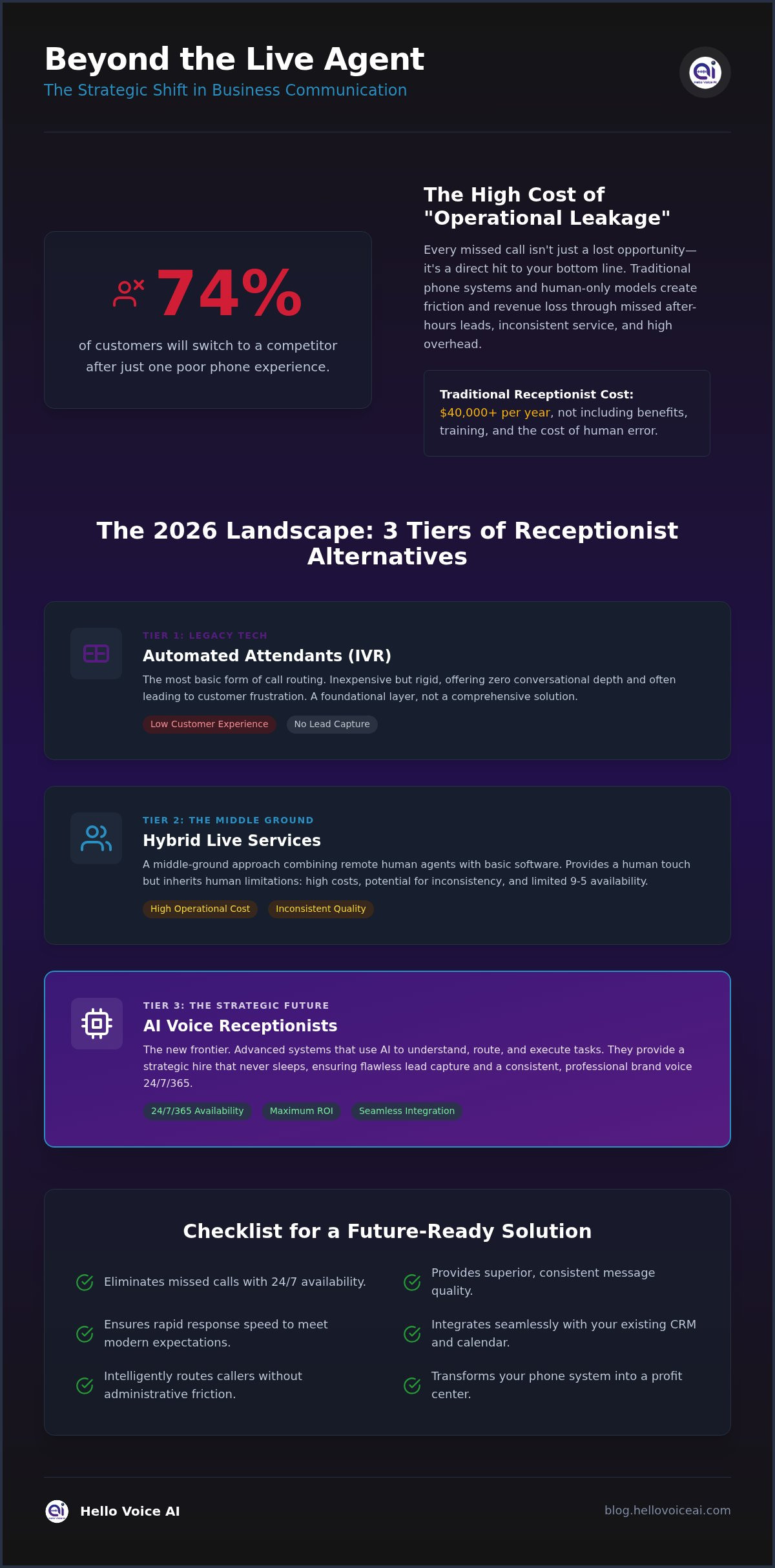
The 2026 business landscape is unforgiving to those who wait. Every unanswered call is a direct hit to your bottom line, yet many firms still cling to traditional staffing models that can’t scale. The rising cost of human capital has transformed the classic answering service from a helpful asset into a significant budget liability. It’s a structural flaw that creates “Operational Leakage,” where potential revenue simply drains away because a live agent was on break or stuck on another line. This systemic failure is driving the urgent search for virtual receptionist alternatives that can handle high volume without the overhead.
Businesses are now actively hunting for these solutions to plug the holes in their lead intake. The logic is simple; a system that never sleeps is inherently more profitable than one bound by human limitations. Moving from a reactive stance, where you hope someone answers, to a proactive strategy ensures every lead is captured instantly. This isn’t just about answering phones. It is about building a future-ready infrastructure that treats every interaction as a high-stakes logical puzzle to be solved.
The Hidden Cost of the “Human-Only” Model
The ROI gap between human staff and modern software is widening. While a full-time receptionist can cost a business upwards of $40,000 annually in base salary, the true cost includes training, benefits, and the inevitable errors caused by human fatigue. Inconsistent brand voice occurs when a tired agent handles a high-stakes inquiry with less than peak professionalism. This inconsistency creates friction. Operational Friction is the delay between a customer inquiry and a professional response.
To solve this, many organizations are leveraging sophisticated virtual assistant technology to standardize their first impression. These systems provide a logical, tech-forward path that ensures every caller receives the same high-caliber experience regardless of the time of day. By removing the human bottleneck, firms can reallocate their capital toward growth rather than just maintaining the status quo.
Modern Consumer Expectations in a Post-Instant World
In 2026, voicemail has officially become the graveyard of leads. Customers no longer accept the “we will call you back” promise. They demand instant, intelligent resolution. If they hit a recording, they simply hang up and call the next listing on their search results. Statistics suggest that the vast majority of consumers will abandon a business after a single unanswered call, moving instantly to a competitor who answers.
The psychological impact of an immediate, intelligent greeting cannot be overstated. It signals that your business is capable, modern, and ready to serve. This shift in capability is why savvy operators are analyzing How AI Receptionist Software Increases Business ROI to justify the move away from legacy systems. By eliminating the lag, you transform your front desk from a bottleneck into a high-speed gateway for new business. Finding the right virtual receptionist alternatives means choosing a partner that understands this need for speed and precision.
The 2026 Landscape: 3 Primary Categories of Receptionist Alternatives
The market for virtual receptionist alternatives has bifurcated into distinct technological camps. Choosing the wrong one doesn’t just waste your budget; it creates a friction-filled experience that drives prospects away. To navigate this landscape effectively, you must understand the three primary tiers of service available in 2026. These range from legacy systems that rely on rigid menus to sophisticated interfaces that function as autonomous team members. Identifying which category fits your specific volume and complexity is the first step toward reclaiming your operational ROI.
- Automated Attendants (IVR): The foundational layer of call routing. It is inexpensive but offers zero conversational depth.
- Hybrid Live Services: A middle-ground approach where remote human agents use basic software to assist with calls. While this provides a human touch, businesses often look to Amplify Yourself, LLC to find high-quality virtual assistants who can mitigate the typical costs of local staffing models.
- AI Voice Receptionists: The current frontier. These systems use advanced processing to execute tasks like scheduling and qualification without human intervention.
Legacy IVR: The “Press 1 for Sales” Era
Traditional phone trees are increasingly viewed as a barrier rather than a service. In an era of instant gratification, forcing a caller to navigate a keypad-based menu is a high-risk strategy. These systems lack the intelligence to understand context, often leading to “circular routing” where callers feel trapped in a loop. If your business depends on high-value lead conversion, a rigid IVR can be a liability. Implementing a sophisticated automated call routing system is the logical path beyond these legacy constraints. For a deeper look at moving beyond these legacy constraints, see The 24/7 Front Desk: A Strategic Guide to AI Voice Receptionists in 2026.
AI Voice Receptionists: The Sophisticated Path Forward
Modern AI has moved far beyond simple voice recognition. Today, Natural Language Processing (NLP) enables fluid, human-like conversations that can handle complex inquiries in real-time. These systems don’t just take messages; they act as a “strategic hire” capable of lead qualification and direct appointment scheduling. They eliminate the “message-taking” bottleneck by integrating directly with your tech stack to solve the caller’s problem on the first interaction.
This category of virtual receptionist alternatives is designed for the future-ready firm. It treats every call as a data point, capturing intent and syncing it with your CRM instantly. By removing the lag between a customer’s need and your business’s response, you fundamentally change your competitive positioning. It’s a methodical way to ensure your front desk is an engine of growth rather than a source of operational friction. If you’re ready to see how this technology scales, you can explore modern AI solutions for your team.
The Efficiency Audit: A Checklist for Evaluating Your Alternative Options
Three rings. That’s the maximum window you have before a modern prospect abandons the call and moves to your competitor’s listing. When you’re vetting virtual receptionist alternatives, you aren’t just buying software; you’re auditing your front-line defense. A systemic failure here doesn’t just lose a lead; it damages your brand’s reputation for reliability. You need a rigorous decision framework to ensure your chosen solution provides a sophisticated, modern path forward rather than just a digital version of a legacy problem.
- Latency and Response Speed: 2026 standards demand a response on the first ring. If the system lags, the lead is gone.
- Integration Capabilities: Your receptionist must speak fluently with your CRM and calendar. If it doesn’t, you’ve just created a new silo of manual work.
- Scalability: Can the system handle 10 or 100 simultaneous calls during a marketing spike? You need a solution that scales elastically without adding per-head costs.
- Brand Alignment: You must be able to customize the voice and script. A “one-size-fits-all” tone will never capture the nuance of your specific industry.
- Data Security and Compliance: Under 2026 TCPA regulations, your system must handle AI disclosure requirements legally and gracefully while securing caller data.
Technical Integration: The “Make or Break” Factor
If your communication tool doesn’t talk to Salesforce, HubSpot, or your specific practice management software, it’s an operational bottleneck. Real-time data synchronization is the only way to eliminate administrative friction. You need to verify API connectivity that allows for instant updates to your lead pipeline and booking schedule. Without this, your team will spend hours chasing “message slips” that should have been automated. For a detailed breakdown of which platforms offer the tightest sync, consult our Best AI Receptionist Services 2026: Buyer’s Guide.
Personalization and Tone Control
The “robotic” stigma is a relic of the past, provided you use the right modulation tools. You should map the customer journey from the initial greeting to the final booking with surgical precision. This isn’t about sounding “happy”; it’s about sounding helpful. A matter-of-fact delivery builds more trust than an overly cheerful script because it signals professional competence and respects the caller’s time. By controlling the tone, you ensure your brand voice remains consistent even during high-volume periods that would typically cause human fatigue. This methodical approach to virtual receptionist alternatives ensures your front desk remains a high-performance engine of growth. Before finalizing your evaluation, it’s also worth understanding how modern business call management software has evolved beyond basic routing to debunk common myths that may be influencing your decision.
Implementation Framework: Navigating the Technical Transition
Data first. Implementation second. Transitioning to virtual receptionist alternatives is a strategic move that requires a methodical audit of your current operational baseline. Start by analyzing your call volume and peak times over the last ninety days. This data identifies when your team is most vulnerable to missed leads and where a 24/7 solution adds the most immediate value. By establishing this baseline, you can measure the true ROI of your new system against your historical abandonment rates and identify specific windows where revenue leakage is highest.
Next, you must draft your “Logic Puzzle.” This involves mapping out every common caller question and the specific routing path it should trigger. Think of this as a strategic blueprint for your front desk. If a caller asks about pricing, the system should qualify their budget; if they need support, it should route them to your ticketing portal or a specific department. Mapping these paths ensures that the automation feels like a seamless extension of your professional team rather than a dead-end menu, maintaining a high standard of message quality. Understanding how a modern automated call routing system transforms your phone lines from a static utility into an active revenue driver can help you design these logic paths with greater precision.
A “Soft Launch” strategy is the safest path to full integration. Begin by deploying your chosen alternative during after-hours and weekends only. This allows you to capture revenue that would have otherwise gone to voicemail without disrupting your primary business hours. Once you’ve verified that the system handles these calls with precision and integrates correctly with your backend, you can scale its involvement to handle overflow during peak daytime hours. Monitoring performance metrics like conversion rates vs. abandonment rates during this phase provides the logical proof needed for a full-scale rollout.
Porting vs. Forwarding: Managing Your Business Identity
You don’t need to sacrifice your established business number to upgrade your backend. Most modern platforms allow for simple call forwarding, where your existing line sends traffic to the digital receptionist. Alternatively, porting your number to a new carrier can offer deeper integration and lower latency. Ensuring business continuity is critical; your customers should never experience a service gap during this switch. For a step-by-step breakdown on maintaining your identity while upgrading your tech, see How to Stop Missing Business Calls: 2026 AI Reception Guide.
The Iterative Approach to Scripting
Your script shouldn’t be static. Use real-world caller feedback to refine how the system responds to complex inquiries. This is particularly vital if you operate in specialized fields requiring medical, legal, or SaaS terminology. Training the system on your specific industry jargon ensures that it sounds authoritative and informed, which builds immediate trust with the caller. Establish a feedback loop between the reception system and your sales team to identify which routing paths lead to the highest conversion rates. You can start optimizing your lead capture today by refining these automated interactions to match your brand’s unique tone.
Hello Voice AI: The Strategic Alternative to Traditional Reception
Zero missed leads. That’s the benchmark for modern commerce. Hello Voice AI provides the definitive fix for the systemic lead loss that plagues traditional staffing models. While other virtual receptionist alternatives might offer basic routing or remote human interaction, our AI Voice Receptionist functions as a strategic hire that scales with your ambition. It eliminates the operational friction that occurs when calls go unanswered; it ensures every prospect receives an immediate, intelligent response regardless of the hour.
Capturing revenue while you sleep isn’t a luxury. It’s a requirement in a globalized, post-instant market. Our 24/7 availability ensures that your business stays open even when your office is closed. This isn’t just about answering phones. It’s about positioning your firm as a leader that values customer time and professional precision. By treating our system as a strategic advisor, you gain access to real-time interaction data that informs your growth goals. If you know exactly why prospects are calling, you can refine your service offerings with surgical precision. Setting up this intelligent interface takes less than 30 minutes, allowing you to plug the leaks in your funnel today.
Lead Capture Without the Overhead
The ROI shift is undeniable. When you compare Hello Voice AI to a live virtual receptionist service, the reduction in overhead is immediate. You’re removing the administrative friction of manual message taking and the inconsistencies of human fatigue. Every interaction is logged, every lead is qualified, and every appointment is synced with your existing calendar automatically. This methodical approach ensures your team focuses on high-value tasks while the AI handles the frontline logistics. For a deep dive into the specific financial advantages, read our Virtual Receptionist ROI Guide for Small Businesses 2026.
The Future of Your Front Desk Starts Here
Adopting a proactive mindset is the differentiator between stagnant firms and market leaders. You can’t afford to wait for the “perfect” human hire when a tech-forward solution is ready to deploy now. This transition from manual processes to an automated future-state is the most logical path to sustainable growth. Many firms hesitate due to outdated assumptions about automation; understanding the myths surrounding business call management software can help you move forward with confidence. It is time to treat your front desk as a high-performance engine that works for your bottom line. Stop letting operational friction dictate your conversion rates and start building a future-ready interface.
Experience the future of business communication with Hello Voice AI.
Future-Proofing Your Front-Line Growth
The cost of inaction is too high in a market that expects instant resolution. You’ve navigated the landscape of virtual receptionist alternatives and identified the logical path forward. Transitioning from a manual, human-bound front desk to a 24/7 AI-powered interface is no longer a luxury; it’s a strategic necessity for any firm focused on scale. By prioritizing seamless CRM and calendar integration, you eliminate the operational friction that once led to systemic revenue leakage.
The math is simple. Every missed call represents a lost opportunity, and human-only models cannot scale at the speed of modern commerce. Hello Voice AI provides the automated responsiveness required to capture every lead while significantly reducing your operational overhead. It is time to treat your communication system as a profit center rather than a budget liability. You’ve identified the systemic leak; now you have the definitive fix to plug it.
Stop losing leads to voicemail; try Hello Voice AI today. Your business deserves a front line that never sleeps and never misses a detail. You’re ready to build a future where every caller is heard and every lead is secured.
Frequently Asked Questions
What is the most cost-effective alternative to a live virtual receptionist?
AI-powered platforms represent the most cost-effective virtual receptionist alternatives available today. They eliminate the high monthly overhead of human agents by utilizing a predictable SaaS subscription model. This approach significantly lowers your cost-per-interaction while providing 24/7 availability. Unlike traditional services that charge per minute, an automated solution scales with your call volume without increasing your headcount or training expenses, maximizing your total operational ROI.
Can an AI receptionist actually book appointments on my calendar?
Modern AI systems handle automated scheduling with surgical precision. Hello Voice AI integrates directly with your existing calendar to identify open slots and book appointments in real-time. This eliminates the administrative friction of manual entry and ensures leads are secured during the first interaction. By removing the back-and-forth of scheduling, your team can focus on high-value tasks while the system maintains a flawless booking pipeline.
Will my customers know they are talking to an AI receptionist?
Under 2026 TCPA regulations, it is a legal requirement to disclose when a caller is speaking with an AI assistant. However, sophisticated voice modulation ensures the interaction feels helpful and professional. Most customers value an immediate resolution over a long hold time for a human agent. The matter-of-fact delivery builds trust by prioritizing efficiency and accuracy, ensuring that your brand’s first impression remains capable and modern.
How long does it take to switch from a traditional answering service to an AI alternative?
Top-tier virtual receptionist alternatives are built to integrate seamlessly with your existing CRM and tech stack. Platforms like Salesforce or HubSpot receive real-time data from every call, including message transcripts and lead qualification details. This automation eliminates the lag between a customer’s inquiry and your team’s response. By syncing data instantly, you reduce operational friction and provide your sales team with the context they need to close deals faster.
What happens if the AI receptionist cannot answer a complex question?
When an inquiry falls outside the AI’s programmed logic, the system executes a graceful escalation path. It can route the caller to a specific human team member or capture a detailed message for a priority callback. This ensures the caller never experiences a dead-end or circular routing loop. By mapping these “Logic Puzzles” in advance, you maintain professional continuity and ensure that complex inquiries are handled by the right expert.
Is an AI-powered alternative safe for handling sensitive client information?
Security is a foundational priority for modern AI communication platforms. These systems utilize enterprise-grade encryption and adhere to strict data protection standards to keep client information secure. Automated processing is often safer than human-operated services because every interaction follows an auditable, logic-based protocol. This reduces the risk of human error or unauthorized data access, ensuring that sensitive information is managed with the high level of professional care your clients expect.
Can I use an AI receptionist for after-hours calls only?
You can certainly configure the system to handle after-hours traffic only. This is an excellent way to capture revenue that typically leaks to voicemail during nights and weekends. By activating the service when your office is closed, you ensure 24/7 responsiveness without changing your daytime operations. Many businesses use this as a starting point before scaling the system to handle overflow calls during peak daytime hours for better efficiency.






2 Comments