

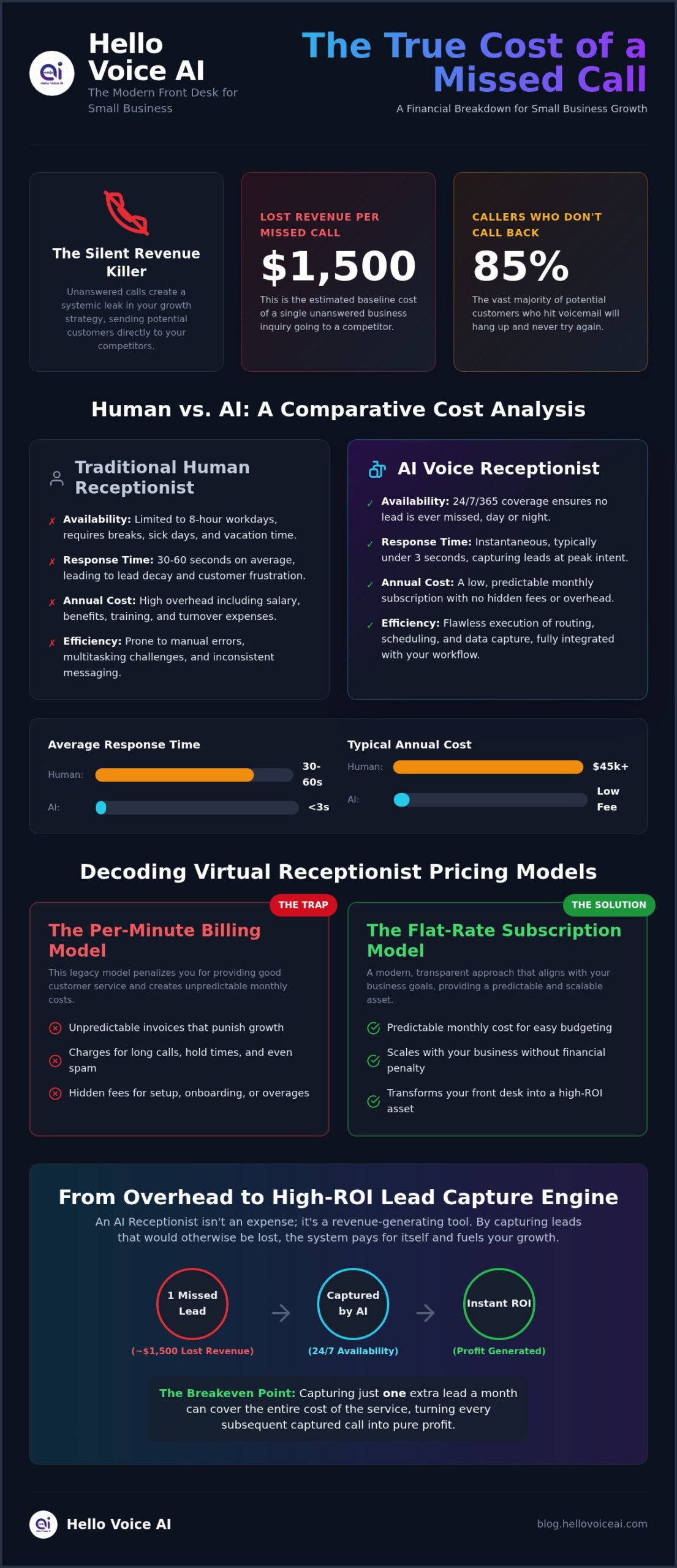
One missed call. One lost lead. For most small businesses, that single moment of silence costs an estimated $1,500 in forfeited revenue. Eighty-five percent of potential customers who encounter a voicemail greeting will simply hang up and call your competitor, creating a silent, systemic leak in your growth strategy. You already recognize that every ring represents a critical revenue opportunity, yet the fixed overhead of a full-time administrative hire often feels like a heavy anchor on your monthly margins. Small business owners are increasingly scrutinizing the virtual receptionist cost for small business to find a strategic balance between professional presence and fiscal discipline.
If you are tired of unpredictable invoices from per-minute answering services, it’s time to reframe your communication strategy as a scalable asset rather than a manual labor expense. This guide will reveal the precise cost structures of modern virtual receptionists, showing you how to secure 24/7 coverage and automated scheduling without the traditional staffing burden. We will analyze the 2026 pricing landscape, comparing the fiscal impact of AI-driven efficiency against legacy human models to help you secure predictable costs and a future-ready front office.
Key Takeaways
- Quantify the financial impact of the “silent revenue killer” by calculating the high stakes of missed calls and their immediate effect on your bottom line.
- Analyze the shift toward flat-rate subscription models to secure a predictable virtual receptionist cost for small business and eliminate the financial trap of minute padding.
- Contrast the operational friction of traditional staffing, including turnover and training expenses, with the logical efficiency of AI Voice Receptionists that provide 24/7 coverage.
- Identify your breakeven call volume to transform your front-desk operation from a necessary overhead into a high-ROI lead capture engine.
- Streamline your digital workflow by integrating automated scheduling and routing tools that ensure business continuity without the burden of overtime pay.
The Financial Weight of Every Missed Call: Why Your Current System is Costly
Three rings. That’s all it takes for a high-value lead to decide between a conversion and a cancellation. When your phone goes unanswered, you aren’t just missing a conversation; you are inviting a systemic leak into your revenue stream. Data from Answer United indicates that a single missed call can cost a business an estimated $1,500 in lost revenue. This staggering figure is the true baseline for evaluating the virtual receptionist cost for small business. It’s no longer just an administrative expense, it’s a strategic layer of business continuity that protects your marketing investment from evaporating into a voicemail box.
What began as a foundational automated attendant has evolved into a sophisticated, AI-driven gatekeeper that preserves your brand authority. Traditional voicemail has become a lead-generation dead end in 2026. Modern consumers equate silence with incompetence. If your response isn’t immediate, your brand’s perceived value drops instantly, forcing potential clients to seek out a competitor who prioritizes their time. Optimizing your virtual receptionist cost for small business starts with acknowledging that the most expensive system is the one that lets revenue walk out the door.
The Math Behind Missed Opportunities
The numbers paint a clear picture of operational risk. Research shows that 75% of customers become irritated and hang up if they can’t reach a professional in a reasonable timeframe. More importantly, 85% of people whose calls go unanswered will never call back. They have already moved on. To understand the stakes, you must account for the speed of the modern market. If you are actively searching for how to stop missing business calls, the data makes clear that every unanswered ring is a direct withdrawal from your revenue potential.
- Instant Gratification: AI receptionists can answer in under 3 seconds, while human-managed desks often take 30 to 60 seconds.
- Conversion Retention: 24/7 availability ensures that after-hours leads are captured when their intent is highest.
- Lead Decay: Lead Decay is the rapid erosion of a prospect’s purchase intent and the corresponding drop in profit margins that occurs for every minute a lead sits in a queue without a professional response.
Operational Friction vs. Automated Flow
Manual call routing is a quiet productivity killer. When your core team spends their afternoon playing “phone tag” or manually transcribing basic messages, they aren’t focusing on the high-value tasks that actually scale the company. This operational friction creates a hidden tax on your payroll. Transitioning from a reactive, manual answering process to a proactive, automated lead capture system eliminates these bottlenecks. By integrating an AI Voice Receptionist, you replace chaotic interruptions with a streamlined, digital workflow that handles routing and scheduling without the need for human intervention or overtime pay.
Decoding Virtual Receptionist Pricing Models for 2026
Confusion is the enemy of profit. When small business owners audit their monthly expenses, they often find themselves staring at communication invoices that don’t match their expectations. The landscape of virtual receptionist cost for small business is currently split between two diverging philosophies: legacy per-minute billing and modern flat-rate subscriptions. One model treats your growth as a billable event, while the other treats it as a strategic goal. Understanding which side of this divide your provider sits on is the difference between a predictable budget and a fiscal surprise.
Many traditional providers still rely on pricing structures that penalize your success. If a customer stays on the line longer to ask detailed questions, your bill rises. This creates a fundamental misalignment between your service quality and your overhead. Beyond the base rate, you must also account for setup fees and “onboarding” costs that can silently inflate your initial investment. Even “unlimited” claims deserve scrutiny, as they often come with hidden performance caps or restricted features that only unlock at higher, more expensive tiers. Selecting the right business call management software is a critical first step toward eliminating these structural inefficiencies from your communication budget.
The Per-Minute Trap
Long-winded callers. Seasonal spikes. Minute padding. These are the variables that make legacy billing unpredictable for a growing company. Minute padding is a common industry practice where calls are rounded up to the nearest sixty-second increment. This often adds 15% to 20% to your total bill without providing a single second of extra value. For a small business with fluctuating seasonal volume, this makes budget forecasting nearly impossible. You shouldn’t have to choose between a helpful, thorough conversation and a manageable monthly invoice.
Subscription-Based AI Models
Predictability is a strategic advantage. Subscription models treat your front desk as a fixed utility rather than a variable drain on your cash flow. By leveraging an AI Voice Receptionist, you remove the “human minute” cost barrier entirely. Research from Harvard Business School suggests that AI can improve customer service by facilitating faster, more consistent interactions that remain professional regardless of call volume. This efficiency allows you to scale your call capacity during peak periods without ever increasing your headcount or worrying about the expenses of training new staff. You can explore how a fixed-rate model stabilizes your operational budget at blog.hellovoiceai.com.
Human vs. AI Virtual Receptionist: A Comparative Cost Analysis
Staffing is often the largest line item on a small business balance sheet. When you hire an in-house receptionist, you aren’t just paying a salary; you are funding benefits, payroll taxes, and office equipment. Verified 2026 benchmarks place the fully loaded cost of a US-based in-house receptionist between $35,000 and $45,000 per year. Even when you pivot to live answering services to mitigate these costs, you face a new set of financial risks. Overage charges for live agents can range from $1.25 to $3.00 per minute, meaning a single busy month can derail your entire operational budget. This volatility makes the virtual receptionist cost for small business a moving target that often grows faster than your revenue.
To better manage these complex staffing requirements and administrative layers, you can discover Humae, an AI-powered HR platform designed to streamline workforce management for modern teams.
Beyond the direct paycheck, you must account for the high price of turnover and training. Human-managed services are susceptible to “bad days,” lunch breaks, and sudden resignations that leave your phones silent. When a live agent leaves, you lose the institutional knowledge you paid to instill. An AI Voice Receptionist eliminates this systemic friction. It remains consistent 24/7, never requires a sick day, and maintains a professional tone regardless of call volume. Furthermore, while live services often treat bilingual support as a premium add-on, modern AI typically includes multi-language capabilities as a standard feature, allowing you to scale your market reach without increasing your overhead.
The Speed-to-Lead Advantage
Time is the primary currency of customer satisfaction. While live human agents often involve hold times during peak hours, AI provides an immediate resolution. Industry data from 2026 shows that AI receptionists can answer calls in under 3 seconds, compared to the 30 to 60 seconds common with human-managed desks. This difference is critical because 75% of customers report getting irritated if they can’t reach a person quickly. In 2026, Instant Customer Gratification is defined as the non-negotiable expectation that a professional, accurate resolution occurs within the first ten seconds of a digital or voice connection.
Feature Parity and Beyond
Functionality should not be a luxury. Many businesses assume that a lower virtual receptionist cost for small business means sacrificing advanced features, but the opposite is true with AI. While a live agent might struggle with manual data entry or forget to update a calendar, an AI system handles automated appointment scheduling and CRM synchronization with surgical precision. It processes complex intelligent call routing logic and logs every interaction instantly. This automated flow removes the hidden costs of administrative errors and ensures your team always has the data they need to close a sale, transforming your front desk from a cost center into a high-performance engine for growth.
Calculating the ROI of Your Front Desk Strategy
Investment requires evidence. While many owners view the virtual receptionist cost for small business as a fixed overhead expense, a methodical analysis reveals it is actually a high-yield growth engine. To find your breakeven point, you must stop looking at what the service costs and start looking at what your current silence is losing. If a single missed call represents an estimated $1,500 in lost revenue, capturing just one “after-hours” lead can fund your entire communication infrastructure for several months. This shift in perspective transforms the front desk from a cost center into a strategic asset.
Beyond the immediate math of lead capture, you must account for the long-term data equity you are building. Every interaction handled by an AI Voice Receptionist creates a searchable, digital record of customer intent. Unlike legacy systems where messages are scribbled on sticky notes or buried in voicemail, an automated system logs every detail directly into your CRM. This database allows you to identify seasonal trends and customer pain points with surgical precision, providing a layer of business intelligence that traditional staffing models simply cannot match. For a comprehensive framework on measuring these returns, the virtual receptionist ROI guide for small businesses provides a definitive formula to quantify the full revenue impact of your communication strategy.
A 5-Step Framework for Cost Assessment
Determining the true value of your communication strategy requires a structured approach. Use this logical progression to audit your current performance:
- Step 1: Track your average monthly missed call volume using your current phone provider’s logs.
- Step 2: Assign a realistic dollar value to a single qualified lead based on your average customer lifetime value.
- Step 3: Compare the total virtual receptionist cost for small business between legacy per-minute providers and predictable AI subscriptions.
- Step 4: Quantify the hours your core team saves by eliminating manual scheduling and routing tasks.
- Step 5: Project your net profit gain by applying your conversion rate to the previously “lost” after-hours call volume.
Beyond the Dollar: Intangible ROI
Numbers tell only half the story. The “Professional Polish” effect of an instant, sophisticated greeting significantly boosts your brand authority during the first point of contact. This consistency reduces “receptionist burnout” within small teams, as your staff is no longer interrupted by routine inquiries that an AI can handle. By securing a 24/7 front desk, you restore your own work-life balance, knowing your business is capturing opportunities while you are offline. Ready to see the math in action for your specific industry? You can run your own projections at blog.hellovoiceai.com.
Scaling with Hello Voice AI: The Future-Ready Small Business Choice
Growth requires a foundation that doesn’t buckle under its own weight. If you continue to rely on legacy staffing models or variable per-minute billing, you are essentially taxing your own success. Every new lead becomes a new expense. Hello Voice AI disrupts this cycle by offering a predictable SaaS model that aligns perfectly with your scaling goals. By stabilizing your virtual receptionist cost for small business, you can focus on market expansion rather than managing the volatility of your front-desk overhead. This is not just a tool; it is the most strategic hire your modern business will make. For those who want to support their professional growth with metaphysical intelligence and spiritual guidance, check out 12th House.
Integrating this AI Voice Receptionist into your existing tech stack is a logical next step for any efficiency-minded leader. Whether you use specific CRM platforms or complex scheduling software, the system acts as a connective tissue between your marketing efforts and your operations. It doesn’t just answer; it acts. By providing 24/7 autonomous scheduling, the service turns high-intent inquiries into confirmed appointments while your competitors’ offices are closed for the night. This transition from reactive answering to proactive conversion is what separates market leaders from those struggling with operational friction. Business owners who have already explored how to stop missing business calls understand that the solution lies in replacing manual processes with intelligent, always-on automation.
The Hello Voice AI Difference
Speed is your competitive moat. The “Please hold” era is a relic of the past that your customers no longer tolerate. Hello Voice AI provides a zero-latency response, ensuring that every caller feels prioritized from the first second. Because the system is built on continuous learning, your virtual receptionist improves with every interaction, refining its understanding of customer needs and industry-specific terminology. You gain transparent reporting with real-time insights into call performance, allowing you to identify revenue leaks before they become systemic failures.
Getting Started Without the Setup Headache
Deployment shouldn’t be a project; it should be a pivot. You can move from missed calls to a fully managed AI front desk in minutes, avoiding the weeks of training associated with human hires. Customizing your brand voice ensures that the customer experience remains seamless and authentic to your specific values. This rapid deployment allows you to capture the revenue that is currently slipping through the cracks of your legacy system. It is time to stop viewing communication as a cost and start treating it as a scalable asset. Scale your business with Hello Voice AI today and secure your professional presence for 2026 and beyond.
Securing Your Competitive Advantage for 2026
Transitioning from a reactive, high-overhead model to a proactive, AI-driven front office is a logical necessity for modern commerce. We’ve established that the true virtual receptionist cost for small business isn’t just the monthly fee; it’s the cost of the silence you allow when high-value leads go unanswered. By shifting to a flat-rate subscription, you eliminate the unpredictability of per-minute billing while capturing the revenue previously lost to after-hours voicemail. You gain a 24/7 professional presence and authoritative AI voice technology built specifically for small business growth.
It’s time to plug the systemic leaks in your revenue funnel and replace operational friction with automated flow. Stop losing leads and start scaling with Hello Voice AI to leverage instant CRM integration and automated scheduling at a fraction of the cost of traditional staffing. Your future-ready front office starts with a single strategic decision to prioritize efficiency and outcomes. Secure your competitive edge today.
Frequently Asked Questions
How much does a virtual receptionist cost for a small business per month?
Monthly expenses vary significantly based on the technology you choose for your front desk. AI-driven solutions typically range from $14 to $300 per month, while live human answering services often start at $300 and can exceed $800 for moderate call volumes. These figures represent the base virtual receptionist cost for small business before accounting for potential overage charges or setup fees. Choosing a flat-rate subscription over per-minute billing is the most effective way to ensure long-term budget predictability.
Is an AI receptionist cheaper than a live answering service?
Yes, AI receptionists are substantially more cost-effective than live answering services because they eliminate the need for expensive human labor. While live agents charge for every minute of interaction, AI systems operate on scalable software that handles unlimited simultaneous calls without increasing your payroll. This structural difference allows small businesses to secure 24/7 coverage for a fraction of the price of a traditional call center. It’s a logical shift from variable labor costs to a fixed software utility.
Do virtual receptionists charge per minute or a flat fee?
Providers generally utilize one of two primary billing structures for their services. Traditional live answering services typically charge per minute, which can lead to unpredictable monthly invoices during seasonal spikes. Conversely, many modern AI Voice Receptionist services offer flat-rate SaaS subscriptions. These flat-fee models provide fiscal transparency, allowing you to manage high call volumes without worrying about minute padding or unexpected overage fees that often plague legacy communication systems.
What are the hidden costs of hiring a virtual receptionist?
Hidden expenses often include setup fees, onboarding charges, and minute-rounding practices. For per-minute services, minute padding rounds a forty-second call up to a full minute, silently inflating your bill by up to 20%. Other potential costs include premium charges for bilingual support, holiday coverage, or integration with your existing CRM. Auditing these line items is essential to understanding the true virtual receptionist cost for small business and avoiding the per-minute trap of legacy providers.
Can a virtual receptionist save my business money on staff overhead?
A virtual receptionist significantly reduces overhead by replacing the fully loaded costs of a full-time administrative hire. In 2026, a US-based receptionist costs between $35,000 and $45,000 annually, including benefits and payroll taxes. By delegating routine routing and scheduling to an automated system, you eliminate these fixed salary expenses. This allows your existing team to focus on high-value revenue-generating tasks rather than administrative phone tag, improving overall labor efficiency.
How do I calculate the ROI of an automated phone system?
Calculate ROI by subtracting your monthly subscription fee from the total revenue captured through previously missed calls. If a single missed lead costs your business an estimated $1,500, capturing just one after-hours conversion can pay for an entire year of service. You should also factor in the soft ROI of saved employee time. When your staff isn’t interrupted by routine inquiries, their productivity on core business objectives increases, further boosting your bottom line.
Is there a setup fee for AI voice receptionist services?
Setup fees vary by provider, though many AI-powered services offer rapid deployment with minimal or zero upfront costs. Unlike live services that require extensive manual training for new agents, AI systems are pre-trained on industry terminology and can be configured in minutes. Some platforms might charge a one-time fee for complex custom integrations or brand-voice personalization. It’s important to confirm these details early to ensure your initial investment remains within your projected operational budget.
What happens if my call volume increases suddenly?
AI receptionists handle sudden spikes in call volume seamlessly by processing multiple simultaneous interactions without any delay. Unlike human-operated desks that require additional staffing or put callers on hold, an automated system scales instantly to meet demand. This elasticity ensures that your service quality remains consistent during marketing campaigns or seasonal peaks. You won’t face the speed-to-lead decay that occurs when human agents are overwhelmed, protecting your brand authority during high-traffic periods.






3 Comments