

Silent phones. Dead leads. Vanishing revenue. What if every missed call after 5:00 PM wasn’t just a notification on your screen, but a direct deposit into your competitor’s bank account? It’s a cold reality. In 2026, a single unanswered ring often represents a lost high-value lead who simply moves to the next search result. Implementing the right business call management software is no longer a luxury for the enterprise. It’s a survival requirement for any firm tired of watching revenue slip through the cracks of a traditional voicemail system.
You likely recognize the friction. Hiring a full-time human receptionist creates a massive overhead expense, yet an unprofessional image caused by long wait times is equally costly. You want a front-desk presence that works while you sleep without the burden of a physical payroll. This guide reveals how to transform your communication infrastructure from a static cost center into a dynamic growth engine. We’ll examine how AI-powered virtual receptionists capture leads, schedule appointments, and route calls with surgical precision. You’ll learn how to ensure your business remains open for growth every hour of the day.
Key Takeaways
- Learn how to stop the “silent revenue killer” by treating your phone line as a strategic growth asset rather than a simple utility.
- Understand the evolution from basic cloud calling to autonomous systems that resolve customer inquiries instantly.
- Identify the non-negotiable features of modern business call management software, such as 24/7 availability and zero-latency lead capture.
- Follow a structured two-step process to secure the ideal business number and integrate a platform built for future-ready automation.
- Discover how an AI voice receptionist can professionalize your front desk and automate scheduling without the high cost of additional payroll.
Beyond the Ring: Why Business Call Management Software is a Strategic Asset
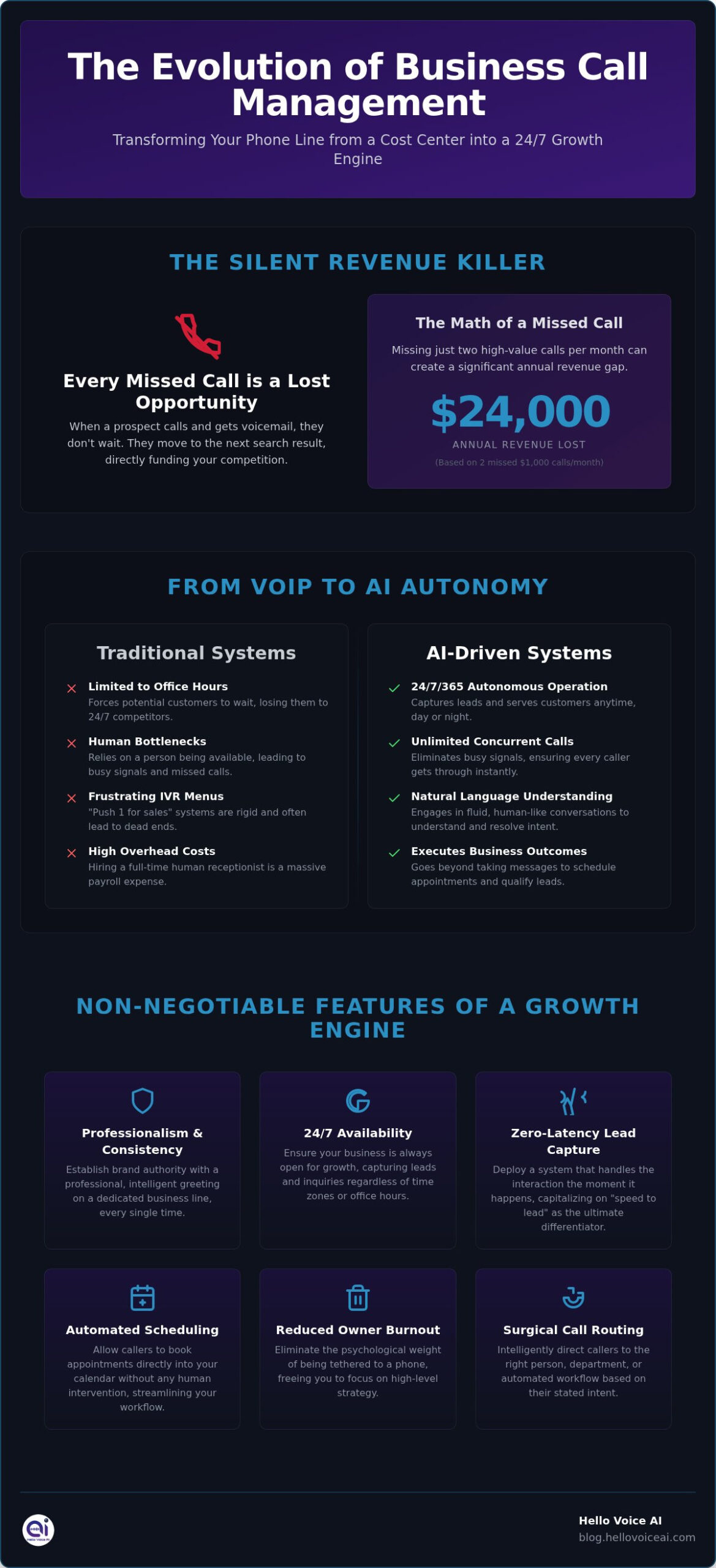
Imagine a prospect ready to buy. They find your number, dial, and wait. The phone rings five times before clicking over to a generic voicemail box. That prospect doesn’t leave a message. Instead, they click the next link in their search results. In that moment, your phone line became a silent revenue killer. By failing to answer, you didn’t just lose a lead; you actively funded your competitor’s growth. This is why modern business call management software is no longer just a tool for routing audio. It’s a strategic asset that captures value at the point of intent. Transitioning from reactive answering to proactive lead management means you stop waiting for the perfect time to talk. You deploy a system that handles the interaction the moment it happens.
Consumer expectations in 2026 have shifted toward a “now or never” mentality. Callers no longer tolerate being put on hold or waiting for a callback the next business day. They demand instant, 24/7 interaction that feels helpful and human. For small businesses, meeting this demand manually is impossible without massive overhead. Professional call management levels the playing field. It allows a small team to project the operational maturity of a global corporation, ensuring no opportunity is ignored due to time zones or office hours.
The Math of a Missed Call
Lead attrition is the measurable erosion of potential revenue caused by friction or delays in the communication process. In the modern market, “speed to lead” is the ultimate differentiator. Research consistently indicates that the first business to respond to an inquiry wins the contract a majority of the time. If your average client contract is worth $1,000, missing just two high-value calls per month creates a $24,000 annual hole in your balance sheet. This isn’t just a missed connection; it’s a systemic leak that compounds over time, draining your marketing ROI and stalling your growth trajectory.
Professionalism as a Competitive Edge
Consistency builds authority. When a caller hears a professional, intelligent greeting every time they dial, their trust in your brand solidifies. You establish an immediate sense of reliability by having a dedicated business line and an organized routing system. Beyond the external image, effective business call management software prevents the chronic burnout often faced by small business owners. By automating the front desk, you eliminate the psychological weight of being tethered to a ringing phone during dinner or weekends. You gain the freedom to focus on high-level strategy while the system executes the tactical necessity of lead capture and appointment scheduling.
The Anatomy of 2026 Call Management: From VOIP to AI Autonomy
Modern business call management software has transitioned from a simple utility to a centralized command center. It’s no longer just about receiving audio. It’s about resolving inquiries at the source. For years, Voice over Internet Protocol (VOIP) was the gold standard because it freed businesses from physical hardware. Yet, VOIP was only a delivery mechanism. It didn’t address the core bottleneck: the requirement for a human to be available on the other end of the line. If no one was there to pick up, the cloud-based tech was effectively useless.
To address these limitations, businesses are turning to advanced platforms that integrate automation directly into the calling process. For example, you can discover Nexdial to see how an AI-powered cloud contact center uses predictive and power dialers to ensure communication remains efficient and automated.
We’ve entered the era of AI autonomy. The rise of the AI Voice Receptionist represents a departure from the rigid, frustrating menus of the past. These systems execute complex business outcomes without human help. They don’t just take a name and number. They schedule appointments directly into your calendar and update your lead records in real-time. They bridge the gap between a ringing phone and a closed deal, ensuring your communication stack is an active participant in your sales funnel.
Traditional VOIP vs. AI-Driven Systems
The “Push 1 for Sales” experience is a relic that modern consumers increasingly reject. Traditional IVR systems force callers into narrow paths that often lead to a dead end. AI-driven systems use natural language processing to understand intent, allowing for fluid, human-like conversations. While traditional call forwarding fails during high-volume periods, AI handles unlimited concurrent calls. You’ll never have to worry about a “busy” signal again. This level of autonomy reduces the need for constant human monitoring, allowing your team to focus on high-value work while the software manages the front-line interactions.
Beyond communication, identifying where else automation can drive efficiency is key to modernizing your operations; you can visit YPrtnrs to explore their free assessment for uncovering AI opportunities across your entire organization.
The Role of Integration in Call Management
Your communication tools shouldn’t exist in a vacuum. Effective business call management software must talk to your CRM and your calendar. When the system captures a lead, that data should flow instantly into your existing workflows. Automated transcription and sentiment analysis add a layer of intelligence that manual logs can’t match. You can identify peak call times and resolution rates with a few clicks. Understanding these technical shifts is the first step toward building a smarter front desk that operates without manual intervention. This data-driven approach ensures you aren’t just answering calls, but optimizing every touchpoint for maximum growth.
Evaluating the Architecture: Features That Distinguish Growth Engines
Your infrastructure determines your ceiling. If you use a system that only routes calls, you’ve built a utility. If you use a system that resolves them, you’ve built a growth engine. Selecting the right business call management software requires looking past the basic dial pad. In 2026, 24/7 availability is the baseline requirement for business continuity. If your system sleeps when you do, you’re leaving the door unlocked for competitors to step in. It’s a solvable logical puzzle that starts with choosing the right features.
Effective architecture prioritizes the caller’s time through intelligent call routing. This isn’t just about finding an open line; it’s about connecting a prospect with the specific expertise they need without a moment of friction. Once connected, the software should execute the next logical business step. Automated appointment scheduling turns a curious caller into a confirmed booking instantly, removing the manual back and-forth that often kills momentum. High-performance systems also provide lead capture and qualification, filtering out the noise. You don’t need more calls. You need more qualified conversations.
Essential vs. Advanced Features
Every small business phone system requires three non-negotiables: high-fidelity voice quality, seamless CRM synchronization, and autonomous interaction capabilities. Beyond these basics, strategic value lies in customization. Brand-aligned voice personas and custom greetings ensure your digital front desk sounds exactly like your physical one. While some owners worry about the initial price tag, the virtual receptionist cost for small business is better viewed as an investment in scalability. It allows you to double your call volume without doubling your staff.
Security and Compliance in Call Management
Modern systems must protect the data they capture. Ensuring data privacy during automated call recording and transcription is a logical necessity, not just a legal one. Secure cloud storage ensures that sensitive customer interactions are archived safely and remain accessible for quality assurance. High-uptime infrastructure is the final piece of the puzzle. A professional image is built on reliability. If your system goes down, your brand’s authority goes down with it. Choosing business call management software with redundant server architecture ensures your front desk remains operational even during regional outages. A comprehensive approach to disaster recovery for business communications ensures that even unexpected crises don’t silence your front desk or cost you high-value leads.
How to Get a Business Phone Number and Set Up Your System
Execution is where growth begins. You’ve identified the systemic leak caused by missed calls. Now, you must build the solution. Setting up a professional communication hub is a linear process that transforms your phone line from a ringing distraction into an automated lead capture tool. Deploying business call management software with precision requires a strategic sequence of five critical steps.
- Step 1: Choose Your Number Type. Decide between a local area code to build community trust or a toll-free number to project national authority.
- Step 2: Select a Call Management Platform. Prioritize software that supports deep AI integration rather than just basic VOIP routing.
- Step 3: Configure Your Virtual Greeting. Draft a script that reflects your brand voice, ensuring every caller feels heard and respected.
- Step 4: Map Your Routing Logic. Define distinct paths for business hours and after-hours to ensure 24/7 coverage.
- Step 5: Integrate Your Tech Stack. Connect your phone system to your CRM, Slack, and calendar to automate data entry and scheduling.
Following this structure ensures that your infrastructure is ready for high-volume traffic without requiring manual oversight. Ready to eliminate missed calls? Start by configuring your AI voice receptionist to handle your front-line inquiries with surgical precision.
Choosing the Right Business Number
Your number is your digital storefront. Using a local area code creates an immediate sense of proximity and community trust. This is particularly effective for service-based businesses targeting specific geographic regions. Conversely, toll-free numbers like 800 or 888 establish a sense of national scale and corporate stability. If you already have a number your customers recognize, most modern platforms allow you to port your existing line. This transition preserves your established brand equity while adding the sophisticated features of modern business call management software.
Configuring Your AI Voice Interface
The interface is the bridge between a prospect and a closed deal. When writing your AI script, aim for a balance of practical business empathy and authoritative confidence. The system should identify the caller’s needs and offer a clear path forward. It’s also vital to set up fail-safes. For highly complex inquiries that require a human touch, the software should offer a seamless handoff or a detailed message capture. Always test the system from the perspective of a first-time caller. If the experience feels fluid and helpful, your system is ready to drive growth.
Future-Proofing Your Front Desk with Hello Voice AI
The phone rings. The opportunity vanishes. For many lean teams, this is the daily cost of manual operations. Hello Voice AI bridges the gap between traditional manual phone lines and total automation. It’s not just about answering; it’s about resolving inquiries with surgical precision. Using this business call management software, you shift from a reactive stance to a proactive growth strategy. You stop being the bottleneck in your own sales process and start operating at the speed of modern commerce. It’s a fundamental change in how you handle the entry point of your business.
Lean teams often struggle with the “double-edged sword” of success: more leads mean more interruptions. By deploying a 24/7 ai voice receptionist, you reclaim your focus. Real-world applications show that businesses regain 10 or more hours of productivity per week by automating the initial touchpoint. This isn’t just time saved; it’s capacity gained to focus on high-level strategy and client fulfillment. It’s the difference between working in your business and working on your business. You gain the freedom to grow without the constant anxiety of a ringing phone.
The Hello Voice AI Advantage
We approach customer service with a sense of enlightened concern. We recognize that every call is a high-stakes moment where trust is either built or broken. Unlike legacy enterprise systems that require weeks of technical onboarding and complex coding, our platform is designed for rapid, intuitive deployment. It fits into your existing workflow without causing friction. The strategic shift here is moving from “answering” to “resolving.” Our system doesn’t just take a name and number; it executes the next logical business step. It qualifies the prospect, provides answers, and integrates the data into your CRM instantly.
Ready to Stop Losing Leads?
The choice is logical. You can continue managing the friction of manual calls, or you can deploy a future-ready interface that works while you sleep. Recovering revenue starts with ensuring no lead ever hits a voicemail again. A virtual receptionist service provides the professional, 24/7 presence your brand deserves. It’s time to move from missed calls to a managed, intelligent front desk. By adopting this technology, you align your business with 2026 consumer expectations. Experience the confidence that comes with knowing your business is always open for growth. Don’t let another high-value lead slip through your fingers because of an unanswered ring.
Mastering the Future of Your Front Desk
The dial tone is changing. Managing calls in 2026 isn’t just about routing audio; it’s about deploying an intelligent interface that executes outcomes without manual intervention. We’ve explored how the shift from traditional VOIP to AI autonomy eliminates the systemic leak of missed calls. You now understand that a professional front desk requires more than just a ringing phone. It demands a system that qualifies leads and schedules appointments while you focus on high-level strategy.
By implementing a modern business call management software, you transform your communication stack from a static utility into a high-velocity growth engine. It’s time to stop the silent revenue leak and secure your competitive edge. Automate your front desk with Hello Voice AI today to leverage 24/7 AI-powered lead capture, integrated appointment scheduling, and a zero missed calls guarantee. Your business is ready for the next level of operational efficiency. Build the future of your front desk today.
Frequently Asked Questions
What is business call management software?
It’s a centralized digital platform that receives, routes, and resolves customer inquiries. Unlike simple VOIP, modern business call management software uses intelligent automation to handle tasks like lead capture and scheduling without manual intervention. It’s the strategic layer that sits between your phone line and your business growth, ensuring that every interaction is captured and processed according to your specific business logic.
How much does business call management software typically cost?
Costs vary based on the level of automation and the volume of calls handled. While traditional systems might charge per user or per line, advanced AI-driven platforms often use usage-based or tier-based structures. It’s best to evaluate the investment against the potential revenue recovered from previously missed calls. Most business owners find that the cost is significantly lower than hiring a full-time human receptionist.
Is AI call management better than a human answering service?
AI offers 24/7 availability with zero downtime and instant response speeds that human services struggle to match. While human-operated services are limited by shift hours and concurrent call capacity, an AI-powered virtual receptionist can handle unlimited simultaneous inquiries. This ensures a consistent, professional brand experience at any hour without the high overhead or management friction of a physical payroll.
Can I keep my existing business phone number?
Yes, most modern platforms allow you to port your existing number directly to the new system. This preserves your established brand equity and ensures your customers don’t experience any disruption. If you prefer to expand your reach, you can also secure new local or toll-free numbers through the software provider to build community trust or project national authority.
Does call management software work for very small businesses?
It’s often most critical for lean teams where every missed call represents a significant percentage of potential growth. Small firms use business call management software to project a professional 24/7 image without the expense of hiring staff. It acts as a force multiplier, allowing a solo founder or small team to manage high lead volumes with the efficiency of a larger corporation.
How does call routing work in a virtual system?
Routing logic directs callers based on predefined rules or real-time intent analysis. The software identifies the purpose of the call and sends it to the appropriate expert, department, or automated resolution path. This eliminates long hold times and ensures that high-intent prospects are prioritized. If a specific team member is unavailable, the system can automatically trigger a fail-safe like an AI message capture. For a deeper look at how these systems work, explore our guide to intelligent call routing strategies for modern business communication.
Can call management software integrate with my CRM?
Seamless integration is a standard feature for high-performance systems. When a call concludes, the software automatically pushes lead data, call transcripts, and appointment details into your CRM. This automation removes the friction of manual data entry and ensures your sales pipeline is updated in real-time. It allows your team to walk into the office with a full schedule of qualified prospects already waiting.
Is it difficult to set up an AI voice receptionist?
Modern interfaces are designed for rapid deployment without technical expertise. You can typically configure your greeting, routing rules, and calendar integrations within a single afternoon. The process is intuitive, focusing on your business outcomes rather than complex coding. This allows you to start capturing leads almost immediately, transforming your phone line from a cost center into a growth engine with minimal effort.