
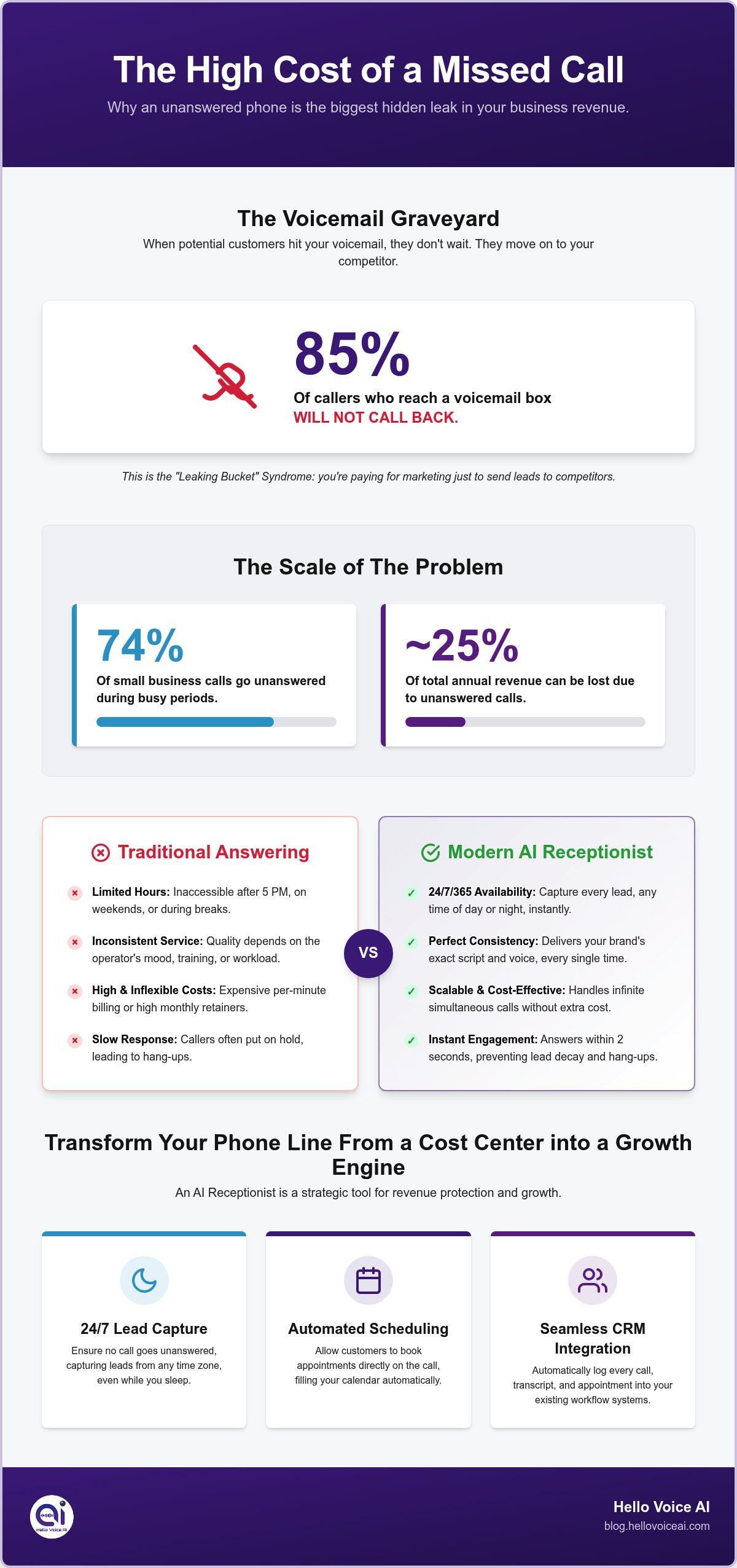
Eighty-five percent of potential customers who reach a voicemail box will never call back. They simply move to the next search result. For a growing company, that silence represents a calculated leak in your annual revenue that most owners find difficult to quantify until it’s too late. Implementing an ai receptionist for small business is no longer a futuristic experiment; it’s a strategic necessity to capture the 74% of calls that typically go unanswered during peak hours.
You likely already know that traditional answering services are often too slow, too expensive, or too inconsistent to represent your brand properly. It’s frustrating to watch hard-earned marketing dollars vanish because a human operator was on break or a lead called at 2:00 AM. This guide will show you how to eliminate missed-call revenue loss and scale your front desk operations using high-accuracy AI voice technology. We’ll explore how 24/7 lead capture, automated scheduling, and seamless CRM integration can transform your phone line from a cost center into a high-performance growth engine.
Key Takeaways
- Quantify the financial impact of the “leaking bucket” syndrome and understand how traditional voicemail actively diverts potential revenue to your competitors.
- Differentiate between outdated “press-button” menus and a modern ai receptionist for small business that utilizes high-fidelity voice synthesis for fluid, natural conversations.
- Master the evaluation framework to avoid predatory per-minute billing traps and learn how to audit a vendor’s accuracy during the trial phase.
- Implement a structured two-step deployment plan that maps your specific call flows and trains the AI on your unique brand voice and FAQs.
- Transition from manual operational friction to a 24/7 automated model that ensures zero downtime and seamless CRM integration for every lead.
The Hidden Math of Missed Calls: Why Small Businesses Lose 25% of Revenue to Voicemail
A customer discovers your brand online. They click your ad, dial your number, and wait. After four rings, they hit a generic recording. This scenario is the “Leaking Bucket” syndrome in action. When you invest heavily in marketing but fail to answer the phone, you aren’t just missing a call; you’re actively subsidizing your competitors. Research shows that 74% of small business calls go unanswered during busy periods, and 85% of people whose first call is not answered will not call back. This creates a systemic revenue drain that most accounting software simply cannot track.
Modern consumers no longer respect the traditional 9-to-5 boundary. They expect a resolution the moment they decide to reach out. While a basic Automated attendant might offer a directory, it often fails to provide the immediate engagement required to stop the “Voicemail Bounce.” If 80% of your callers refuse to leave a message, your voicemail box is effectively a graveyard for potential leads. Implementing an ai receptionist for small business ensures that every dial results in a conversion opportunity rather than a dial tone.
The 2-Second Rule: Why Response Speed is the New Competitive Advantage
In 2026, the window to capture a lead has shrunk to nearly nothing. If a caller reaches a live-sounding AI within two seconds, they stay on the line. If they wait longer, they go back to Google. Lead decay is the rapid deterioration of a prospect’s commercial intent that occurs when a business fails to provide an immediate response to an inbound inquiry. An AI pick-up prevents this decay by providing instant validation, making the caller feel heard and valued before they have a chance to hang up.
Opportunity Cost vs. Operational Expense
Strategic owners are shifting their mindset from viewing phone management as an expense to seeing it as a revenue protection strategy. To understand your specific “Hidden Math,” use this simple logic: multiply your average monthly missed calls by your booking rate and your average customer value. The resulting number is your annual revenue leak. By moving from manual friction to an automated future-state, you can stop this loss immediately. You can find a deeper breakdown of these metrics in our virtual receptionist ROI guide for small businesses. Adopting an ai receptionist for small business isn’t just about cutting costs; it’s about reclaiming the 25% of revenue you are currently leaving on the table.
How Modern AI Receptionists Bridge the Gap Between Software and Strategy
Old systems were hurdles. You’ve experienced the “press 1 for sales” loop that leads to a dead end. In 2026, an ai receptionist for small business functions as a cognitive layer, not a rigid menu. It uses advanced Natural Language Processing (NLP) to handle regional accents, mid-sentence interruptions, and multi-part queries that would baffle older software. This isn’t just about answering; it’s about understanding the specific intent behind the caller’s voice. When the technology can parse complex sentences in real-time, the distinction between a software tool and a strategic hire begins to disappear.
Conversational Intelligence vs. Scripted Automation
Intent recognition is the benchmark of modern performance. While legacy bots scanned for keywords, today’s AI interprets the emotional context and urgency of a request. High-fidelity voice synthesis has evolved to a point where the “robotic” cadence is gone, replaced by a tone of enlightened concern. This shift allows businesses to maintain professional empathy even at 3:00 AM. When a caller feels they are speaking to a competent professional rather than a script, trust remains intact. It transforms a cold interaction into a warm lead before your human team even sees the notification.
Handling Complex Business Logic and Escalation
Strategic call handling requires more than just a pleasant voice. It demands logic-based routing. Modern systems employ “Safe Handoffs,” where the AI identifies when a conversation requires human nuance and transfers the caller with a full data brief. This ensures your team doesn’t start from zero. Emergency filtering also allows you to set custom rules, prioritizing high-value or urgent calls while the AI manages routine scheduling and basic FAQs. If you’re looking to stop missing business calls, this transition from software to strategy is the critical first step.
Personalized experiences are no longer reserved for enterprise-level budgets. Contextual awareness allows the AI to recognize returning numbers, greet callers by name, and reference previous interactions. This level of sophistication transforms a simple phone call into a strategic touchpoint that builds loyalty. To see how this technology fits into your specific workflow, you might consider how Hello Voice AI streamlines these interactions. By treating the phone as a dynamic asset, you eliminate the operational friction that stalls growth.
The Evaluation Framework: Accuracy, Pricing Models, and Technical Friction
Selection is a high-stakes puzzle. Choosing the wrong ai receptionist for small business creates technical friction that can be more costly than the missed calls you’re trying to save. To avoid this, you must look beyond the marketing gloss and evaluate three critical pillars: financial predictability, linguistic accuracy, and ecosystem compatibility. A strategic hire should simplify your life, not add a new layer of software management to your weekend to-do list.
Scalability is often overlooked until a crisis hits. If your business runs a successful seasonal promotion or a viral social media campaign, your call volume might spike from ten calls a day to one hundred simultaneous inquiries. Legacy systems often buckle under this pressure, placing callers in a queue. A modern AI solution should handle unlimited concurrent lines with zero latency, ensuring that your marketing success doesn’t become an operational failure. Furthermore, the tool must speak the language of your existing tech stack. Whether you rely on Slack for internal comms, HubSpot for lead tracking, or Clio for legal intake, the data must flow automatically to prevent the “manual data entry” trap.
Flat-Rate vs. Usage-Based Pricing: A 12-Month Comparison
Per-minute billing is effectively a success tax. If your business grows, your bill explodes. Usage-based models create volatile monthly overhead that makes long-term budgeting impossible. For growth-oriented firms, a flat-rate model is the only logical path forward. It provides a predictable cost structure that allows you to scale your marketing spend without fearing a massive invoice from your receptionist provider. Before committing to any plan, it’s worth reviewing a detailed live receptionist vs AI receptionist cost comparison to understand exactly how 24/7 coverage pricing differs between human agents and automated platforms. You can find a detailed breakdown of these market dynamics in our virtual receptionist cost guide.
The Accuracy Test: 3 Scenarios Every Small Business Should Run
Don’t trust a demo; run a stress test. Every ai receptionist for small business should be put through these three scenarios during a trial period to check for “hallucinations” or logic failures:
- Scenario 1: The ‘Vague Query’. Call and ask something non-linear, like “I’m not sure if I need a consultation or just a quote, what do you think?” This tests the AI’s ability to interpret intent rather than just following a script.
- Scenario 2: The ‘After-Hours Emergency’. Call at midnight and claim a crisis. Does the AI follow your specific escalation rules and route the call to the right person, or does it offer a generic callback?
- Scenario 3: The ‘Appointment Reschedule’. Attempt to change an existing booking. This verifies if the AI has true, bi-directional calendar sync with your CRM or if it’s just sending a static email notification.
Operational Integration: How to Deploy an AI Receptionist Without Disrupting Your Workflow
Operational friction often stems from a lack of clarity in call routing. Deploying an ai receptionist for small business should feel like onboarding a highly competent employee, not installing a complex software patch. The process begins with mapping your “Success Paths.” This involves identifying exactly where a caller needs to end up, whether that’s a booked appointment, a routed emergency, or a simple answer to a pricing question. By defining these outcomes first, you ensure the AI never hits a logical dead end or traps a customer in a circular loop. This strategic mapping transforms your phone line from a chaotic entry point into a structured funnel that respects the caller’s time.
Training follows a linear, purposeful progression. Once your call flows are mapped, you provide the knowledge base that allows the system to learn your specific terminology. You then set the “Human-in-the-Loop” triggers. This is your operational safety net. It ensures that if a conversation becomes too nuanced or high-stakes, the AI hands it off to your live team instantly with a full context brief. This structured deployment ensures that your business remains accessible without overwhelming your staff with routine inquiries.
CRM and Calendar Synchronization
Manual data entry is a silent productivity killer that creates unnecessary lag in your sales cycle. When your receptionist syncs directly with HubSpot, Slack, or Clio, every lead is created in real-time without your intervention. The AI manages your availability with surgical precision, checking your actual calendar before offering a slot to a prospect. Zero-touch lead management ensures that every prospect is captured and categorized instantly without requiring a single minute of manual administrative work. This automation stops the “manual friction” that often leads to lost data and forgotten follow-ups.
Brand Voice Customization: Teaching AI Your Business Empathy
Your business has a specific vocabulary. There are phrases you love and “Never-Say” rules that protect your professional reputation. Teaching these to an AI is the difference between a generic bot and a strategic partner that understands your market dynamics. You can fine-tune the persona to be authoritative for a law firm or warm and helpful for a medical practice. This level of customization ensures that the ai receptionist for small business maintains your brand empathy even during peak hours. If you want to dive deeper into this setup, read the 24/7 front desk guide for a complete roadmap.
Ready to eliminate the operational leak in your front desk? Explore how Hello Voice AI can streamline your lead management today.
Hello Voice AI: Turning Your Business Phone into a 24/7 Revenue Engine
The silent leak has a definitive solution. Identifying a systemic failure in your call handling is the first step toward recovery; fixing it requires a platform built for high-stakes performance. Hello Voice AI provides the definitive ai receptionist for small business, designed to move your operations from manual friction to an automated future-state. While legacy systems focus on basic routing, we prioritize the big picture of your business health. Our platform ensures that 24/7 lead capture isn’t just a feature but a guarantee of operational continuity across every time zone. If your business is losing 20 to 30 percent of leads to after-hours voicemail, the logic for a transition is undeniable.
Modern commerce moves too fast for traditional answering services. Hello Voice AI functions as a cognitive layer that captures intent, routes calls, and schedules appointments without human intervention. This ensures that your marketing spend is never wasted on an unanswered dial. By integrating directly with your CRM, the platform creates a seamless flow of data that eliminates the “manual data entry” trap. You gain access to real-time dashboards that track ROI and call resolution, allowing you to see exactly how much revenue is being reclaimed in real-time. It is a methodical approach to efficiency that prepares your firm for the demands of 2026 and beyond.
From Operational Friction to Streamlined Growth
Hello Voice AI acts as a strategic advisor for your front-office efficiency. We treat every missed call as a solvable logical puzzle rather than an inevitable cost of doing business. By adopting this tech-forward model, you aren’t just buying software; you’re making a strategic hire that never takes a sick day or misses a detail. This matter-of-fact transition to automation allows your core team to focus on high-value work while the AI manages the high-volume friction. It is the most direct path to scaling your front desk without increasing your headcount or your stress levels. Stop losing leads and start scaling with Hello Voice AI.
Why Strategic SBOs Choose Hello Voice AI
Reliability is the foundation of trust. With 99.9% uptime and the capacity to handle unlimited simultaneous calls, Hello Voice AI eliminates the “busy signal” hurdle that stalls growth. Our high-fidelity voice synthesis employs an “Enlightened Concern” tone, providing a level of professionalism that builds immediate trust with callers. This isn’t a robotic recording; it’s a fluid, helpful interaction that validates the customer’s needs instantly. One small firm recently reported recovering $50k in missed leads within just three months of deploying their ai receptionist for small business. They didn’t increase their advertising budget; they simply ensured that every person who called was given a path to success. This is the definitive fix for a leaking revenue bucket.
Reclaiming Your Competitive Edge in 2026
The “leaking bucket” of missed calls is a solvable logical puzzle, not an inevitable cost of doing business. You have seen how the hidden math of missed opportunities translates into a systemic revenue drain that stalls growth. By implementing an ai receptionist for small business, you transition from manual friction to a future-ready operational model that protects your marketing investment. This isn’t just about answering phones; it’s about ensuring every dial results in a captured lead or a booked appointment.
Hello Voice AI provides the definitive fix with 24/7 availability guaranteed and seamless CRM and calendar integration. You can eliminate the “voicemail bounce” and ensure zero missed calls without increasing your headcount or administrative overhead. It’s time to turn your phone line into a high-performance growth engine that works while you sleep. Start your 24/7 front desk with Hello Voice AI today and stop letting your most valuable leads slip through the cracks. Your path to streamlined growth and recovered revenue starts with a single, automated response.
Frequently Asked Questions
Will my customers know they are talking to an AI receptionist?
Modern regulations in states like California and Maine now require businesses to disclose when an artificial voice is used during a call. While high-fidelity synthesis makes the interaction feel fluid and natural, transparency is a strategic choice that builds long-term trust. Most businesses find that customers prioritize an immediate 24/7 response over the specific nature of the voice. An ai receptionist for small business ensures no one is left on hold, which is the primary driver of satisfaction.
How much does an AI receptionist for a small business typically cost?
Pricing for these services typically follows a Monthly SaaS Subscription model. Most providers offer tiered plans based on your expected call volume or specific feature requirements like CRM integration and automated scheduling. Choosing a flat-rate model is often the most logical path forward, as it prevents the “success tax” associated with per-minute billing. This allows your firm to scale marketing efforts without fearing a volatile overhead spike during busy seasons or promotional surges.
Can the AI receptionist actually schedule appointments in my specific calendar (Google/Outlook)?
Yes, the system utilizes bi-directional synchronization with Google Calendar, Outlook, and major CRMs to manage your bookings. It doesn’t just send a notification; it checks your real-time availability to prevent double-bookings. This “zero-touch” automation ensures that an ai receptionist for small business can move a lead from a phone call to a confirmed appointment without any manual intervention. It effectively acts as a strategic filter that only puts qualified meetings on your schedule.
Is an AI phone system secure enough for sensitive client information?
Security is a foundational component of modern automated communication platforms. Professional services employ end-to-end encryption and rigorous data protection protocols to safeguard sensitive client information during every interaction. For industries with specific regulatory needs, such as healthcare or legal services, enterprise-grade plans are designed to meet HIPAA and other compliance standards. This ensures that your automated front desk is just as secure and reliable as a traditional human-operated office environment.
How long does it take to set up and train the AI on my business rules?
Initial deployment typically takes between a few hours and two business days depending on your specific requirements. The process involves mapping your call flows and providing the AI with your “Brand Voice” guidelines and FAQs. Once the logic is defined, the system begins learning your terminology and business rules instantly. Most firms find they can transition from a manual phone system to a fully automated future-state within a single work week without any technical friction.
What happens if the AI receptionist gets a question it doesn’t know how to answer?
The system follows predefined escalation triggers known as “Safe Handoffs” to protect the customer experience. If the AI encounters a query outside its training, it can instantly route the call to a live team member or capture a detailed brief for immediate follow-up. This ensures that complex or high-stakes inquiries are always handled with the necessary human nuance. You remain in total control of the logic that determines when a human handoff is required.
Do I need to change my existing business phone number to use AI?
You don’t need to change your established contact details or update your marketing materials. Most businesses use simple call forwarding to route inbound traffic to the AI platform. This allows you to keep your existing local or toll-free numbers while gaining the benefits of 24/7 availability. The transition is technically seamless and requires no downtime for your callers. It is a matter-of-fact process that integrates directly with your current communication infrastructure.
Can an AI receptionist handle multiple calls at the exact same time?
Yes, one of the primary strategic advantages of this technology is its ability to handle unlimited concurrent calls. Unlike a human receptionist who can only manage one conversation at a time, the AI scales instantly to meet any demand. Whether you receive one call or one hundred simultaneous inquiries during a marketing surge, every customer receives an immediate, professional response. You’ll never have to worry about busy signals or placing potential leads in a queue again. If you’re still weighing your staffing options, a side-by-side live receptionist vs AI receptionist analysis covering 24/7 coverage costs can help you determine which model best fits your call volume and budget.