
Production voice AI deployments surged by 340% in 2026. Despite this, many firms still treat their phone lines like static utilities rather than active revenue drivers. If you’ve ever felt the sting of a high-value lead vanishing because your team was off the clock, you understand the high stakes of modern commerce. Implementing a sophisticated automated call routing system is no longer just about managing volume; it’s about identifying and plugging the systemic leaks that drain your bottom line and stifle growth.
You’re likely tired of seeing customers trapped in legacy IVR loops or paying the rising costs of human answering services that can’t scale. It’s a logical puzzle with a clear, tech-forward solution. Discover how AI-powered call routing transforms your phone system from a simple switchboard into a strategic growth engine that never misses a lead. We’ll explore how to maintain 24/7 availability, reduce operational friction, and improve first-call resolution rates to ensure your business remains ahead of the curve. This transition represents a fundamental shift in how successful enterprises handle customer interactions, prioritizing speed and financial health over outdated manual processes.
Key Takeaways
- Understand why legacy “Press 1” menus are failing your customers and how intent-based AI creates a frictionless entry point for every caller.
- Learn how a modern automated call routing system utilizes Natural Language Processing to resolve queries instantly instead of just moving them to a queue.
- Identify the specific routing frameworks, such as skills-based or time-based logic, that align your communication infrastructure with your global growth targets.
- Follow a clear two-step modernization roadmap to audit your current call flows and define the core AI intents that will capture more leads.
- Discover how an AI Voice Receptionist acts as a strategic partner that ensures 24/7 availability and eliminates the high costs of traditional answering services.
The Strategic Evolution of Automated Call Routing Systems
Communication is the heartbeat of any modern firm. An automated call routing system acts as the central nervous system, directing the flow of information to ensure every lead reaches its destination. It’s no longer just a digital switchboard; it’s a strategic layer that determines whether a prospect converts or disappears. In 2026, the gap between “Press 1 for Sales” and intelligent intent-based routing has become a competitive chasm. If you’re still using legacy menus, you’re likely operating a “leaky bucket” business. Every missed call or circular IVR loop is a hole where potential revenue escapes. Transitioning your telephony from a sunk cost into an AI-powered profit center is a logical necessity for any growth-oriented enterprise. To support your organization’s development during these technological shifts, check out Trainetics Academy.
From Switchboards to AI: A Timeline of Call Management
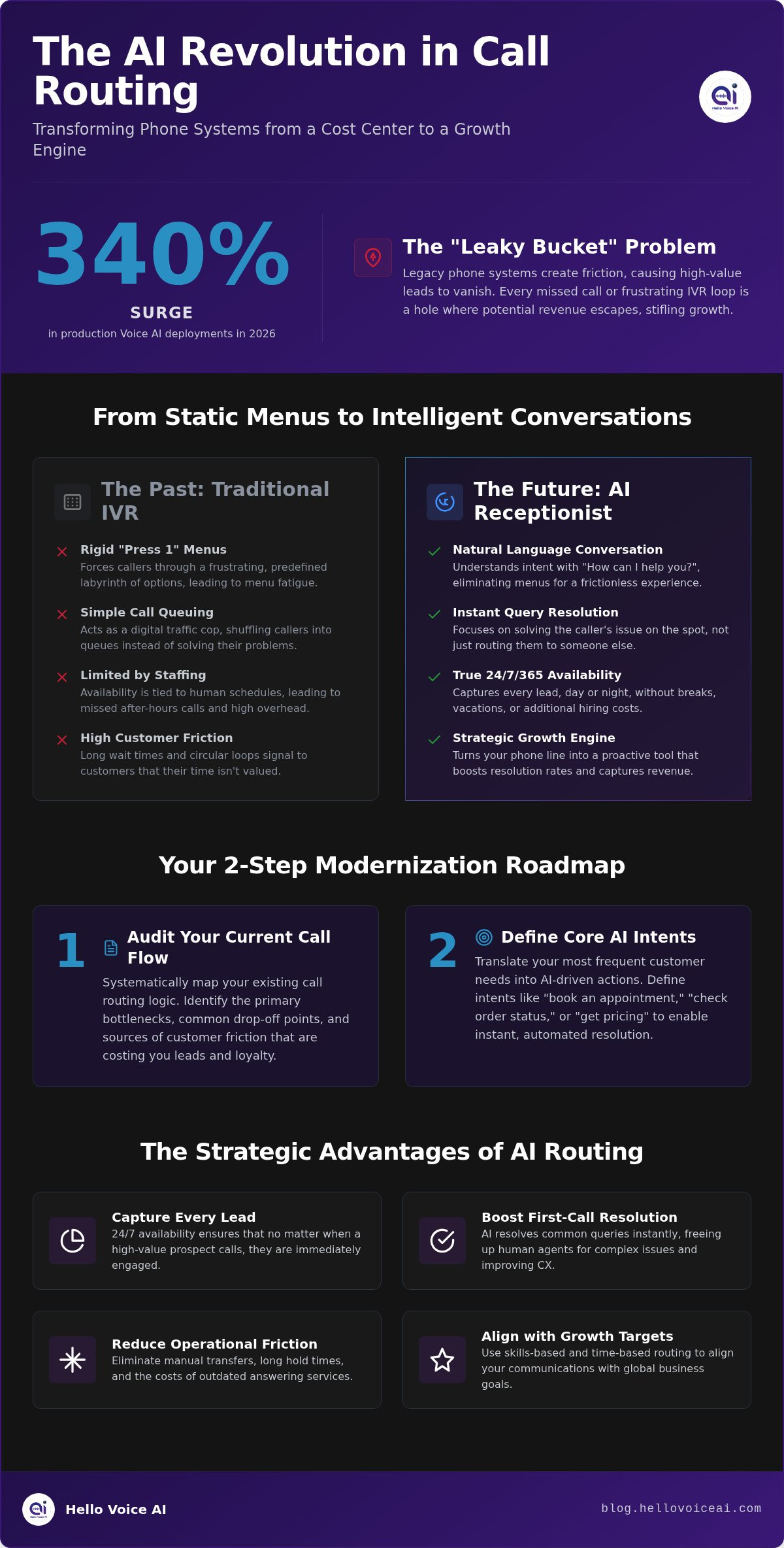
The journey of call management has been defined by a search for efficiency. In the early days, manual transfers required high human overhead and created significant delays. The rise of legacy IVR systems promised to solve this, yet they often delivered frustration, trapping customers in rigid, pre-defined menus. By 2026, we’ve moved beyond these limitations. The emergence of the conversational AI phone receptionist has shifted the focus from simple redirection to actual resolution. According to recent industry data, production voice AI deployments saw a 340% year-over-year growth in 2026, signaling a massive move toward systems that understand nuance rather than just button presses.
Why Static Routing Rules are Failing Your Customers
Static rules were built for a slower world. In today’s high-speed market, “fixed-order” routing creates operational friction that modern consumers won’t tolerate. When a business relies on rigid logic, it ignores the fluid nature of customer needs. This failure has clear consequences:
- Erosion of Lifetime Value: Long wait times correlate directly to a decline in customer loyalty.
- The Instant Gratification Gap: In an era where information is available in seconds, being “on hold” feels like an eternity.
- Missed Opportunities: If a prospect can’t reach a human or an intelligent agent immediately, they’ll simply call the next name on their search list.
The psychological impact of being stuck in a routing loop is profound. It signals to the caller that their time isn’t valued. When you replace these failing structures with an intelligent automated call routing system, you stop the leak. You move from a defensive posture, trying to manage a “necessary evil,” to a proactive strategy where every call is an opportunity for engagement and growth.
AI Phone Receptionist vs. Traditional IVR: A 2026 Comparison
Traditional IVR systems are essentially digital traffic cops. They rely on Automatic Call Distribution (ACD) to shuffle callers into queues based on rigid, pre-set rules. An automated call routing system powered by Natural Language Processing (NLP) operates on a different logic entirely. Instead of simply moving a caller from point A to point B, modern AI agents focus on closing the “Resolution Gap.” While an IVR merely routes to a person, AI identifies the underlying intent and can often resolve the query on the spot. This shift transforms your phone line from a waiting room into a high-speed service desk that functions with calm, logical confidence.
The 24/7 advantage of AI cannot be overstated. Traditional models require complex shift rotations and high overhead to maintain after-hours coverage. AI doesn’t sleep, doesn’t require breaks, and maintains a consistent brand voice regardless of the time of day. For a detailed breakdown of the tools leading this change, consult our Best AI Receptionist Services 2026: Buyer’s Guide. By removing the friction of human scheduling, you ensure that high-stakes leads are captured the moment they call, rather than being left to a voicemail that may never be checked.
Natural Language Understanding: The End of ‘Press 1’
The era of “Press 1 for Sales” is ending. AI identifies caller intent through conversational context, allowing for open-ended greetings like “How can I help you today?” This approach eliminates menu fatigue, a common pain point that leads to high abandonment rates. When callers can speak naturally, first-call resolution rates climb because the system accurately matches the inquiry to the solution without forcing the user through a labyrinth of irrelevant options. It’s a sophisticated, modern path forward that respects the caller’s time and intelligence. To explore how this logic can be applied across your entire contact center, learn more about GraiaCX.
Human scaling is fundamentally inefficient in a high-speed market. Traditional call centers face perpetual turnover and high training overhead, which act as a silent tax on your growth. In contrast, implementing an automated call routing system allows for infinite scalability, handling 100 simultaneous calls without increasing your physical footprint. Research from August 2026 indicates that while human agents cost between $5 and $15 per interaction, AI agents handle routine tasks for just $0.10 to $0.50 per call. Given these metrics, the ROI of AI-driven automation is a solvable logical puzzle for any firm focused on financial health. If you’re still weighing the true operational differences between passive message-taking services and intelligent automated management, the virtual receptionist vs answering service comparison offers a clear breakdown of which model best protects your revenue. Integrating a Virtual Receptionist Service allows you to reallocate your human capital toward high-value, complex interactions that require deep empathy while the AI handles the bulk of the volume.
Selecting Your Routing Strategy: Frameworks for Growth
Choosing a routing strategy is a high-stakes decision. It determines how effectively you deploy your most expensive resource: human time. A well-configured automated call routing system doesn’t just shuffle calls. It prioritizes them based on business logic and financial impact. For instance, priority routing ensures that your highest-value clients bypass queues entirely, while skills-based routing matches complex technical queries to specific specialists. In a global market, time-based routing allows you to manage “follow-the-sun” support, ensuring that a caller in London gets a response just as quickly as one in New York. This isn’t just about convenience; it’s about maintaining competitive positioning in a world that never sleeps, often supported by the strategic growth initiatives of Big Voice – Digital Marketing Agency.
The most significant shift in 2026 is the move toward AI-First triage. Industry benchmarks show that AI agents can handle between 60% and 85% of routine contact volume autonomously. To capitalize on this, Engineer Up specializes in building custom AI agents that drive business efficiency and handle complex interactions. This model identifies which inquiries, such as appointment scheduling or FAQ resolution, can be fully automated at the point of entry. By resolving these tasks instantly, you reserve your human team for high-emotion escalations that require deep empathy. The success of this model relies on the handoff. If the AI detects frustration or a query it can’t resolve, it must provide a seamless transition to a human agent, carrying over the full context of the conversation so the customer doesn’t have to repeat themselves.
Data-Driven Routing: Using Analytics to Refine Rules
Refining your routing rules requires a methodical approach to data. You shouldn’t guess where your friction points are; you should measure them. Tracking call drop-off points allows you to see exactly where callers lose patience with your logic. Modern systems use real-time sentiment analysis to identify frustrated callers, automatically escalating those interactions to senior agents before the relationship is damaged. This level of insight is only possible when you integrate your telephony with sophisticated business call management software. Holistic data allows you to move from reactive fixes to a proactive, future-ready strategy that scales alongside your revenue. When you treat every call as a data point, your automated call routing system becomes a tool for continuous operational improvement.
Implementation Guide: Modernizing Your Call Infrastructure
Modernizing your infrastructure is a methodical process. It requires moving away from static, visual dial plans toward a dynamic, data-driven framework. First, you must audit your current flow. Identify every instance where a caller hits a dead end or an unmonitored voicemail. These are systemic leaks. Next, define your core AI intents. Whether it’s booking a consultation or qualifying a sales lead, your automated call routing system needs a clear objective for every interaction. Once these goals are set, integrate the system with your CRM. This allows for personalized routing based on existing customer data. Finally, use real-world transcripts to iterate. Testing isn’t a one-time event; it’s a cycle of continuous refinement that ensures your system remains future-ready. To ensure your underlying network is up to the task, check out Bunnji for managed IT and telecommunications services.
A siloed phone system is a liability. To achieve a 360-degree customer view, your routing must connect directly to Salesforce or HubSpot. This unified data approach ensures that when a client calls, the AI already knows their history and value. When evaluating virtual receptionist alternatives, prioritize those with robust API capabilities. A seamless connection allows for instant lead logging and automated follow-ups, reducing the manual labor usually required to keep a CRM updated. This integration transforms your telephony from a simple communication tool into an active participant in your sales funnel.
Training Your AI Voice Receptionist for Brand Consistency
Your AI is a strategic hire. It must reflect your brand’s specific tone, whether that’s professional urgency or calm empathy. Start by building a comprehensive knowledge base from your existing FAQs and support documentation. This acts as the AI’s brain, allowing it to resolve queries without human intervention. In 2026, a distinct voice personality is the invisible thread that connects your digital presence to your human reputation. By training your AI to speak with logical confidence, you reinforce your position as a reliable, forward-thinking partner. This consistency ensures that every caller receives the same high level of service, regardless of when they call.
Ready to stop the leaks and capture every opportunity? Modernize your call infrastructure with a sophisticated AI Voice Receptionist today.
Hello Voice AI: The Future of Automated Reception
A midnight call is a test of your infrastructure. For most firms, it’s a silent failure. Hello Voice AI transforms this vulnerability into a strategic advantage by positioning itself as the definitive 24/7 solution for modern commerce. If a prospect reaches out at 2 AM, they expect a path forward, not a digital dead end. An automated call routing system that merely records a message is a relic of a slower era. Hello Voice AI provides an “Instant Response” guarantee, ensuring that lead leakage becomes a historical footnote rather than a daily operational reality. Transitioning is a matter of logic, not months of development. You can transform a standard business line into a sophisticated AI hub in minutes, capturing revenue at the point of entry. For those focused on the big picture of business success, our strategic guide to AI voice receptionists offers the definitive roadmap for long-term planning.
24/7 Availability Without the Overtime
Your team needs sleep. Your business doesn’t. Hello Voice AI captures midnight leads with the same professional urgency as a midday inquiry. It doesn’t just route calls; it acts on them. By scheduling appointments directly into your calendar, the system eliminates the back-and-forth friction that often kills a deal before it begins. This level of automation significantly reduces the mental load on your front-desk staff. They’re no longer buried in routine administrative triage or the frustration of legacy IVR loops. Instead, they’re free to focus on high-stakes interactions that require human empathy, while the AI handles the bulk of the volume with calm, logical confidence.
Scaling Efficiency: From 1 to 1,000 Employees
Growth brings complexity. A system that works for a solo practitioner often breaks when scaled to a thousand employees. Hello Voice AI is built for this evolution, growing alongside your business complexity without the need for additional human overhead. It leverages a global AI infrastructure to ensure security and reliability, regardless of call volume or organizational depth. This is a future-ready persona that encourages a more proactive and technologically integrated mindset. It’s a strategic hire that never sleeps and never misses a detail. Ready to stop losing leads? Discover Hello Voice AI Today.
Future-Proof Your Business with Intelligent Routing
Legacy telephony is a silent leak in your revenue pipeline. By now, the logic is clear. If your business relies on static menus, you’re losing leads to more agile competitors. Modernizing your automated call routing system isn’t just a technical upgrade; it’s a strategic move to ensure your firm never misses a high-stakes opportunity. We’ve explored how shifting from rigid IVR to conversational AI provides 24/7 instant lead capture and automated appointment scheduling. These aren’t just features. They’re the building blocks of a future-ready enterprise that values speed and financial health.
The transition from a cost-center to a profit-center is a solvable puzzle. By integrating intelligent triage and data-driven insights, you position your firm as a methodical efficiency expert in a crowded market. It’s time to stop the friction and start the growth. Secure your revenue with Hello Voice AI’s 24/7 receptionist and ensure every caller receives the instant response they deserve. Your growth engine is waiting.
Frequently Asked Questions
What is an automated call routing system and how does it differ from IVR?
An automated call routing system is a sophisticated digital layer that identifies caller intent to direct inquiries to the correct destination. While traditional IVR relies on rigid “Press 1” menus and Automatic Call Distribution, modern AI-driven systems use Natural Language Processing to understand spoken words. This shift allows your business to move from static redirection to active query resolution. It’s the difference between a gatekeeper and a strategic partner that understands every incoming lead.
Can AI routing actually schedule appointments without human intervention?
Yes, modern AI receptionists integrate directly with your existing calendar software to book consultations or service calls in real time. When a caller expresses a desire to meet, the system checks your live availability and secures the time slot immediately. This automation eliminates the administrative friction of back-and-forth emails. It ensures that high-value prospects are committed to your pipeline before they have a chance to call a competitor or lose interest.
Is an automated call routing system difficult to set up for a small business?
Setting up a sophisticated automated call routing system is surprisingly straightforward. Most modern SaaS solutions allow you to transform your business phone line in under thirty minutes without specialized technical knowledge. You simply define your core intents, upload your FAQ data, and connect your calendar. This ease of implementation ensures that even small firms can adopt a “future-ready” posture, capturing every lead with the same logical confidence as an enterprise-level corporation.
How does AI call routing improve customer satisfaction metrics?
AI routing eliminates the “on hold” experience that typically erodes customer lifetime value. By providing an instant response 24/7, you respect the caller’s time and desire for immediate gratification. Systems that use natural language understanding resolve routine queries on the first call, which directly correlates to higher satisfaction scores. When customers feel heard and their problems are solved without a circular menu loop, their trust in your brand’s professional urgency increases significantly.
Can I use my existing business phone number with an AI receptionist?
You don’t need to change your established identity to modernize your infrastructure. Most businesses simply forward their existing number to the AI platform, which then handles the routing and response logic. This seamless transition ensures there is no disruption to your marketing materials or saved contact information. It’s a methodical way to upgrade your front-desk capabilities while maintaining the brand consistency your long-term clients have come to expect and trust.
What happens if the AI routing system cannot answer a caller’s question?
The system is designed with a “fallback” logic for complex or high-emotion scenarios. If the AI identifies a query outside its knowledge base, it triggers a seamless handoff to your human team. This transfer includes a full transcript of the conversation, so the agent has complete context before they even say hello. This ensures the customer doesn’t have to repeat themselves, maintaining a sophisticated and empathetic experience throughout the entire interaction.
How much does a professional automated call routing system cost in 2026?
The cost of a professional system is typically structured as a recurring SaaS subscription, which is significantly more efficient than legacy human overhead. By automating routine tasks, you eliminate the need for shift rotations and the hidden costs of staff turnover. Instead of paying per minute or per agent, you invest in a scalable infrastructure that grows with your call volume. This shift from a variable cost center to a predictable investment is a logical move for financial health. Before committing to a solution, understanding the full virtual receptionist vs answering service cost and capability comparison can help you make the most financially sound decision for your firm.
Will my customers know they are talking to an AI during the routing process?
Modern voice synthesis is incredibly natural, but transparency is a strategic choice for your brand. In 2026, many firms opt for a “human-in-the-loop” feel where the AI identifies itself as a digital assistant. This sets clear expectations while still delivering a high-quality, empathetic experience. The focus isn’t on deception; it’s on providing a calm, logical confidence that solves the caller’s problem faster than any legacy system or overwhelmed human receptionist ever could.