
A missed call isn’t just a notification. It’s a silent withdrawal from your company’s growth account. If a potential client reaches your voicemail after hours or during a morning rush, they rarely leave a message. Instead, they call your competitor. You’ve likely felt the sting of this operational friction, knowing that the high cost of traditional answering services often outweighs the leads they actually save.
Identifying the best ai receptionist for your specific workflow is no longer a luxury; it’s a strategic move to eliminate the “friction of silence” in your sales funnel. You need a solution that offers 24/7 coverage and instant appointment booking without the complexity of a human-managed desk. This 2026 buyer’s guide reveals the top-rated AI voice tools that capture every lead with human-like precision and significantly reduce overhead. We’ll analyze how these automated systems handle routing and scheduling to ensure your front desk becomes a consistent engine for revenue retention rather than a source of missed opportunities.
Key Takeaways
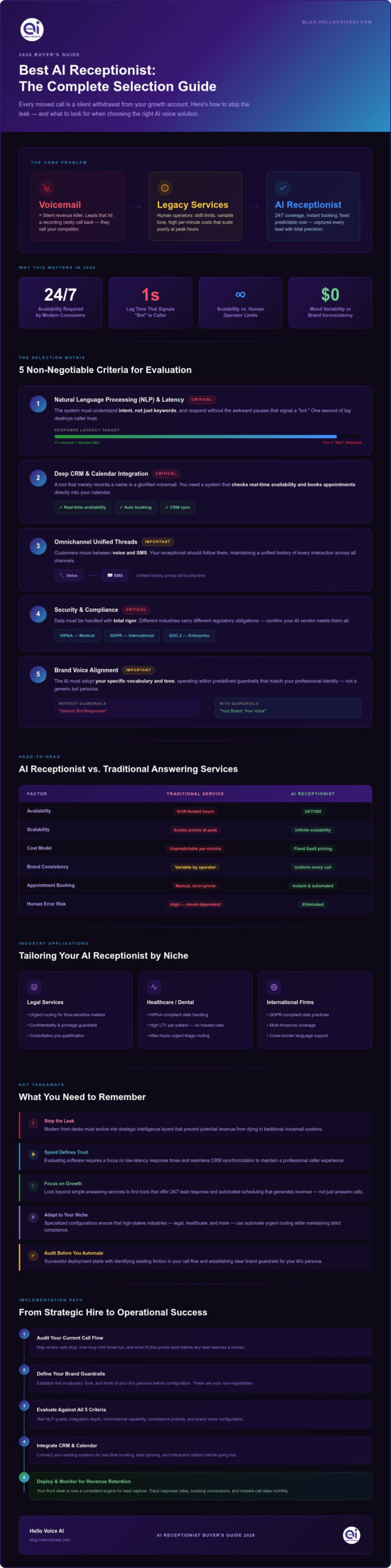
- Stop the leak. Modern front desks must evolve into strategic intelligence layers that prevent potential revenue from dying in traditional voicemail systems.
- Speed defines trust. Evaluating software requires a focus on low-latency response times and seamless CRM synchronization to maintain a professional caller experience.
- Focus on growth. Choosing the best ai receptionist involves looking beyond simple answering services to find tools that offer 24/7 lead response and automated scheduling.
- Adapt to your niche. Specialized configurations ensure that high-stakes industries, such as legal and healthcare, can automate urgent routing while maintaining strict compliance.
- Audit before you automate. Successful deployment starts with identifying existing friction in your call flow and establishing clear brand guardrails for your AI’s persona.
The Evolution of the Front Desk: Why AI Receptionists Are Now Non-Negotiable
The front desk has shifted. It is no longer a physical station defined by a telephone and a ledger. In the current market, the entry point of your business has evolved into a strategic layer of business intelligence. This transition marks the end of the traditional IVR era, where callers were trapped in “press 1 for sales” loops. Modern systems utilize Natural Language Understanding (NLU) to engage in fluid, human-like dialogue, transforming the first touchpoint from a barrier into a conversion tool.
Voicemail is the silent revenue killer. In high-stakes industries, a lead that reaches a recording is a lead that is effectively dead. If a potential client can’t reach a person or an intelligent surrogate immediately, they simply move to the next search result. This isn’t just a missed call; it’s a permanent loss of lifetime value. Solving this is a logical puzzle with a clear, tech-forward answer: automation that captures every lead with total precision. For businesses looking to implement these systems, Memphis Web Solutions specializes in AI-driven business automation and lead desks that manage customer interactions 24/7.
The High Stakes of Modern Commerce
Consumer expectations in 2026 are unforgiving. Speed is the primary currency of trust. In sectors like legal or dental services, where the lifetime value of a single client is significant, the cost of a single missed call is staggering. Maintaining operational continuity requires 24/7 availability. By deploying the best ai receptionist, companies ensure that every inquiry is met with a precise, immediate response, regardless of the hour. This isn’t just about answering the phone; it’s about capturing intent the moment it’s expressed before it has a chance to cool. For businesses looking to capitalize on this intent immediately, Lead Lock Tek offers automated tools designed to keep your schedule full and your office operating smoothly around the clock.
AI vs. Traditional Answering Services
Relying on legacy answering services often introduces more friction than it resolves. Human operators are limited by shift changes, variable moods, and high per-minute costs that scale poorly during peak hours. Conversely, a SaaS-based AI Voice Receptionist offers infinite scalability. It eliminates the risk of human error or inconsistent tone, providing a uniform brand experience for every caller.
The logic becomes undeniable when you analyze the virtual receptionist ROI. You trade unpredictable overhead for a fixed, performance-driven model that never sleeps and never misses a detail. Finding the best ai receptionist means moving away from manual, error-prone processes toward a streamlined future-state where your front desk operates with methodical efficiency. This shift isn’t just an upgrade; it’s a necessary evolution for any business focused on growth and lead retention.
The Selection Matrix: 5 Core Criteria for Evaluating AI Receptionist Software
Selecting the right technology is a high-stakes decision. It isn’t just about software; it’s about delegating your brand’s first impression to an automated system. To identify the best ai receptionist, you must evaluate solutions through a lens of performance rather than just a checklist of features. A system that fails to integrate or responds with a robotic lag doesn’t just miss a lead; it actively damages your reputation. You need a partner that understands the nuances of your industry and the specific friction points of your current call flow. Before committing to any platform, it’s worth reviewing a comprehensive framework for evaluating virtual receptionist alternatives to ensure you’re making the most informed decision possible.
When auditing potential solutions, focus on these five non-negotiable pillars:
- Natural Language Processing (NLP) and Latency: The system must understand intent, not just keywords, and respond without the awkward pauses that signal a “bot.”
- Deep CRM and Calendar Integration: A tool that merely records a name is a glorified voicemail. You need a system that checks real-time availability and books appointments directly into your schedule.
- Omnichannel Unified Threads: Your customers move between voice and SMS. Your receptionist should follow them, maintaining a unified history of every interaction.
- Security Compliance: Whether it’s HIPAA for medical practices or GDPR for international firms, data must be handled with total rigor.
- Brand Voice Alignment: The AI must adopt your specific vocabulary and tone, operating within predefined guardrails that match your professional identity.
Latency and the “Uncanny Valley”
One second. That is all it takes for a caller to realize they are talking to a bot and disengage. Conversational Latency is the time between a caller finishing a sentence and the AI responding. Near-zero latency is the holy grail of the best ai receptionist because it preserves the natural rhythm of human speech. By incorporating human-like pauses and “verbal nods” like “I see” or “understood,” the system moves past the robotic uncanny valley and builds genuine rapport. If you’re ready to secure your leads, exploring a virtual receptionist service is the logical next step.
Calculating the Strategic ROI
Stop viewing your front desk as a cost center. It’s a leak. If you want to understand the impact of automated service, use this simple formula: (Missed Calls x Conversion Rate x LTV) = Monthly Revenue Leak. If you miss ten calls a month with a 20% conversion rate and a $5,000 lifetime value, you are losing $10,000 every single month. A virtual receptionist doesn’t just “answer the phone”; it recovers that capital. Learning how to stop missing business calls is the fastest way to improve your bottom line without increasing your marketing spend.
The Best AI Receptionist Solutions of 2026: A Comparative Analysis
Context is everything. A tool that excels for a solo consultant will likely buckle under the complexity of a mid-market law firm. Finding the best ai receptionist is not a search for the most features, but a search for the most logical fit for your specific operational leaks. You need a partner that doesn’t just answer the phone, but understands the high stakes of your specific business cycle.
Market options in 2026 offer a broad spectrum of technical maturity. Large-scale enterprise platforms provide massive integrated ecosystems for corporate environments where voice is just one part of a broader communication stack. Specialized platforms like CloudTalk serve as the global standard, specifically engineered for businesses requiring robust multilingual support across international borders. For smaller operations, minimalist entry points provide basic automation without the overhead of enterprise-grade logic, though they often lack the deep integration required for complex scheduling. If your current system relies on expensive human staff or inconsistent message quality, exploring virtual receptionist alternatives is a critical step toward eliminating revenue leakage.
Hello Voice AI: The Strategic Partner for Revenue Retention
Hello Voice AI positions itself as the strategic hire that never sleeps. It operates with a sense of enlightened concern, treating every missed call as a critical systemic leak that needs an immediate, modern fix. By focusing on 24/7 availability and instant lead response, it ensures that high-value opportunities aren’t lost to the silence of a voicemail box. The routing logic and appointment scheduling are handled with methodical precision, making it the definitive choice for growing companies that prioritize revenue retention over simple message taking. It acts as a methodical efficiency expert, ensuring your front desk is a proactive engine for growth.
Smith.ai vs. CloudTalk: Which Path to Take?
Choosing between these two often comes down to your need for high-touch versus high-speed interaction. Smith.ai provides a hybrid solution, utilizing AI for initial intake but maintaining human backup for complex scenarios. This makes it a comfortable transition for businesses moving away from traditional manual staffing that aren’t yet ready for full automation. CloudTalk, by contrast, is built for scale within a multilingual framework. It’s about high-speed automation for global teams. If your priority is a dedicated best ai receptionist that integrates with your current CRM and calendar to stop leads from dying, an ai voice receptionist is the superior path. You can explore how this technology creates a 24/7 front desk in our strategic guide to AI voice receptionists, which details the transition from manual friction to automated success.
Industry-Specific Guidance: Tailoring Your AI Receptionist to Your Niche
A burst pipe at 2 AM doesn’t wait for business hours. In sectors like home services, the first company to answer the phone wins the contract. For HVAC and plumbing professionals, the best ai receptionist is one that captures emergency leads in real-time, preventing them from bouncing to a competitor. Legal firms face a similar urgency. High-stakes intake requires immediate routing based on case type, ensuring that a potential client feels heard and processed the moment they dial. One missed call is one lost case. By automating these initial touchpoints, you eliminate the friction of waiting and the risk of lead abandonment.
SaaS and technology companies require a different level of precision. These businesses often deal with global support tiers where technical routing is essential to maintain customer satisfaction. Instead of letting a technical query sit in a sales inbox, an intelligent voice system identifies the caller’s intent and routes them to the appropriate department. This methodical approach ensures that your team focuses on high-value tasks while the AI manages the heavy lifting of initial classification. It’s about moving from a reactive state to a proactive, automated future-state. Many of the assumptions businesses hold about these tools are addressed in this breakdown of common myths about business call management software that may be holding your growth hostage in 2026.
The Dental Practice Blueprint
Dental offices often struggle with a heavy volume of routine inquiries that distract from clinical care. Integrating an AI Voice Receptionist with your practice management software allows for real-time appointment booking without human intervention. This offloads routine scheduling from your front desk, significantly reducing staff burnout and operational overhead. The system maintains a tone of professional empathy, ensuring that patients in pain receive a calm, logical response while their data is handled with total HIPAA rigor. It’s a strategic hire that scales with your patient load without the need for additional training or office space. For a deeper look at how AI is transforming dental practice call management, the leading solutions of 2026 reveal just how much revenue is recoverable through intelligent automation.
Global SaaS Continuity
Software companies operate in a world without time zones. Hiring 24/7 human staff for every global market is rarely cost-effective and often leads to inconsistent service quality. Instead, tech firms use AI to manage support tiers and technical routing across international borders. The system acts as a filter, separating basic Tier 1 inquiries from high-value sales leads. This ensures that your brand voice remains consistent from London to Tokyo, regardless of the hour. If you want to see how this logic applies to your business, you can start by learning how to stop missing business calls today. This simple transition can recover thousands in lost monthly revenue by ensuring every global inquiry is captured with human-like precision.
Implementing Your AI Receptionist: From Strategic Hire to Operational Success
Implementation is where strategy meets reality. It isn’t enough to simply subscribe to a service; you must integrate it into the very fabric of your operations. Deploying the best ai receptionist requires a methodical approach that treats the software as a high-level hire. This means defining its boundaries, mapping its intelligence, and ensuring it has the tools to bridge the gap between a ringing phone and a closed deal. Without a clear framework, even the most sophisticated technology becomes just another layer of friction.
Step 1: The Call Flow Audit
Start by identifying the leaks. You can’t fix what you haven’t measured. Analyze your call logs to pinpoint peak times when your team is most overwhelmed and identify the common reasons for missed connections. This audit reveals which interactions are ripe for automation and which still require the nuanced touch of your core team. Understanding these patterns helps you justify the virtual receptionist cost for small business, as you’ll see exactly where revenue is currently slipping through the cracks. If a significant portion of your daily volume consists of simple scheduling requests, that’s a massive amount of staff time that can be recovered through automation.
Step 2: Scripting for Success
Effective communication is built on clarity. When you define your AI’s persona, you are setting the guardrails for every customer interaction. This involves choosing a vocabulary that matches your brand’s tone and establishing clear escalation paths for complex inquiries. The most successful AI receptionist scripts are those that prioritize the caller’s intent over the business’s internal jargon. Beyond the initial greeting, you must map out post-call actions. Whether it’s an immediate SMS follow-up or a real-time CRM update, these automated workflows ensure that no lead is left cold. Before finalizing your configuration, it’s worth understanding how modern business call management software has evolved far beyond basic routing tools into autonomous intelligence systems that can handle complex caller scenarios.
Testing is the final, ongoing phase of operational success. You don’t just set it and forget it. Use call transcripts to identify where callers might hesitate or where the AI’s logic could be sharper. By reviewing these interactions, you can iterate on the routing and response patterns to ensure the best ai receptionist performance possible. This commitment to refinement transforms a basic answering tool into a sophisticated engine for growth. It’s a transition from manual, error-prone intake to a future-ready state of total lead retention.
Eliminate the Friction of Silence
The modern front desk is no longer a physical location. It’s a digital gateway that either captures growth or leaks revenue. Choosing the best ai receptionist is the logical move to resolve the silent revenue killer of missed calls. We’ve analyzed how zero-latency response and deep CRM integration transform a simple answering tool into a strategic intelligence layer. By automating these touchpoints, you move from a reactive state of catching up to a proactive state of total lead retention.
You’ve identified the leaks in your current call flow. Now, it’s time to plug them with a system that offers 24/7 instant lead response and seamless calendar synchronization. Transitioning to an automated future-state doesn’t just reduce overhead; it ensures your business never sleeps. It’s a methodical upgrade that pays dividends in both operational efficiency and customer trust. Secure your revenue and stop missing calls with Hello Voice AI today. Your growth is too important to leave to the uncertainty of a voicemail box. Embrace the precision of a future-ready front desk.
Frequently Asked Questions
What is the best AI receptionist for a small business in 2026?
Hello Voice AI is the best ai receptionist for small businesses focusing on ROI and lead retention. It provides 24/7 coverage without the high overhead of traditional answering services. Small businesses need a tool that handles both routing and scheduling to prevent revenue from dying in voicemail. Hello Voice AI acts as a strategic hire that never sleeps, ensuring every inquiry is met with human-like precision and methodical efficiency.
Does an AI receptionist sound like a real person?
Modern AI receptionists utilize advanced Natural Language Understanding to mimic human speech patterns with high accuracy. By incorporating near-zero latency and natural verbal nods, these systems move past the robotic “uncanny valley” to build rapport. While they are automated, the interaction feels fluid and professional. This ensures that your brand’s first impression remains high-quality and empathetic, which is critical for maintaining caller trust during that first contact.
How much does an AI virtual receptionist cost compared to a human?
AI solutions typically operate on a SaaS subscription model, providing a fixed and predictable cost structure for your business. This contrasts sharply with the variable and often high per-minute rates of human-operated answering services. By switching to an automated system, you eliminate the expenses related to employee benefits, training, and physical office space. It’s a methodical way to reduce overhead while simultaneously increasing your call capacity to 24/7 availability.
Can an AI receptionist book appointments directly in my calendar?
Yes, the best ai receptionist tools integrate directly with popular calendar systems like Google, Outlook, or industry-specific practice management software. When a caller expresses intent to book, the AI checks real-time availability and secures the slot immediately. This eliminates the back-and-forth of traditional message taking. It transforms your phone line into a proactive booking engine that works even when your physical office is closed for the day.
Is an AI receptionist HIPAA compliant for medical or dental offices?
Leading AI voice receptionists are engineered with strict security protocols to meet HIPAA and GDPR requirements. These systems ensure that patient data and protected health information are encrypted and handled with total rigor. For dental or medical practices, this means you can automate appointment bookings and initial intake without compromising any regulatory compliance. It’s a secure way to offload routine administrative tasks from your busy clinical staff.
How long does it take to set up an AI phone system?
Most systems can be deployed within a few business days, depending on the complexity of your routing logic. The process involves auditing your current call flow, defining your AI’s persona, and mapping the escalation paths. Once you’ve scripted your conversational prompts and integrated your CRM, the system is ready to go live. It’s a streamlined transition that provides immediate relief and a professional edge to your front desk.
What happens if the AI receptionist cannot answer a complex question?
If the system encounters a query beyond its predefined guardrails, it follows a logical escalation path. This typically involves routing the call to a specific human team member or capturing a detailed message for a follow-up. You can configure these “fallback” actions to ensure the caller never feels ignored. By reviewing call transcripts, you can continuously refine the AI’s knowledge base to handle similar complex questions in the future.
Can I use my existing business phone number with an AI receptionist?
You can maintain your current business identity by simply forwarding your existing number to the AI service. Most providers offer a seamless porting or forwarding process that doesn’t require you to change your marketing materials. This ensures total continuity for your established clients while allowing you to benefit from 24/7 automated coverage. It’s a simple technical adjustment that immediately upgrades your business’s accessibility and professional brand image.






3 Comments