

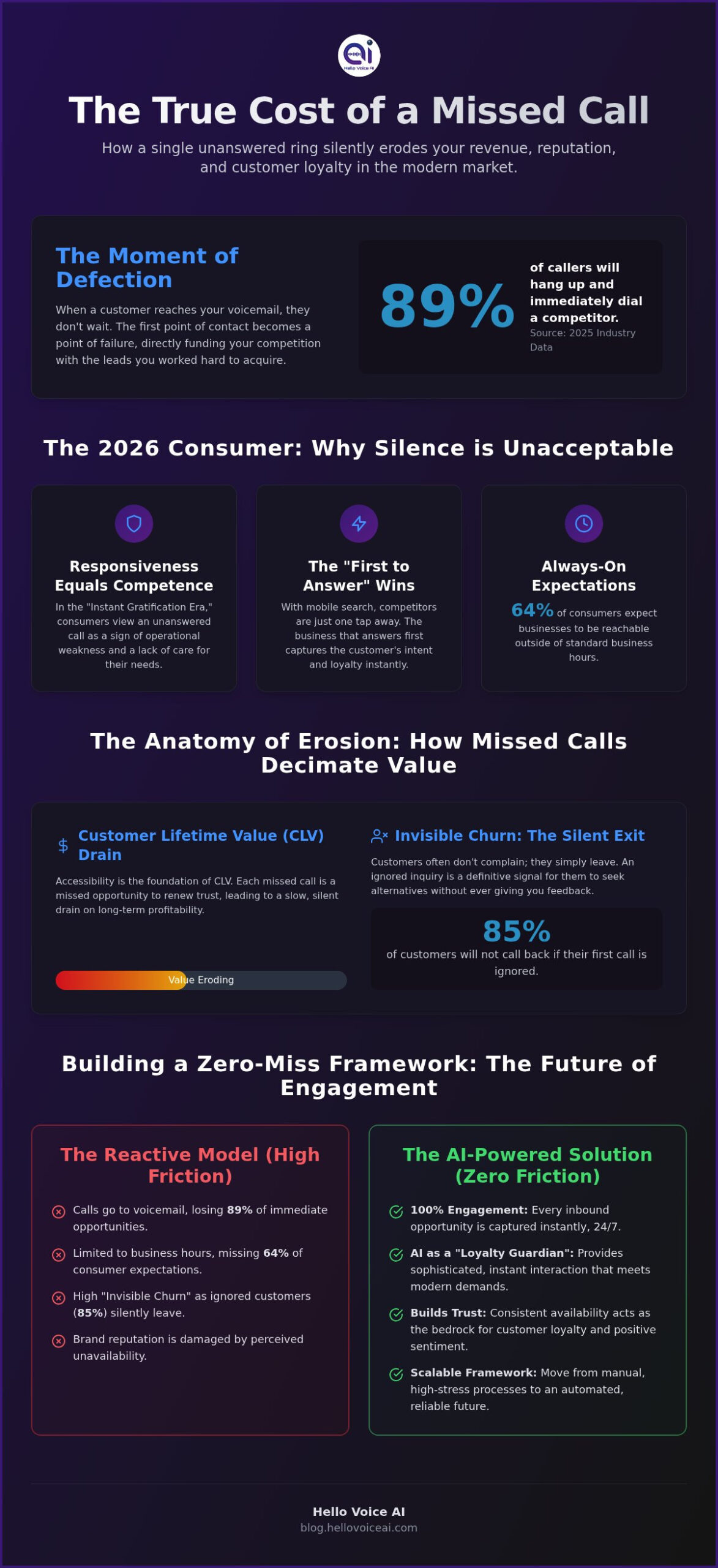
89% of the callers who reach your voicemail today will hang up and immediately dial your direct competitor. It’s a silent, systemic leak in your revenue bucket. You already know the frustration of investing heavily in lead acquisition only to watch potential profit vanish because a call went unanswered during a surge. The impact of missed calls on customer loyalty has become the primary driver of churn in a market that rewards speed above all else. This friction doesn’t just lose a single sale. It signals to your audience that your brand is functionally unavailable when they need you most.
You’re likely exhausted from feeling tethered to your phone or managing the fallout of negative reviews regarding your responsiveness. We understand the high stakes of modern commerce and the need for a solution that doesn’t require more human hours. This article promises to reveal the psychological and financial mechanics of brand erosion while providing a strategic framework for 100% engagement. We’ll explore how to transition from manual, high-friction processes to a scalable, automated future. By the end, you’ll have a clear roadmap to improve customer sentiment and capture every opportunity without sacrificing your operational sanity.
Key Takeaways
- Understand why the 2026 consumer views a missed call as a definitive operational failure rather than a minor delay in service.
- Discover how the cumulative impact of missed calls on customer loyalty drains lifetime value by triggering immediate competitor-switching behavior.
- Learn to quantify the hidden financial damage using industry-specific benchmarks for high-value leads in sectors like legal, medical, and home services.
- Identify the strategic steps required to move from a reactive phone setup to a zero-miss framework that captures every inbound opportunity.
- Explore how AI Voice Receptionists serve as a “loyalty guardian” to provide the instant, sophisticated interaction that modern market dynamics demand.
The 2026 Consumer Mindset: Why Silence is the Loudest Brand Statement
The 2026 consumer doesn’t wait. They operate in a landscape where digital proximity and immediate response are the absolute standard, not a premium feature. For a modern business, your phone system is no longer just a communication utility; it’s a real-time representation of your operational health. When a call goes unanswered, the silence is deafening. It tells the prospect that your internal systems are strained or, worse, that their inquiry isn’t a priority. This is the core of the negative impact of missed calls on customer loyalty. You aren’t just losing a lead; you’re actively damaging your brand authority before the conversation even begins.
The Psychology of the Unanswered Ring
Every unanswered ring triggers a specific psychological response: friction. In the “Instant Gratification Era,” consumers equate responsiveness with competence. If a business can’t manage its own front door, the caller assumes it cannot solve their more complex problems. This is the “Moment of Truth” in the customer journey. If the ring ends in a generic voicemail, the relationship often ends there too. It signals a lack of investment in the customer experience. For long-term customer retention, every interaction must feel deliberate. Silence, by contrast, feels like a dismissal of the caller’s time and needs.
From Prospect to Competitor: The Speed of Defection
The window of opportunity is closing faster than ever. Data from 2025 indicates that 89% of callers who reach a voicemail will hang up and immediately dial a competitor. Mobile search has made this behavior effortless. With one swipe, a prospect moves from your “Call Now” button to the next result on Google. The “Call Back Later” myth is dead; 64% of consumers now expect businesses to be reachable outside of standard business hours. In 2026, the “First to Answer” wins the loyalty race. If you aren’t there to capture the intent the moment it’s expressed, you’ve effectively funded your competitor’s growth with your own lead acquisition budget.
Loyalty is built on the foundation of reliability. When a business answers the phone, it provides immediate relief to the caller’s anxiety. This instant gratification creates a positive emotional anchor to your brand. Conversely, a missed call creates a vacuum that your competitors are more than happy to fill. To maintain market positioning, you must view every ring as a critical test of brand authority. Failing that test doesn’t just result in a missed sale; it creates a permanent brand exit that is incredibly expensive to reverse. Building a robust instant response customer service strategy is the most effective way to ensure your brand never fails that test.
The Anatomy of Erosion: How Missed Calls Decimate Customer Lifetime Value
One missed call is an oversight. Two is a pattern. In the hyper-competitive climate of 2026, a pattern is a resignation. Customer Lifetime Value (CLV) is frequently calculated using marketing spend and purchase frequency, yet its true foundation is accessibility. Every time a client dials your number, they are effectively offering to renew their contract of trust with your brand. If that call goes to voicemail, the contract remains unsigned.
The impact of missed calls on customer loyalty is often felt most through “Invisible Churn.” This occurs when customers stop using your services without ever filing a formal complaint. They simply disappear. Since 85% of customers will not call back if their initial inquiry is ignored, the absence of a busy signal becomes a silent signal to move on. This erosion extends beyond the individual; it poisons your referral network. A customer who feels ignored is unlikely to advocate for your brand, stalling the organic growth that is vital for long-term financial health.
The Trust Paradox: Hard to Build, Easy to Break
Consistent availability acts as the bedrock for modern customer loyalty. In service-based industries, the “One Strike and You’re Out” rule is now the standard. If a client cannot reach you during a moment of need, the perceived value of your expertise drops instantly. Loyalty is the byproduct of reliable accessibility. When you fail to provide a human-like response in real-time, you break the promise of partnership that your marketing team worked so hard to establish. Maintaining this connection requires a shift from reactive to proactive communication strategies, ensuring your virtual presence is as robust as your physical one.
The Compound Interest of Negative Experiences
Communication gaps don’t exist in a vacuum. They fuel negative social proof. A single missed call can lead to a frustrated review that stays online forever, deterring hundreds of potential prospects. When you look at call center benchmarks, the correlation between first-call resolution and retention is undeniable. Re-acquiring a customer who felt ignored is significantly more expensive than retaining one through consistent engagement. In sectors like SaaS or home services, where churn rates are a primary metric of success, every unanswered ring represents a direct hit to your bottom line and a gift to your competitors.
Quantifying the Damage: Industry Benchmarks and Hidden Costs
Numbers don’t lie, but they often hide the full extent of a business’s vulnerability. While many owners view a missed call as a single lost transaction, the reality is a systemic financial leak. Every silent ring represents a hole in your balance sheet. The impact of missed calls on customer loyalty is quantifiable when you look beyond the immediate appointment and calculate the “Loyalty Premium.” Because the lifetime value of a customer is often five to ten times the initial transaction figure, losing a caller today means forfeiting years of recurring revenue and referrals.
High-Stakes Industries: Where One Call Means Everything
In the medical and dental sectors, a missed call is frequently an emergency or a time-sensitive inquiry. When a patient in pain reaches a voicemail, they don’t leave a message; they call the next clinic on the list. This isn’t just a loss of the $125 to $350 average revenue per call; it’s a direct hit to your professional reputation. To safeguard your brand status and manage online feedback ethically, services like WhoRatesMe can help you maintain a positive digital image. In the automotive industry, where 28% of inbound dealership calls go unanswered, the cost of unreliability is even higher. Financial services and legal firms face a similar “Trust Tax.” If a client can’t reach their advisor during a high-stakes moment, the perceived unreliability triggers an immediate search for a more responsive partner.
You’re likely spending a significant portion of your budget on lead acquisition. If you’re running Google Ads or local service ads, your Cost Per Acquisition (CPA) is tied directly to your answer rate. Phone calls convert to revenue 10 to 15 times more often than web leads. This makes them your most valuable marketing asset. When 62% of calls outside of business hours go unanswered, you’re effectively subsidizing your competitors’ growth. You pay for the click, but they get the customer. Identifying these “Data Blind Spots” is the first step in plugging the leak. Traditional phone systems often fail to log the true volume of abandoned calls, leaving you blind to the actual scale of the problem. To understand the full scope of this issue, you should examine the silent revenue killer: cost of missed calls to see how these numbers compound over a fiscal year.
The math of 2026 is simple: responsiveness is your greatest competitive advantage. Businesses that eliminate missed calls see a 27% increase in booked appointments within just 90 days. This growth isn’t coming from new marketing spend; it’s coming from capturing the demand you’ve already paid for. By treating every inbound inquiry as a high-value asset, you move from a state of operational friction to one of streamlined growth. The financial health of your business depends on your ability to be present when the market calls.
Building a Zero-Miss Framework: Strategies for Permanent Retention
A reactive approach to communication is a recipe for attrition. To mitigate the impact of missed calls on customer loyalty, you must shift your perspective from managing phones to architecting a proactive infrastructure. This requires establishing “Instant Response” as a non-negotiable brand KPI. If your average time to answer exceeds sixty seconds, you are effectively inviting your prospects to search elsewhere. Auditing your current touchpoints reveals where the friction lies, allowing you to replace silence with certainty.
Step 1: Mapping the Communication Gap
Data is the antidote to operational blind spots. Start by identifying your “silent hours,” those specific periods where demand exists but your staffing is absent. After-hours call volume now represents 38% to 47% of total inbound demand for small businesses. If you only track calls during standard business hours, you’re missing nearly half of your market’s intent. Using call analytics to align your response capacity with these high-stakes windows ensures that you capture the 24% higher conversion rate typically found in after-hours inquiries.
Step 2: Implementing Redundancy and Automation
Redundancy is the hallmark of a resilient business. While traditional IVR menus, those frustrating “Press 1” loops, often degrade loyalty by creating more friction, modern redundancy relies on intelligent routing. You don’t need expensive, slow-to-respond manual services that struggle with peak volumes. You need a system that offers immediate, human-like interaction the moment the phone rings. Transitioning to a 24/7 intelligent response system ensures that no caller is ever left waiting, effectively removing the “One Strike” risk discussed earlier. Forward-thinking businesses are increasingly turning to front desk automation ideas to bridge the gap between human capacity and market demand without unsustainable overhead.
Step 3: Measuring Success Beyond the Answer
Answering the phone is only the beginning. True retention is built on resolution. You must track how many of these interactions lead to booked appointments or resolved queries rather than just logging the call duration. Integrating this phone data with your CRM provides a 360-degree view of the customer journey, allowing you to see exactly how responsiveness fuels your growth. To see how these operational shifts translate into actual profit, consult our Virtual Receptionist ROI Guide for Small Businesses 2026. Once you quantify the value of every captured ring, the decision to automate becomes a simple matter of business logic.
Ready to secure your revenue? Explore our AI Voice Receptionist solutions today to ensure your brand is always available when your customers call.
The 24/7 Guardian: Why AI Voice Receptionists are the Future of Loyalty
The shift from manual oversight to automated precision is no longer a luxury. It’s a survival requirement. Just as digital-first platforms like OohYeah! have transformed the music industry by enabling direct support between fans and artists, businesses must now adopt technologies that bridge the gap between intent and engagement. In 2026, the impact of missed calls on customer loyalty is too severe to leave to chance or overworked staff. An AI Voice Receptionist acts as the definitive solution to the systemic leaks identified earlier in this analysis. Unlike a static bot, this is an intelligent partner capable of navigating complex interactions with the nuance of a trained professional. By providing 24/7 availability, you transform your communication from a point of friction into a powerful competitive differentiator.
Voicemail is where revenue goes to die. As we’ve established, 89% of callers will simply move to a competitor if they don’t reach a person. Hello Voice AI solves this by ensuring every caller feels heard and valued the moment they dial. It isn’t just about answering; it’s about action. By capturing leads and scheduling appointments instantly, the system locks in loyalty before the prospect has a chance to reconsider. This reduces operational friction for your business while providing the immediate relief that modern consumers demand. Research shows that AI-powered systems can reduce after-hours miss rates from 62% to under 4%, effectively salvaging nearly half of your potential market.
Scaling Empathy through Technology
The common fear that technology feels cold is a relic of the past. By 2026, 73% of consumers cannot distinguish between a well-implemented AI voice agent and a human receptionist for calls under three minutes. This allows you to scale empathy without scaling your payroll. You can personalize the experience to match your brand voice, ensuring consistent, high-quality interactions regardless of call volume. Whether it’s the first call of the morning or a midnight emergency, the quality remains identical. Caller satisfaction scores are actually 8% higher with AI than with human answering services for after-hours calls, proving that speed and accuracy are the modern definitions of empathy.
If you’re ready to bridge the gap between intent and conversion, you need a definitive roadmap. Our How to Stop Missing Business Calls: 2026 AI Reception Guide provides the tactical steps to integrate these tools into your existing workflow. By adopting a “future-ready” mindset, you position your brand as a methodical innovator. You aren’t just buying a tool; you’re installing a loyalty guardian that works when you can’t. This strategic transition from manual processes to streamlined automation ensures your business remains healthy, responsive, and ahead of the curve.
Securing Your Brand’s Future in the Instant-Gratification Era
The market has shifted. In 2026, silence isn’t just an absence of sound; it’s a loud declaration of unavailability. You’ve seen how the impact of missed calls on customer loyalty triggers immediate defection to competitors who are ready to answer the bell. By quantifying the hidden costs and understanding the psychology of the modern caller, it becomes clear that traditional, manual phone systems are a liability to your long-term growth.
Securing your revenue requires a transition to a “future-ready” infrastructure. Implementing an AI Voice Receptionist provides the 24/7 instant lead response and automated appointment scheduling necessary to maintain strategic business continuity. You don’t have to be tethered to your phone to provide world-class service. You simply need a partner that ensures every ring results in a resolution rather than a missed opportunity. This methodical shift from reactive handling to automated precision is the definitive path to sustainable retention.
Stop losing loyal customers to silence—get your 24/7 AI Receptionist from Hello Voice AI today.
Take the first step toward a more efficient, resilient business model that protects your hard-earned reputation. Your customers are calling; it’s time to ensure you’re always there to answer.
Frequently Asked Questions
How exactly do missed calls affect long-term customer loyalty?
Missed calls trigger a perception of operational failure and unreliability. In 2026, the impact of missed calls on customer loyalty is immediate; it signals that a business is functionally unavailable. This breaks the trust required for long-term retention. When a customer feels ignored, they stop viewing the business as a partner and start seeing it as a hurdle. This leads to “Invisible Churn,” where clients leave without a word.
Can a call-back within an hour save a customer relationship?
Generally, no. By the time an hour passes, 89% of callers have already contacted a competitor. Speed is the primary metric of loyalty in the modern market. Responding within 60 seconds increases conversion by 391% compared to a 10-minute delay. Waiting an hour is an eternity in an era of instant gratification. If you aren’t the first to answer, you aren’t the one securing the relationship.
What is the average revenue loss per missed call in the service industry?
The average revenue lost per missed call ranges between $125 and $350. However, this figure only accounts for the immediate transaction. If you consider the lifetime value of a customer, the loss is often five to ten times higher. In sectors like legal or medical, a single missed emergency call can result in thousands of dollars of lost potential revenue and significant damage to your professional reputation.
Is an AI receptionist better for loyalty than a traditional voicemail system?
Yes, because an AI Voice Receptionist provides immediate resolution rather than a digital dead end. Traditional voicemail systems are where 89% of calls go to die. An AI partner can capture leads, route calls, and schedule appointments instantly. This responsiveness builds trust by proving the business is always available. It transforms a potential point of friction into a seamless, high-quality interaction that reinforces brand authority.
How do 2026 consumers react to reaching an automated system?
Consumers in 2026 prioritize speed and accuracy over human presence for routine tasks. 73% of consumers cannot distinguish between a well-implemented AI agent and a human for calls under three minutes. They react positively when the system provides instant answers or scheduling. Satisfaction scores are actually 8% higher with AI than with human answering services for after-hours calls. They value the efficiency and 24/7 availability that automation provides.
What are the top customer satisfaction metrics to track for phone interactions?
Focus on resolution rates and “Time to Answer” rather than just call duration. While answer rates are important, the impact of missed calls on customer loyalty is best measured by how quickly a caller’s intent is fulfilled. Tracking first-call resolution and the percentage of calls converted into booked appointments provides a clearer picture of operational health. Integrating these metrics into your CRM allows for a 360-degree view of customer sentiment.
Does 24/7 availability really impact small business growth?
It is a primary driver of growth. After-hours call volume has grown 23% since 2024 and now represents nearly half of total inbound demand. Small businesses that eliminate missed calls through 24/7 availability see a 27% increase in booked appointments within 90 days. Since after-hours calls have a 24% higher conversion rate than business-hour calls, being reachable around the clock is a strategic necessity for market expansion.
How can I calculate the ROI of an AI virtual receptionist?
Calculate ROI by multiplying your average revenue per call by the number of previously missed calls now captured by the system. Subtract the monthly service cost from this total. To be thorough, include the “Loyalty Premium” by factoring in the average lifetime value of a retained customer. Most businesses find that capturing just two or three high-value leads per month covers the entire operational cost of the AI Voice Receptionist.





3 Comments