

A silent phone isn’t a sign of peace. It’s often the sound of a systemic leak where potential revenue drains away while your office is dark. You’ve likely felt the sting of a missed lead that called after-hours, only to find a competitor who was actually available. Hiring a 24/7 human team is a financial burden most margins can’t support; yet, leaving customers to a generic voicemail feels like a professional failure. It’s a logical puzzle that traditional staffing simply can’t solve without compromising your bottom line.
You’re right to worry about the friction that fragmented data and slow response times create in your sales funnel. This article promises to reveal how modern business call management software has evolved from a basic routing tool into a sophisticated, autonomous intelligence system. We’ll debunk five persistent myths about automation that are currently holding your growth hostage in 2026. You’ll learn how to transition from manual, reactive processes to a proactive strategy that secures every booking and elevates your brand’s authority without the overhead of a traditional call center.
Key Takeaways
- Realize why “instant resolution” has replaced the traditional “human touch” as the gold standard for first impressions in a high-velocity market.
- Explore how modern business call management software functions as an autonomous business facilitator rather than a simple, gatekeeping IVR system.
- Identify the “hidden math” behind missed calls and learn how lean budgets can now support enterprise-level automation through the SaaS model.
- Uncover the reality of the no-code revolution, which allows you to modernize your telephony infrastructure without technical friction or service downtime.
- Learn to leverage transparency as a trust-building asset by prioritizing your customer’s time and resolution speed over outdated small talk.
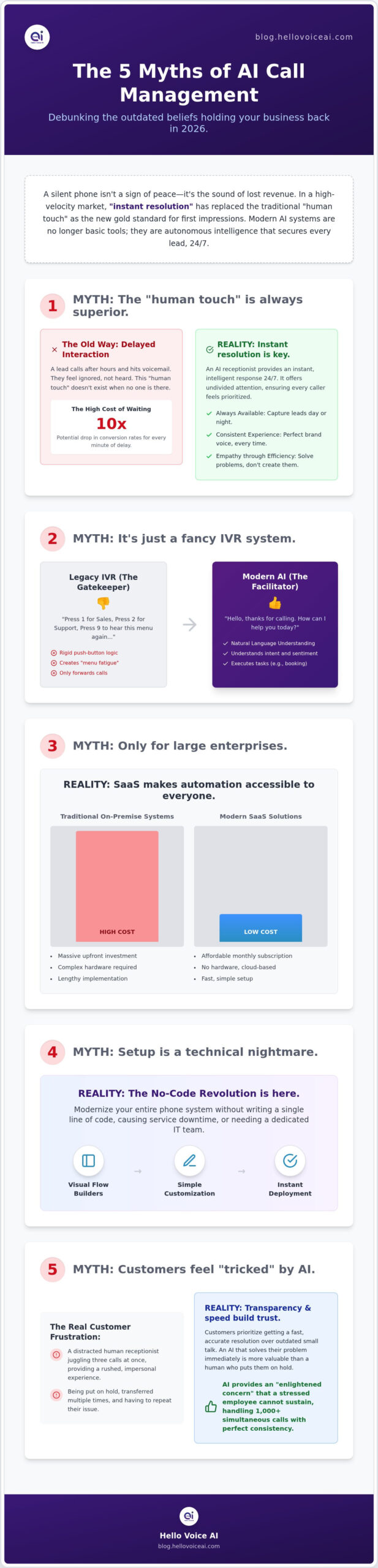
Myth #1: “The Human Touch” is Always Superior for First Impressions
The phone rings. It’s 6:15 PM on a Tuesday. Your team has gone home, and the “human touch” you’ve invested in is currently sitting in a parking lot. This is where the myth of human superiority collapses. If a potential client reaches a voicemail box, that human touch doesn’t exist; it’s just a digital barrier. Modern Call management strategies have shifted because the market no longer rewards the “personal” if it comes with a delay. In 2026, an instant, intelligent response from business call management software is objectively more valuable to a lead than a friendly conversation that happens sixteen hours too late. Prioritizing a physical person over immediate availability is a tactical error that assumes your customers have the patience to wait for your schedule.
The High Cost of the “Wait and See” Strategy
When a caller hits a voicemail, they don’t feel heard; they feel ignored. This triggers a psychological pivot where the caller immediately moves to the next name on their search list. The phenomenon of “Lead Decay” is brutal. Research indicates that every minute of delay in responding to a new inquiry can reduce your conversion rates by as much as 10x. In our current landscape, a 24/7 front desk isn’t a luxury. It’s a baseline expectation. If you aren’t available to capture the data and schedule the appointment the moment the need arises, you aren’t just losing a call. You’re leaking revenue to a more responsive competitor who has automated their intake process. Relying on a “wait and see” approach is essentially a decision to let your leads cool off before you even speak to them.
Empathy vs. Efficiency: Can AI Really Connect?
There’s a common fear that automation feels cold. However, consider the reality of a distracted human receptionist juggling three lines, a walk-in client, and a mounting to-do list. That interaction is rarely empathetic; it’s rushed. Modern AI doesn’t just scan for keywords; it processes intent and sentiment. It offers undivided attention to every caller, ensuring they feel prioritized rather than processed. By deploying an AI Voice Receptionist, you provide a level of “enlightened concern” that a stressed employee simply cannot sustain during peak hours. This ensures that every interaction is handled with calm, logical confidence, regardless of how many people are calling at once.
An AI receptionist maintains absolute brand voice consistency across 1,000 simultaneous calls, ensuring every prospect receives the same high-caliber experience regardless of call volume.
Myth #2: Automated Call Management is Just a Fancy IVR
This level of consistency is invaluable for companies with remote or traveling teams. To stay reachable while abroad, many professionals rely on Always Mobile for affordable eSIM data, ensuring they can oversee these automated interactions from any country.
Think of the last time you were trapped in a telephonic labyrinth. You pressed 1 for support, 3 for billing, and 9 to hear the menu again, only to be disconnected. This is the legacy of the Interactive Voice Response (IVR) system; a gatekeeper designed to reduce costs by keeping customers at arm’s length. In 2026, equating modern business call management software with these rigid, push-button relics is a fundamental misunderstanding of the technology. Modern systems have evolved from passive gatekeepers into active facilitators that prioritize the caller’s time over the company’s convenience. While many evaluations of call center software focus on basic routing, the true differentiator today is the shift from “Push-Button” logic to “Natural Language” understanding.
The Death of the “Press 1 for Sales” Menu
The “Infinite Menu” is the fastest way to lose a modern customer. It creates “menu fatigue,” driving abandonment rates that quietly bleed your marketing budget while you assume your lines are just quiet. Conversational AI removes this friction by allowing callers to speak naturally. Instead of forcing a lead to navigate a tree, the software understands intent. It uses automated call routing system logic to predict where a call should go based on the caller’s history or the specific nuance of their request. To understand how this works as a comprehensive solution, see our guide on The 24/7 Front Desk: A Strategic Guide to AI Voice Receptionists in 2026.
Task Execution vs. Call Forwarding
Legacy systems were built for call forwarding. They simply “passed the buck” to a human agent, often losing context during the transfer and forcing the customer to repeat themselves. Modern business call management software doesn’t just route; it executes. It schedules appointments directly in your calendar, captures detailed messages, and updates your CRM in real-time. This matter-of-fact delivery of logistics ensures that the interaction ends in a resolution, not just a hand-off. It’s a strategic hire that works within your existing tech stack to close the loop on every inquiry. If you’re tired of systems that only move calls rather than solving problems, it’s time to modernize your intake strategy through autonomous task execution.
Myth #3: Professional Call Systems are Only for Large Enterprises
You likely assume that sophisticated infrastructure is a luxury reserved for the Fortune 500. This perspective often keeps small business owners tethered to their personal cell phones, believing that “enterprise-grade” tools come with an enterprise-sized invoice. In reality, the democratization of AI has inverted this logic. Modern business call management software is now delivered via a SaaS model, meaning the same technology used by global agencies is accessible to a local three-person shop. When researching how to choose call center software, many owners discover that the barrier to entry isn’t technical or financial; it’s purely a legacy mindset. In 2026, the cost of one missed high-value lead often exceeds the entire monthly subscription for an automated system, making the “too expensive” argument a logical fallacy.
Small businesses actually need automation more than large corporations. While a big firm can absorb the friction of a missed call through sheer headcount, a small team doesn’t have that margin for error. Every ring that goes unanswered is a direct hit to your growth trajectory. These systems provide “Invisible Scalability” that allows you to handle 100 calls during a seasonal peak or a successful marketing campaign without hiring temporary staff or increasing your overhead. It’s about building a foundation that expands effortlessly as your lead volume grows. For a deeper understanding of how a sophisticated automated call routing system transforms your phone lines from a static utility into an active revenue driver, explore how AI-powered routing keeps your business available around the clock.
Calculating the ROI of Every Ring
To understand the necessity of this shift, you must calculate your “Revenue Per Call.” If your average booking is worth $500 and you miss two calls a week, you’re leaking $4,000 in monthly potential revenue. This “hidden math” makes the subscription fee for professional software look like a rounding error. Relying on a personal cell phone as a growth strategy is a bottleneck that signals amateurism to your prospects. For a deeper breakdown of these figures, consult our Virtual Receptionist ROI Guide for Small Businesses 2026 to see how the numbers stack up in your specific industry.
Leveling the Playing Field
Professional call routing makes a solo operation sound like a 50-person agency. It provides operational continuity, ensuring that even if you’re in a meeting or on a job site, your business remains “open” and responsive. This professional image builds immediate trust with new leads who expect a structured intake process. Budgeting for this transition is simpler than you think; our Virtual Receptionist Cost: 2026 Small Business Price Guide provides a transparent look at how these services are priced to fit lean operations. By adopting business call management software, you aren’t just buying a tool; you’re securing a strategic partner that ensures your small team never sounds small.
Myth #4: Setting Up Call Management Software is a Technical Nightmare
Resistance to change is often born from a fear of complexity. You might imagine that deploying sophisticated business call management software requires a dedicated IT department, weeks of downtime, and an expensive consultant. This mental image belongs to a bygone era of hardware-heavy telephony. In 2026, the “No-Code” revolution has completely dismantled these technical barriers. Modern systems utilize pre-built industry templates that allow for instant configuration, removing the need to manually train a virtual receptionist from scratch. If you can navigate a basic SaaS dashboard, you can modernize your infrastructure in a single afternoon. The transition is seamless, ensuring your customers never experience a “line out of service” tone while you upgrade your capabilities.
The 3-Step Migration Path
Moving away from a single cell phone line or a legacy landline is now a structured, three-step process that prioritizes zero-downtime. First, you connect your existing business number through simple call forwarding or number porting. Second, you define the “Knowledge Base” by uploading your FAQ or linking your website; this serves as the system’s brain, allowing it to answer specific questions about your services. Finally, you set the routing logic to determine who receives a live transfer when a call requires human intervention. This methodical setup ensures that the system is ready to represent your brand with absolute precision from the first minute it goes live.
Integrating the Ecosystem
A common misconception is that adding new software creates another “data silo” you have to monitor. You don’t need to check a separate, clunky dashboard just to see if you have messages. Modern business call management software “talks” directly to the tools you already use, such as Slack, HubSpot, and Google Calendar. When a lead books an appointment, it appears on your calendar instantly. If a message is captured, it pings your team in Slack. This integration removes operational friction, allowing you to manage your entire intake process from within your existing workflow. For those ready to eliminate the chaos of missed opportunities, our How to Stop Missing Business Calls: 2026 AI Reception Guide provides practical tips for a frictionless setup. If you want to secure your revenue stream today, start your no-code migration and see how quickly automation becomes your most reliable strategic hire.
Myth #5: Customers Feel “Tricked” by AI Receptionists
The “uncanny valley” of early automation left a bad taste in many mouths. You might fear that using an AI Voice Receptionist will make your brand seem deceptive or “cheap.” This is a legacy concern from a time when software tried, and failed, to mimic human stuttering and breathing. In 2026, the most successful brands have realized that transparency is actually a trust builder. Stating clearly, “I am an AI assistant,” works better than pretending to be human because it sets a clear expectation for efficiency. Customers don’t feel tricked when they’re told the truth; they feel respected. Modern business call management software isn’t about deception. It’s about speed.
Customers have undergone a massive psychological shift. They now prioritize “Resolution over Relationship” for routine interactions. They value their time more than forced small talk with a distracted employee. When you use business call management software to handle the intake, you eliminate the hold times and the “repeating information” loops that frustrate modern callers. You’re providing a service that respects their schedule. It’s a matter-of-fact upgrade to the customer journey that replaces friction with flow. If you’re still weighing your options for professional call support, understanding the key differences in the virtual receptionist vs answering service debate can help you make the most strategic choice for your business in 2026.
The Value of Instant Resolution
Beyond business communication, this shift toward AI-enhanced “flow” is also reaching the creative arts; learn more about Ilena – A writing companion for serious lyricists to see how technology assists in the craft of poetry and lyrical expression.
Consider the difference in customer experience. A human receptionist might say, “I’ll have someone call you back to confirm that.” An AI says, “I have booked your 2 PM appointment and sent a confirmation to your email.” The former leaves the customer in limbo. The latter provides instant closure. Industry data suggests that 70% of customers prefer automated options for simple tasks like scheduling and status updates. Frictionless Communication is the new gold standard for 2026, where the quality of the interaction is measured by how quickly the problem disappears, not how many pleasantries were exchanged.
When to Hand Off to a Human
Hello Voice AI isn’t designed to replace your team’s expertise. It’s a strategic partner that handles the 90% of routine queries so your humans can focus on the 10% of high-value, complex conversations. This is achieved through “Warm Transfers.” The software prepares your team with a brief summary of the AI conversation before they even pick up the handset. This ensures the hand-off is graceful and context-aware, preserving the human element for the moments that truly require it. If you’re ready to stop leaking leads and start providing the instant resolution your customers crave, explore how Hello Voice AI transforms your call management today.
Securing Your Growth in the Autonomous Era
Outdated assumptions are expensive anchors. We’ve seen that the human touch is a liability if it results in a missed call, and that modern business call management software is far more than a simple routing tool. It’s an autonomous facilitator that levels the playing field for small businesses by providing enterprise-grade availability without the traditional overhead. By prioritizing transparency and instant resolution, you aren’t just automating a process; you’re plugging a systemic revenue leak that quietly drains your marketing budget.
If you’re still relying on a legacy voicemail box, you’re essentially choosing to let leads cool off. Transitioning to an AI Voice Receptionist offers 24/7 availability and instant scheduling integration, which can reduce missed-call revenue loss by up to 15%. It’s a strategic hire that works while you sleep, ensuring that every inquiry is met with calm, logical confidence. Stop losing leads to voicemail; start your 24/7 AI Receptionist journey today. Your business deserves a front desk that never misses a beat.
Frequently Asked Questions
What is the difference between call management software and a virtual receptionist?
Call management software is the broad category of tools used to route, track, and organize business calls. An AI Voice Receptionist is a specific, sophisticated implementation of that software that interacts directly with your callers. While the software provides the underlying infrastructure, the virtual receptionist acts as the intelligent interface that captures leads and executes tasks. Hello Voice AI bridges this gap by providing an integrated solution that performs both functions autonomously without human overhead.
Will I lose my existing business phone number if I switch to an automated system?
No, you can keep your existing business phone number through simple call forwarding or number porting. Most modern systems are designed for zero-downtime transitions, allowing you to route calls to an AI assistant without changing your public-facing identity. This ensures your marketing materials and established customer contacts remain valid while you upgrade your backend capabilities. The process is typically handled via a simple digital authorization that takes minutes to configure.
Can business call management software handle appointment scheduling automatically?
Yes, modern business call management software integrates directly with scheduling tools like Google Calendar and Calendly to book appointments in real-time. The AI identifies the caller’s intent, checks your live availability, and secures the slot without any human intervention. This eliminates the friction of traditional booking and ensures you never miss a lead because your office was closed. It’s a logical solution for businesses that want to convert inquiries into confirmed meetings instantly.
How much does automated receptionist software typically cost for a small business?
Automated solutions are typically delivered via a Monthly SaaS Subscription model, making them significantly more affordable than hiring human staff. Since you avoid the high costs of salaries, benefits, and office space, the ROI is often realized within the first few captured leads. While specific pricing varies based on call volume and features, it’s designed to fit lean small-business budgets. It’s a strategic hire that scales naturally with your growth without increasing your fixed overhead.
Is AI call management secure enough for sensitive customer data?
Security is a core component of enterprise-grade telephony in 2026. These platforms utilize encrypted data transmission and comply with modern privacy standards to protect caller information. When an AI Voice Receptionist captures data, it’s logged directly into your secure CRM rather than sitting in an unsecured voicemail box or on a paper notepad. This structured data handling reduces the risk of human error or unauthorized access to sensitive client details, ensuring your business remains compliant.
Do I need special hardware or VoIP phones to use an AI receptionist?
No special hardware is required to modernize your intake. You don’t need to purchase expensive VoIP handsets or install new physical phone lines. Because the system is cloud-based, it works with your existing mobile phone, landline, or digital setup. You manage the entire interface through a web dashboard, allowing you to deploy a professional front-desk solution without any capital expenditure on equipment. It is a purely software-driven upgrade that works with your current tech.
How does call management software handle spam and robocalls?
Modern business call management software acts as an intelligent filter against unwanted interruptions. By requiring callers to state their intent, the AI effectively screens out automated robocalls that cannot engage in natural conversation. This preserves your time and ensures that only legitimate prospects or clients reach your team. You can also set specific rules to block known spam numbers, keeping your lines clear for high-value interactions and reducing the daily operational friction caused by telemarketers.
Can I customize the voice and personality of my automated receptionist?
Customization is a standard feature that allows you to align the AI’s persona with your specific brand identity. You can select different vocal tones, adjust the level of formality, and define specific scripts for how the assistant greets your callers. This ensures that every interaction feels like a natural extension of your company. You maintain absolute control over the brand voice without the inconsistency that often comes with human staff, providing a reliable experience for every prospect.






3 Comments