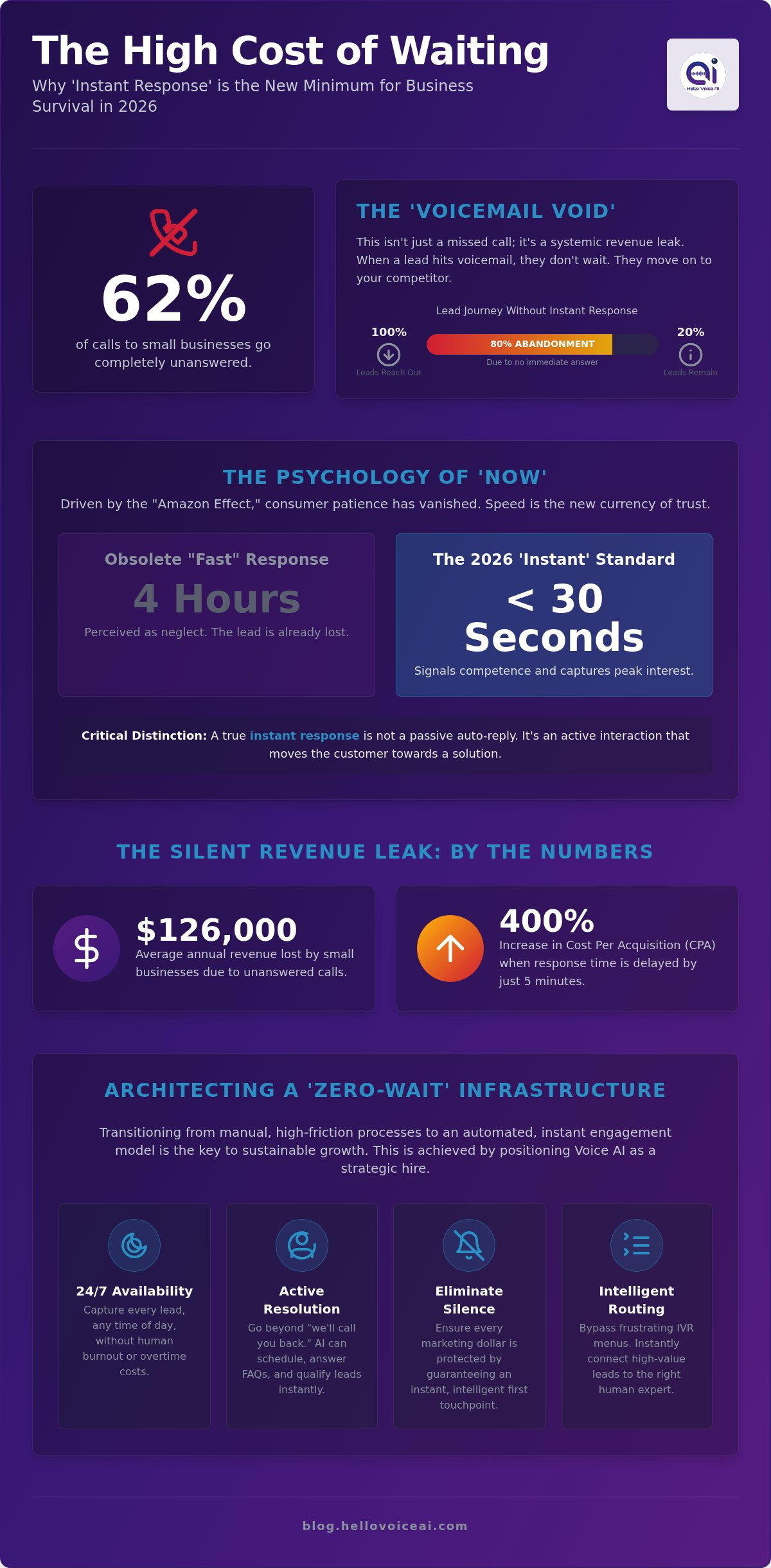
Sixty-two percent of calls to small businesses go unanswered. It is a staggering statistic that represents a systemic leak in your revenue bucket. The phone rings, the lead waits, and within minutes, they have moved on to your competitor. In 2026, fast is no longer a competitive advantage; it is the bare minimum for survival. Establishing an instant response customer service strategy is the only way to bridge the gap between a marketing lead and a closed deal.
You likely feel the pressure of the “always on” economy. It’s the exhaustion of trying to be everywhere at once while watching high-value leads disappear into the “Voicemail Void.” We understand that you cannot personally answer every call, yet you cannot afford to lose the significant annual revenue that the average business forfeits to missed connections. This guide promises a way out of that cycle. You’ll discover how to transition from manual, high-friction processes to a streamlined, “Zero-Wait” customer experience. We will analyze how to automate lead capture 24/7 and ensure your marketing spend finally delivers the ROI it deserves by engaging every prospect the moment they reach out.
Key Takeaways
- Understand why 2026 consumers define “instant” as engagement within 30 seconds and how the “Amazon Effect” has reshaped baseline market expectations.
- Discover the critical difference between First Response Time and Instant Resolution Time to refine your instant response customer service strategy for maximum impact.
- Identify the operational failures within the “Voicemail Void” that cause 80% of potential leads to abandon your business in favor of a faster competitor.
- Learn a two-step framework to audit your current speed-to-lead and implement intelligent routing that eliminates traditional IVR friction.
- Evaluate the transition from manual staffing to positioning AI as a strategic hire to achieve 24/7 availability without human burnout or increased overhead.
The Psychology of Now: Defining Instant Response Customer Service in 2026
Time has compressed. For the 2026 consumer, the gap between a need arising and its fulfillment is measured in heartbeats, not hours. If your business treats a four-hour reply as “fast,” you are operating on an obsolete timeline. Today, instant response customer service is strictly defined as a meaningful engagement that occurs within 30 seconds of the initial contact. This shift isn’t just a trend; it’s a fundamental rewiring of the buyer’s journey. When a prospect reaches out, they are at the peak of their intent. Every second of silence that follows acts as a tax on their interest, slowly draining the likelihood of a conversion until they inevitably click away to a competitor who is ready to talk right now.
This reality is driven by the “Amazon Effect.” Decades of immediate digital gratification have conditioned buyers to expect frictionless, real-time interactions across every sector. Modern customer service standards now dictate that speed is a proxy for competence. If a company can’t manage a simple greeting or a routing request instantly, the consumer assumes the actual service will be equally sluggish. There is a direct emotional link between immediate response and perceived brand authority. An instant reply signals that your business is organized, well-resourced, and values the customer’s time. Conversely, a delayed response suggests a systemic lack of care, positioning you as a secondary option rather than a market leader.
The 2026 Consumer Patience Threshold
The window for capturing a lead is narrower than ever. Research indicates a precipitous drop-off in lead viability after just five minutes of silence. This occurs because of “search fatigue.” A customer in 2026 rarely contacts just one provider; they are often moving down a list of search results. The first business to engage provides immediate psychological relief. By answering instantly, you stop their search process and satisfy the urge to have the problem “being handled.” If you wait ten minutes, you aren’t just late; you’re irrelevant, as the customer has likely already committed to the firm that answered in thirty seconds.
Instant Response vs. Auto-Responders
There is a critical distinction between a functional interaction and a digital placeholder. In the past, an email stating “We have received your message” was acceptable. In 2026, these passive auto-responders are viewed as a “Voicemail Void” in text form. They provide no utility and resolve no friction. True instant response customer service moves beyond notification into active resolution. It involves a system capable of scheduling an appointment, answering a specific pricing question, or routing a high-value lead to the correct department immediately. If the interaction doesn’t move the needle toward a solution, it isn’t a response; it’s just more noise in an already crowded inbox.
Decoding the Metrics: FRT vs. Instant Resolution Time
Metrics are more than just numbers on a dashboard. They are the pulse of your operational health. In the high-stakes environment of 2026, instant response customer service is measured through two primary lenses: First Response Time (FRT) and First Contact Resolution (FCR). FRT tracks how quickly you acknowledge the lead; FCR measures how quickly you solve their problem. While both are vital, the “Engagement Gap”, the time between a customer’s intent and your business’s reaction, is where most sales are lost. Calculating the ROI of every second saved involves looking at your missed call volume. With the average small business losing approximately $126,000 a year due to unanswered calls, every second of delay represents a tangible financial loss.
Why FRT is a Revenue Metric, Not a Cost Center
Traditional thinking views support as a cost to be minimized. This is a strategic error. In reality, a sub-minute FRT has a direct, linear correlation with lead-to-close rates. When you respond in under 30 seconds, you capture the lead at their highest point of interest. Delaying that response by even five minutes can inflate your Cost Per Acquisition (CPA) by 400 percent because you are losing the majority of your paid traffic to silence. First Response Time is the heartbeat of business growth in 2026. Improving this metric isn’t about being polite; it’s about protecting your marketing investment and ensuring your growth remains sustainable.
Measuring the ‘Abandonment Rate’ in Real-Time
Silence is the ultimate conversion killer for any instant response customer service strategy. Statistics show that 62 percent of calls to small businesses go unanswered, leading to a phenomenon known as “silent churn.” These are the prospects who hang up without leaving a message, never to return. Tracking your abandonment rate in real-time reveals exactly where your funnel is leaking. High hold times correlate directly with plummeting Customer Satisfaction (CSAT) scores, as 90 percent of customers now state that an immediate response is essential. To see how these metrics transform with automation, explore our latest guide on operational efficiency. By identifying these leaks, you can move from a reactive posture to a proactive, “Zero-Wait” model that captures every dollar of intent.
The Silent Revenue Leak: The Cost of the ‘Voicemail Void’
The phone rings. No one answers. In that precise moment, you haven’t just missed a call; you’ve actively financed your competitor’s growth. This is the reality of the “Voicemail Void,” a systemic operational failure where 80 percent of callers hang up rather than leave a message. In 2026, instant response customer service isn’t a luxury for the elite. It’s the only barrier preventing your hard-earned leads from evaporating into the digital ether. When a prospect hits a recording, they don’t wait for a callback. They simply move to the next search result. This delay-induced churn erodes brand loyalty before the relationship even begins, turning a potential advocate into a lost opportunity. For a deeper analysis of this dynamic, explore The Silent Churn: Impact of Missed Calls on Customer Loyalty in 2026.
The Math of Missed Opportunities
Consider the Lifetime Value (LTV) of a single lost lead. If your average client represents thousands of dollars in revenue over their tenure, missing just one call is a significant blow to your balance sheet. Slow responses create a compounding negative effect on your marketing budget efficiency. If you spend money to generate traffic but fail to answer 62 percent of the resulting calls, your effective Cost Per Acquisition (CPA) doesn’t just increase; it explodes. “After-hours” is often the most expensive time to be offline. While your physical office is dark, “night-owl” leads with high intent are actively searching for solutions. Your unavailability during these peak decision-making windows becomes their primary reason to sign with a competitor who stays ready. Forward-thinking businesses are already deploying front desk automation ideas to ensure no after-hours lead is ever lost to a competitor again.
The Competitive Advantage of 24/7 Readiness
Architecting a Zero-Wait Infrastructure for Your Business
Stop guessing where your leads go. Transitioning to a “Zero-Wait” model requires a methodical overhaul of your communication stack. It begins with a comprehensive audit of your current “speed-to-lead” across every channel. If you find that your average response time exceeds the 30-second benchmark established earlier, your infrastructure is failing. You must then implement intelligent routing to bypass traditional IVR friction, followed by the deployment of an AI Voice Receptionist for immediate, human-like engagement. Finally, integrate these tools with your CRM to ensure every interaction is logged without manual effort. This allows you to monitor and optimize response patterns using sophisticated 2026 analytics to maintain peak performance.
Building a robust instant response customer service system is about more than just speed. It’s about data integrity. When your communication tools “talk” to your CRM, you eliminate the risk of human error in data entry. This ensures that every lead is captured, categorized, and ready for follow-up without a single second of administrative delay. This automated future-state transforms your front desk into a high-velocity engine that fuels your sales pipeline 24/7.
Eliminating the ‘Gatekeeper’ Friction
The era of “Press 1 for Sales” is over. In 2026, these rigid menus are viewed as roadblocks rather than helpful tools. They represent a significant friction point that drives frustrated callers back to their search results. Modern infrastructure favors Natural Language Processing (NLP), allowing customers to simply state their needs in plain English. This creates a frictionless path from “Hello” to “Help,” ensuring the caller feels heard immediately. By removing these digital gatekeepers, you reduce the psychological burden on the prospect and increase the likelihood of a successful conversion. Businesses that experience surges in inbound demand can find proven strategies for how to manage high call volume in a small business without sacrificing response quality or adding headcount.
Omnichannel Sync: Ensuring No Lead Falls Through the Cracks
Consistency is the backbone of brand trust. Your instant response customer service strategy must be unified across phone, SMS, and web-chat. If a customer receives an instant reply on chat but waits an hour for a phone callback, the brand experience is fractured. Syncing these channels ensures a seamless transition for the lead regardless of how they choose to reach out. Integrating automated scheduling is the final piece of this puzzle. When a lead calls, the system shouldn’t just answer; it should book the appointment. For a detailed roadmap on implementing these systems, read our How to Stop Missing Business Calls: 2026 AI Reception Guide. Ready to eliminate the wait-time gap? Explore our virtual receptionist services and start capturing every opportunity today.
Scaling Instant Response: Why Voice AI is the 2026 Strategic Hire
Human capacity has a ceiling. Managing a 24/7 operation with staff alone is a logistical nightmare that often results in burnout, high turnover, and inconsistent service quality. While your team needs sleep, your market does not. In 2026, the only way to maintain a true instant response customer service standard is to move beyond manual labor. Hello Voice AI acts as a strategic partner, providing the immediate engagement your leads demand without the crippling overhead of a traditional call center. By deploying an AI virtual receptionist, you ensure every interaction is handled with precision, regardless of whether the call comes in at noon or midnight.
This shift represents a fundamental transition from front-desk friction to an automated future-state. Traditional models rely on the availability of a specific person at a specific desk. If they’re on another line or away from their station, the lead is lost. Voice AI eliminates this single point of failure. It provides a scalable solution that grows alongside your marketing efforts, ensuring that as your lead volume increases, your response time remains at zero. You’re no longer just “getting to” calls; you’re architecting a system where every prospect is greeted, qualified, and routed instantly. Businesses looking to get started can explore proven front desk automation ideas that bridge the gap between human capacity and the always-on demands of the modern market.
The 24/7 Virtual Receptionist Advantage
Peak call volumes often create a bottleneck where even the best teams fail. When three high-value leads call simultaneously, two are inevitably sent to voicemail. This is where the Zero-Wait infrastructure proves its worth. An AI-driven system handles unlimited concurrent calls, capturing every lead every time. There is no latency and no “please hold” music. For a deeper look at this operational shift, consult The 24/7 Front Desk: A Strategic Guide to AI Voice Receptionists in 2026. By removing the human limit, you provide a consistent experience that builds trust before a human ever joins the conversation.
Beyond Answering: Driving ROI with AI Intelligence
Modern Voice AI does more than just greet; it qualifies. By asking the right questions in a natural, human-like manner, Hello Voice AI filters out the noise. This ensures your human team only spends time on high-intent prospects who are ready to buy. The real power lies in instant scheduling. Turning a curious caller into a confirmed appointment in a single interaction is the ultimate conversion hack. This positions your business as a future-ready innovator that respects the customer’s time. You aren’t just answering a phone; you’re operating a sophisticated revenue engine that maximizes the ROI of every marketing dollar spent on instant response customer service.
Capturing the Future of Frictionless Growth
Wait times are the silent killers of conversion. Every second your business remains silent is an opportunity gifted to a competitor. We’ve analyzed how the 2026 patience threshold has shrunk to just thirty seconds, necessitating a shift from manual front-desk friction to automated future-states. By architecting a Zero-Wait infrastructure, you don’t just answer phones; you protect your marketing ROI and establish your brand as a market leader.
The solution isn’t to work harder. It’s to work smarter. Implementing an AI Voice Receptionist ensures 24/7 instant lead capture and automated appointment scheduling, effectively sealing the systemic leaks in your sales funnel. This strategic reduction in missed-call revenue loss allows your team to focus on high-value tasks while the technology handles the initial intent. It’s time to stop losing leads to the Voicemail Void.
Stop losing leads to voicemail—get an AI Voice Receptionist that responds instantly 24/7.
The transition to instant response customer service is a logical puzzle with a definitive fix. By embracing this technology today, you position your business to thrive in an increasingly competitive landscape. Your growth is waiting.
Frequently Asked Questions
What is considered a good first response time in 2026?
A good first response time is now defined as 30 seconds or less for all real-time communication channels. For asynchronous channels like email, 90 percent of customers expect a reply within one hour, though 60 percent prefer ten minutes or less. If your current systems can’t meet these benchmarks, you’re likely seeing a high drop-off rate in your sales funnel. Speed has become the primary filter through which consumers judge your brand’s professionalism.
Can an AI really provide ‘instant response’ without sounding robotic?
Modern Natural Language Processing has evolved past the stilted voices of the past. Today’s AI Voice Receptionists utilize sophisticated speech patterns and low-latency processing to engage callers in a natural, fluid conversation. These systems don’t just read a script; they understand intent and provide contextually relevant answers. This ensures your prospects feel heard and valued immediately, moving them closer to a conversion without the friction of a traditional automated menu.
How much revenue does the average small business lose to missed calls?
Revenue loss occurs primarily through “silent churn,” where prospects hang up without leaving a message. When 62 percent of calls to small businesses go unanswered, the financial impact is massive. Each missed connection is a lost opportunity for a lifetime of customer value. Instead of just looking at the single transaction, you must calculate the total cost of acquisition wasted on leads that never reach a human or AI because of response latency.
Is an auto-responder the same as instant response customer service?
No, an auto-responder is a passive notification while instant response customer service provides active resolution. A basic “we’ll get back to you” message does not satisfy the modern consumer’s need for immediate gratification. True instant response requires a system capable of answering specific questions or scheduling appointments in real-time. Moving from a static placeholder to a functional interaction is what prevents prospects from moving on to the next competitor in their search results.
How do I implement instant response for a small team with limited budget?
Small teams can achieve “Zero-Wait” engagement by utilizing an AI Voice Receptionist rather than expanding their human payroll. Hiring additional staff for 24/7 coverage is financially prohibitive for most growing firms. In contrast, an AI-driven Virtual Receptionist Service provides the same outcome at a fraction of the cost. This transition allows you to scale your response capabilities alongside your lead volume without the operational friction or burnout associated with manual call handling.
What happens if a customer calls after business hours?
After-hours calls are often the most high-intent leads your business receives. If a customer reaches out at 9:00 PM, an AI virtual receptionist can capture their information and book a consultation immediately. This prevents the lead from disappearing into the “Voicemail Void” while your team is away. By maintaining a constant presence, you ensure that your marketing spend continues to work for you regardless of the time of day or office hours.
Does instant response actually improve customer loyalty or just sales?
Immediate engagement improves both loyalty and sales by establishing early brand authority. When you solve a customer’s search fatigue by answering their call instantly, you build a foundation of trust that persists throughout the relationship. Customers associate speed with competence. If you are the first to answer, you aren’t just winning a one-time transaction; you’re proving that your business is reliable, well-organized, and deeply respectful of the customer’s time.
What are the most important customer satisfaction metrics to track in 2026?
Beyond basic response times, you should focus on the Abandonment Rate and the Lead-to-Appointment conversion rate. These metrics reveal how many potential customers are lost due to communication friction. Tracking how many callers hang up before an interaction occurs is vital for identifying systemic leaks. By optimizing these specific data points, you can move toward a “Zero-Wait” model that maximizes the ROI of your marketing efforts and ensures a superior customer experience.