
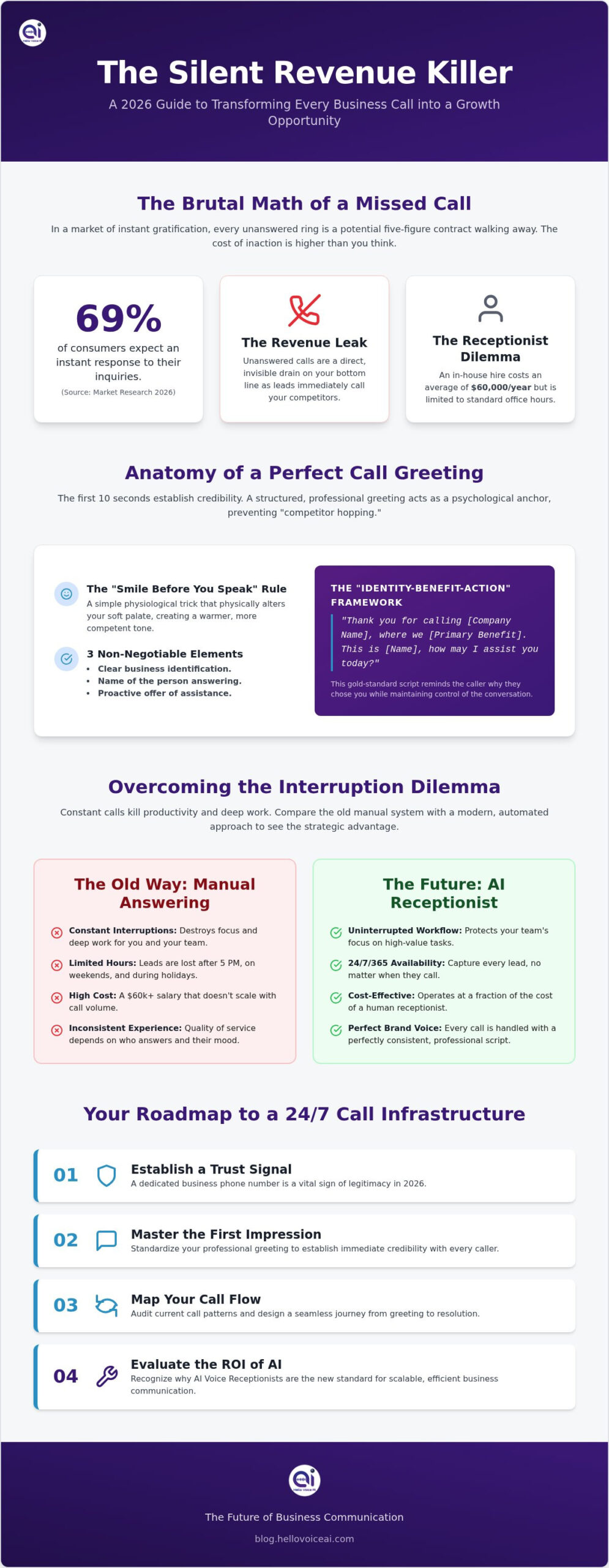
What if every silent vibration in your pocket was actually a five-figure contract slipping through your fingers because you were too busy to answer? The math is brutal. In a market where 69% of consumers prefer instant responses for quick inquiries, a missed call is a direct leak in your revenue bucket. Learning how to handle business calls in 2026 is no longer just about basic phone etiquette; it’s about building a bulletproof system that works while you’re focused on high-level strategy. You’ve likely felt the sting of losing a lead simply because you were in a meeting or couldn’t justify the $60,000 annual salary of an in-house receptionist.
It’s a frustrating trade-off between productivity and growth. We understand that tension. This guide promises to show you how to transform every incoming call into a revenue opportunity through professional etiquette, intelligent routing, and 24/7 automation. We’ll examine the strategic shift toward AI-powered receptionists that capture every lead, boost your credibility, and provide the operational freedom you need to scale. By the end, you’ll have a roadmap for a communication system that never sleeps and never misses an opportunity.
Key Takeaways
- Recognize why a dedicated business phone number remains a vital trust signal in 2026 and how it functions as a critical touchpoint in the customer journey.
- Master the anatomy of a professional greeting, including the “Smile Before You Speak” rule, to establish immediate credibility with every caller.
- Discover how to handle business calls effectively by leveraging automation to eliminate the productivity cost of manual interruptions during deep work.
- Audit your current call patterns and map a seamless “Call Flow” that guides prospects from the initial greeting to a structured resolution.
- Evaluate the strategic ROI of AI voice receptionists and learn why they’ve replaced traditional hires as the standard for scalable business communication.
The Strategic Importance of Modern Business Call Management
Voice is the new storefront. Business call management isn’t just a back-office task; it’s the deliberate architecture of your brand’s first impression. It functions as a critical component of the customer journey, serving as the bridge between a prospect’s curiosity and their commitment. In 2026, a dedicated business phone number remains a powerful trust signal. It provides a level of legitimacy that digital-only channels often struggle to replicate. Mastering how to handle business calls effectively requires a shift in perspective. You aren’t just answering a phone; you’re securing a relationship.
The “Silent Revenue Killer” is the lead that vanishes before it’s even logged. When a call goes unanswered, the financial impact is immediate and often invisible. Modern buyers operate in an era of instant gratification. They demand 24/7 availability. If your business doesn’t respond instantly, the caller isn’t going to wait. They’ll simply move to the next name on their list. This shift in customer expectations has turned traditional office hours into a competitive liability. Deciding how to handle business calls is a strategic choice that directly impacts your bottom line.
The Psychology of the First Impression
Snap judgments happen in seconds. The first 10 seconds of a call determine customer retention rates before a single service is even discussed. A professional greeting acts as a psychological anchor, establishing brand authority and competence. By following modern business call etiquette, you signal that your operation is sophisticated and reliable. This immediate professionalism is the most effective tool to prevent “competitor hopping” behavior, ensuring the prospect’s search for a solution ends with your business.
Calculating the Opportunity Cost of Missed Calls
Revenue leaks are often found in the call logs. To understand the stakes, you must calculate the opportunity cost of every missed connection. Most callers who reach a voicemail will never leave a message; they simply hang up and dial your rival. You can explore the Silent Revenue Killer concept to see how these small gaps compound into massive monthly losses. The “I’ll call them back later” mentality is a failing strategy. In a high-speed market, the second you miss a call, the lead is already decaying.
The Anatomy of a Professional Phone Greeting
A professional greeting is more than just words; it’s an acoustic signature. You’ve likely called a business only to be met with a flat, disinterested “Hello?” and immediately felt your confidence waver. This is a subtle but critical operational failure. The “Smile Before You Speak” rule isn’t just a cliché. It physically alters your soft palate, creating a warmer, more resonant tone that callers subconsciously interpret as competence. When you’re figuring out how to handle business calls, this physiological trick is your first line of defense against being perceived as unprofessional.
To ensure consistency across your team or different departments, every greeting must contain three non-negotiable elements. First, clear identification of the business. Second, the name of the person answering. Third, a proactive offer of assistance. Without these, the caller is left in a state of cognitive friction, wondering if they’ve reached the right place. Standardizing these components creates a unified brand voice that signals reliability to every prospect, regardless of who picks up the phone.
Standard Professional Scripts for 2026
The “Identity-Benefit-Action” framework is the gold standard for high-converting greetings. Instead of a passive “How can I help?”, try: “Thank you for calling [Company Name], where we [Primary Benefit]. This is [Name], how may I assist you today?” This structure reminds the caller why they chose you while maintaining control of the conversation. When building a 24/7 call infrastructure, these scripts ensure that whether it’s 2 PM or 2 AM, the brand voice remains identical. For on-hold situations, never leave a caller in silence for more than 30 seconds without an update. If you need more time, offer a prompt callback rather than testing their patience. Similarly, voicemail greetings should promise a specific callback window to encourage the caller to actually leave a message.
Active Listening and Information Capture
Effective call management requires a methodical approach to intake. Start by capturing the caller’s name and contact number immediately, framed as a way to “reconnect in case we get disconnected.” This ensures no lead is lost to a technical glitch. Staying calm with difficult callers involves acknowledging their frustration without accepting blame, using a “matter-of-fact” delivery to de-escalate the situation. Always verify the spelling of names and digits of phone numbers before hanging up. If you’re looking for more ways to refine your communication strategy, you can explore our latest industry insights on professional voice interaction to stay ahead of the curve.
Overcoming the Interruption Dilemma: Manual vs. Automated Systems
Focus is your most expensive asset. Every time you pause a high-stakes strategy session to answer a basic inquiry, you’re paying a cognitive tax that drains your productivity. For many, the instinct on how to handle business calls is to stay “hands-on” to ensure quality. However, this manual approach creates a ceiling for your growth. You can’t scale a business if the founder is also the primary front-desk operator. The switching cost alone can consume up to 40% of someone’s productive time, turning a simple phone call into a major operational leak.
Comparing your options requires a cold look at the numbers. Human receptionists offer a personal touch but carry high overhead and rigid schedules. Conversely, traditional IVR systems offer scale but often alienate modern callers who find them cold and restrictive. The modern solution lies in intelligent call routing, which filters out the noise and ensures that only high-value opportunities reach your desk. This system acts as a strategic gatekeeper, allowing you to prioritize growth over administrative maintenance.
The Solo Entrepreneur’s Phone Struggle
Using a personal cell number for business is a subtle signal of amateurism. It blurs the line between your private life and professional identity, making it impossible to truly “switch off.” Transitioning to virtual numbers allows you to establish a corporate presence without the need for physical office space. By integrating business call management software, solo operators can present a sophisticated image while maintaining the agility of a small team. It’s about building a system that captures leads even when you’re unavailable.
Traditional IVR vs. Conversational AI
The era of the rigid phone menu is ending. Customers in 2026 have zero patience for “Press 1 for Sales” or “Press 2 for Support” loops. These systems feel like barriers rather than bridges. The rise of natural language processing has introduced a new standard: conversational AI. These systems understand intent and context, allowing for a professional call intake that feels human-like in its empathy but remains machine-like in its efficiency. It’s the definitive fix for the friction of traditional automation, providing a seamless experience that guides callers to a resolution without the frustration of a keypad.
Building a 24/7 Call Infrastructure for Business Growth
Growth is a systems problem. If your strategy for how to handle business calls relies on your personal availability, you’ve built a bottleneck, not a business. Mastering communication at scale requires a transition from reactive answering to a proactive, 24/7 infrastructure. This shift ensures that every lead is captured, qualified, and moved through your sales funnel without requiring a second of your manual intervention. For leaders looking to inspire their teams during such organizational shifts, Speakers.com offers access to world-class keynote speakers who specialize in business transformation and leadership.
Constructing this framework involves four methodical steps:
- Step 1: Audit your patterns. Analyze your call logs to identify when your most valuable inquiries arrive. You’ll likely find that a significant percentage of potential revenue is knocking during “dark hours” when your team is offline.
- Step 2: Map the flow. Document the journey from the initial greeting to the final resolution. Every path should lead to a clear outcome, whether it’s an appointment, a support ticket, or a direct transfer.
- Step 3: Deploy a Virtual Receptionist Service. Use automated support to handle after-hours inquiries and overflow during peak business hours. This ensures zero callers reach a dead-end voicemail.
- Step 4: Sync with your CRM. Integrate your call data directly into your customer relationship management software. This creates a seamless trail for follow-up and prevents leads from falling through the cracks of manual data entry.
Achieving 24/7 Availability Without Burnout
The 9-to-5 model is an artifact of a pre-digital economy. In 2026, global commerce means your next big client might be calling from a time zone eight hours ahead of yours. Expecting yourself or your staff to remain tethered to a phone around the clock is a recipe for operational exhaustion. Using disaster recovery strategies provides the continuity you need, ensuring your phone lines remain professional and responsive during regional outages or unexpected volume surges. It’s about building resilience into your communication layer so you can protect your time while protecting your revenue.
Automated Scheduling and Lead Routing
Modern call management has evolved beyond “taking a message.” A sophisticated system should move the needle on your sales goals instantly. By implementing automated scheduling, your phone system can qualify a lead based on your specific business criteria and book a meeting directly onto your calendar. This eliminates the “ping-pong” of back-and-forth emails and secures the prospect while their interest is at its peak. Setting up instant notifications ensures your team is alerted to high-priority opportunities the moment they occur. You can explore our advanced integration guides to see how to connect your phone system to your existing tech stack for maximum efficiency.
The Future of Virtual Reception: Why AI is the Strategic Choice
The business landscape has reached a tipping point. Relying on outdated answering services or overburdened staff is no longer a viable strategy for high-growth firms. The evolution toward AI voice receptionists represents more than just a technological upgrade; it’s a fundamental shift in how to handle business calls for maximum profitability. While traditional manual processes were once the standard, they often struggle with scalability and the high costs of round-the-clock staffing.
Analyzing the financial logic makes the choice clear. A full-time in-house receptionist can cost between $55,000 and $65,000 per year when salary and benefits are factored in. When you compare virtual receptionist costs to these traditional overheads, the ROI of automation becomes undeniable. Hello Voice AI transforms this operational expense into a strategic asset. It provides a sophisticated, future-ready persona that never takes a sick day and captures every lead with precision. It’s a methodical solution to a systemic leak.
Transitioning to an automated call handling model requires a clear checklist:
- Define your brand’s vocal “personality” to ensure a consistent caller experience.
- Identify your most frequent call intents, such as sales inquiries or appointment scheduling.
- Establish clear escalation paths for complex or high-priority inquiries.
- Integrate your AI system with your existing CRM and team calendars.
Maintaining the Human Touch with AI
Maintaining a professional connection doesn’t require a human on every call. It requires empathy built into the logic. Modern AI can be configured to match your brand’s unique personality, ensuring the interaction feels natural rather than robotic. The key is knowing when to transition. A well-designed system identifies high-stakes scenarios and routes them to your live team members instantly. This ensures that human empathy is reserved for the moments it matters most, and platforms like Georgia can help your team practice these soft-skill conversations to maintain technical reliability without sacrificing the personal connection.
Activating your virtual front desk is a matter of minutes. You can start capturing missed revenue immediately by monitoring key performance metrics like answer speed, resolution rate, and lead capture volume. These data points turn your phone system into a measurable sales channel, providing a clear view of your operational health. This is the definitive fix for modern communication friction. Ready to stop losing leads? Activate your 24/7 AI Receptionist today.
Securing Your Revenue Through Communication Excellence
Operational friction is the silent enemy of scale. We’ve established that a professional greeting is the anchor of trust, yet manual call handling often becomes a bottleneck that prevents high-level growth. Mastering how to handle business calls in 2026 requires a transition from reactive answering to a resilient, automated infrastructure. By implementing a system that never sleeps, you ensure that every prospect feels heard and every opportunity is logged. It’s the difference between a business that simply survives and one that dominates its market through superior responsiveness.
Hello Voice AI provides the definitive fix with 24/7 AI-powered lead capture, designed to reduce missed-call revenue loss by up to 90%. With seamless CRM and calendar integration, your front desk operates with methodical efficiency while you focus on the big picture. It’s time to stop the leak in your revenue bucket and adopt a future-ready mindset. Eliminate missed calls and scale your business with Hello Voice AI today. Your growth is too valuable to leave to chance.
Frequently Asked Questions
How do I answer a business call professionally on my personal cell phone?
Use a virtual number to distinguish work calls from personal ones. When the call arrives, respond with your business name and a professional greeting even if you’re mobile. This separation ensures you don’t inadvertently answer a client with a casual “Hello?” which can damage your credibility. Maintaining this boundary is essential for anyone learning how to handle business calls effectively while using personal hardware for work.
What are the best phrases to use when putting a customer on hold?
Always ask for permission before placing a caller on hold. Use clear phrases like, “May I place you on a brief hold while I verify those details?” When you return, thank them for their patience specifically. Avoid leaving them in silence for more than 30 seconds. If the delay is longer, offer a prompt callback to respect their schedule and maintain a professional brand image.
Is an AI receptionist better than a traditional answering service?
AI receptionists outperform traditional services through superior speed and integration. While human-operated services often involve wait times and potential transcription errors, AI provides instant lead capture and direct calendar syncing. It removes the high overhead of human staffing while ensuring every inquiry is handled with consistent brand logic. This transition from manual to automated states represents a significant leap in operational efficiency for modern firms.
How many rings should I wait before answering a business call?
Aim to answer within three rings to balance responsiveness with professional composure. Answering on the first ring can catch callers off guard, while waiting beyond four rings increases the risk of abandonment. If you’re concerned about how to handle business calls during busy hours, automation ensures every caller is greeted within this optimal window. This consistency builds trust and prevents prospects from moving to a competitor.
What should be included in a professional business voicemail greeting?
Your greeting should include your company name, your name, and a clear expectation for a callback. Encourage callers to leave specific details so you can be prepared for the return conversation. A professional voicemail must be concise and updated for any planned absences. Always promise a specific follow-up window to keep the lead engaged and prevent them from calling another business while they wait.
Can an AI receptionist actually schedule appointments for my business?
Modern AI receptionists sync directly with your digital calendars to book appointments in real-time. They can qualify leads based on your custom criteria before offering available time slots. This functionality eliminates the friction of back-and-forth emails, ensuring your sales funnel stays active 24/7. You can wake up to a calendar of pre-qualified meetings, allowing you to focus entirely on closing deals rather than managing your schedule.
What is the most common mistake made when handling business calls?
The most frequent error is failing to secure the caller’s contact information at the start of the interaction. If the connection drops, that potential revenue vanishes. Professionals always confirm the caller’s name and phone number early, explaining it’s a precaution in case of a disconnection. This methodical approach protects your lead pipeline and ensures that every marketing dollar spent on driving calls results in a reachable prospect.
How do I handle multiple business calls at once without a receptionist?
Handling multiple calls solo requires a sophisticated automated routing system. You cannot speak to two people at once without compromising professional standards. Implementing a virtual receptionist allows the system to manage overflow, answer basic questions, and schedule meetings simultaneously. This ensures no caller ever hears a busy signal, providing you the freedom to give your full attention to one client while the system captures the next.






One Comment