
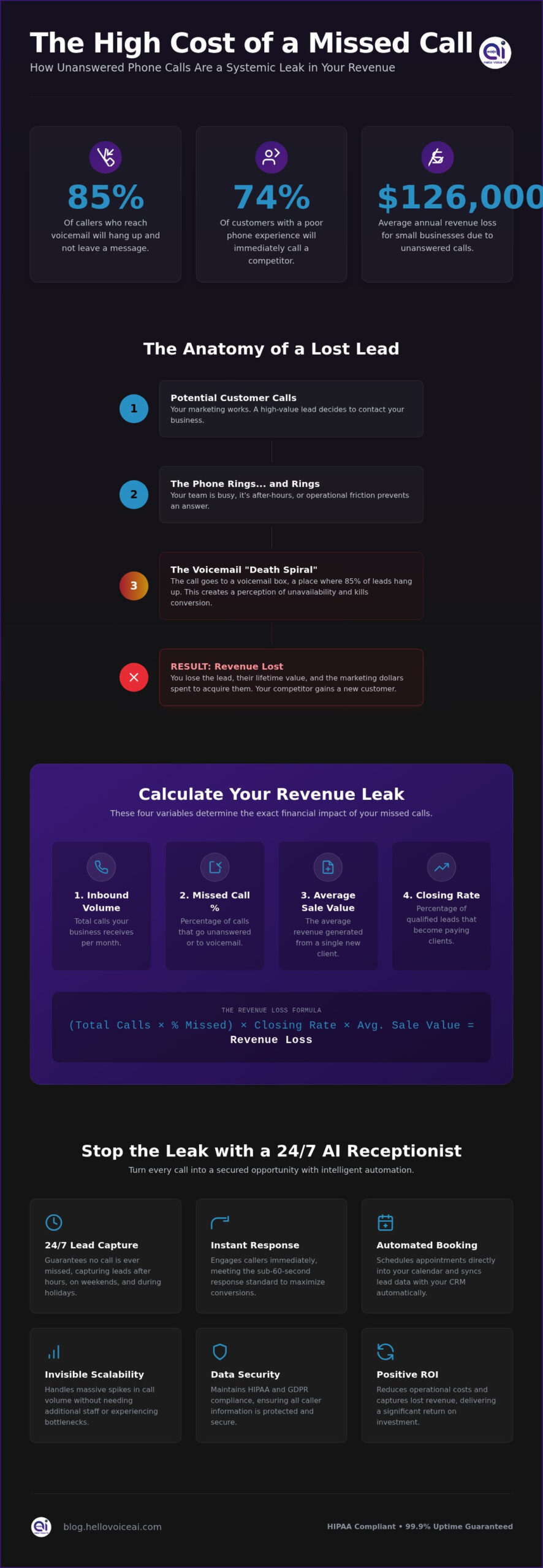
Eighty-five percent of callers who reach a voicemail will simply hang up and call a competitor. In fact, 74% of potential customers who endure a poor phone experience will immediately take their business elsewhere. For the average small business, this silence results in a loss of approximately $126,000 every year. Understanding this impact requires a precise missed call revenue loss calculator to identify exactly where the budget is failing and where the growth has stalled.
A silent phone isn’t a sign of peace. It’s the sound of a systemic leak. Operational friction at the front desk often creates a scenario where potential revenue drains away while the office is dark. It’s natural to feel uncertainty about the return on marketing spend when abandonment rates spike after-hours. This guide provides the exact mathematical framework to quantify specific financial exposure. You’ll move beyond guesswork to a clear dollar figure that informs smarter staffing decisions and ensures 24/7 lead capture.
The following analysis examines the virtual receptionist ROI, explores how to eliminate menu fatigue, and demonstrates how automated lead response turns every incoming ring into a secured opportunity through 24/7 AI responsiveness.
Key Takeaways
- Quantify the $126,000 average annual loss and understand the mechanics of why 85% of callers hang up on voicemail.
- Apply a missed call revenue loss calculator to identify specific financial leaks based on your monthly inbound call volume and abandonment rate.
- Adopt the sub-60-second response standard to prevent the 74% of customers who switch to competitors after a poor phone experience.
- Analyze virtual receptionist ROI to identify the strategic hire point for automating front-desk processes and achieving invisible scalability.
- Ensure 24/7 lead capture and data security through HIPAA-compliant AI systems that integrate directly with existing CRM and calendar tools.
The Financial Impact of the Unanswered Call: A Systemic Leak
A silent phone isn’t a sign of peace. It’s the sound of a systemic leak where potential revenue drains away while your office is dark. Many managers assume a missed call is merely a minor delay in communication, but the data suggests a more permanent failure. To understand the gravity of the situation, one must first ask: What is a missed call? In a commercial context, it’s a broken connection that signals to the customer that your business is unavailable. This leads to a staggering reality: 74% of potential customers who endure a poor phone experience will immediately take their business to a competitor. They won’t wait. They won’t try again tomorrow. They simply move to the next search result.
The True Cost of Voicemail Abandonment
The “voicemail death spiral” is a documented psychological barrier that kills conversion rates. Eighty-five percent of callers who reach your voicemail will simply hang up. This isn’t just a missed conversation; it’s a direct loss of marketing ROI. If you’ve spent significant budget to generate that lead through PPC or local SEO, that investment vanishes the moment the beep sounds. This problem is often exacerbated by “menu fatigue,” where long, repetitive IVR menus frustrate callers into hanging up before they even reach a mailbox. For compliance-sensitive industries like healthcare or law, the stakes are even higher. An after-hours call regarding a medical emergency or a high-value personal injury case represents significant revenue that requires an instant response, not a recording.
Why Small Businesses Lose $126,000 Every Year
The $126,000 figure is a documented average, but for many, it’s a conservative estimate of the “invisible” loss that never appears on a standard P&L statement. Traditional accounting tracks expenses and gross revenue, but it fails to track the revenue that never arrived. This is where a missed call revenue loss calculator becomes essential for strategic planning. Operational friction, caused by manual call handling and front-desk bottlenecks, creates a gap between a “missed call” and a “lost lead.” A missed call is a technical event; a lost lead is a financial one. When your abandonment rate climbs because no one is available to answer, you aren’t just missing a phone call. You’re losing the lifetime value of a customer.
Establishing a “revenue per call” metric is the first step toward restoring business health. By dividing your total monthly revenue by the number of inbound calls, you create a baseline for every ring. If your average lead value is $1,200, then every unanswered call is a $1,200 withdrawal from your potential earnings. Using a missed call revenue loss calculator allows you to see these figures in black and white, transforming a vague operational worry into a solvable logical puzzle. You can’t fix what you don’t measure, and you can’t grow while your primary intake channel is leaking leads.
The Math Behind the Missed Call Revenue Loss Calculator
Quantifying a systemic leak requires more than a gut feeling. It requires a rigorous analysis of your intake funnel. While industry reports show that an average small business loses $126,000 a year, your specific exposure depends on four key variables. By populating a missed call revenue loss calculator, you can transform abstract frustration into a concrete financial roadmap.
- Step 1: Inbound Volume. Total every call that hits your system monthly.
- Step 2: Abandonment Rate. Identify how many callers reach voicemail. Remember, 85% of these will hang up immediately.
- Step 3: Average Lead Value. Assign a dollar amount to a qualified inquiry based on your historical data.
- Step 4: Closing Rate. Determine the percentage of answered leads that become paying clients.
The Revenue Loss Formula Explained
The basic formula for calculation is: (Total Calls x % Missed) x % Conversion x Average Sale Value. This equation reveals the immediate impact, but it’s only the surface. A more sophisticated missed call revenue loss calculator also accounts for the Lifetime Value (LTV) of a lost customer. When a potential client switches to a competitor, you don’t just lose the first transaction. You lose every future referral and repeat booking they would’ve provided over several years. This is why “revenue per call” is a superior metric to total revenue; it highlights the high stakes of every single ring.
Industry-Specific Lead Value Benchmarks
The cost of a missed call varies wildly by sector. In the legal industry, a single missed personal injury inquiry can represent a case value between $1,000 and $5,000. In healthcare, a missed dental patient costs an average of $653. For home services like HVAC, an emergency call is often worth $300 to $500, but the loss of a long-term maintenance contract pushes that figure much higher. If your business operates in these high-stakes environments, you might want to review your current call flow mapping to ensure no high-value leads are slipping through the cracks. Identifying these bottlenecks is the first step toward reclaiming your marketing ROI.
Benchmarking Your Performance: Industry Standards for 2026
Business standards have shifted. In 2026, a five minute response window is no longer a competitive advantage; it’s a liability. Current data shows that 78% of buyers choose the first business that responds to their inquiry. If you’re using a missed call revenue loss calculator to evaluate your performance, you must account for this “first-responder imperative.” Modern consumers expect an immediate, live interaction. Anything less triggers a search for the next available provider. This is why the sub-60-second response standard has become the new industry benchmark for growth-oriented firms.
Response Time vs. Conversion Rates
The correlation between speed and revenue is absolute. Instant lead response leads to conversion rates that are twice as high as those with even a short delay. “Call-back lag” is a silent killer of marketing ROI. When a lead waits hours for a return call, their emotional intent to buy cools. AI voice agents eliminate this friction by providing an immediate answer every time. Unlike human-staffed services that may have hold times or staffing shortages, an AI receptionist ensures every caller is engaged within seconds. This immediacy prevents the abandonment that occurs when callers feel ignored, ensuring high-quality lead capture occurs on every dial.
Staffing Costs: AI vs. Full-Time Receptionists
Evaluating your missed call revenue loss calculator results requires a comparison of overhead costs. The fully loaded cost of a US-based in-house receptionist is approximately $55,400 per year when accounting for benefits and taxes. For specialized fields, these figures climb higher. A medical secretary costs roughly $67,000 annually, while a legal secretary reaches approximately $81,000. These costs remain fixed regardless of call volume, creating a financial burden during slow periods and a bottleneck during busy ones.
In contrast, the virtual receptionist ROI is driven by “invisible scalability.” During peak marketing campaigns or seasonal spikes, the system handles hundreds of simultaneous calls without increasing your headcount. There are no live agent overage charges or hiring delays. You gain 99.9% uptime and a guarantee of zero missed calls, ensuring operational continuity even when your physical office is closed. This transition from high fixed costs to a streamlined, automated lead response system is the definitive fix for systemic revenue leaks. It allows businesses to capture every lead without the logistical friction of traditional staffing.
From Data to Decision: Using Your Calculator Results
Once the missed call revenue loss calculator reveals the extent of your annual leak, the focus must shift to identifying the “strategic hire” point. This is the threshold where the financial impact of missed opportunities exceeds the cost of a 24/7 AI Voice Receptionist. It’s a logical pivot point for any efficiency-minded operations manager. At this stage, the data is no longer just a metric. It’s a mandate for change.
A call flow audit helps you pinpoint exactly where the friction occurs. Many businesses discover that their current routing relies on manual hand-offs that fail during peak hours. By implementing CRM integration, you turn every incoming ring into an opportunity for automated appointment booking. This ensures that the caller is handled, qualified, and scheduled without your staff ever lifting a finger. It moves the business from a reactive state to a proactive, automated future-state.
Security remains a primary concern for compliance-sensitive industries. When choosing an AI virtual receptionist, HIPAA and GDPR compliance must be the baseline. Protecting caller data through encryption and secure protocols isn’t just about safety; it’s about maintaining the professional trust required to scale in healthcare, law, or finance. A secure system ensures that your growth doesn’t come at the cost of your reputation.
Plugging the Leaks with Call Flow Mapping
Designing a call path requires a methodical approach to ensure zero missed calls. You must eliminate dead ends where a caller might be left on hold or sent to an unmonitored mailbox. Using an automated lead response allows the system to qualify callers instantly. This process filters high-priority leads and routes them to the correct department, reducing the burden on your front desk and maximizing the value of every interaction. It’s about creating a seamless journey from the first ring to a final resolution.
The ROI of 24/7 Availability
Market dynamics show that 35-45% of high-value service calls happen after-hours. If your response system is tied to a 9-to-5 schedule, you’re effectively ignoring a massive segment of your audience. Capturing these leads while your office is dark isn’t just a convenience; it’s a strategic growth lever. For a comprehensive look at these financial dynamics, see our Virtual Receptionist ROI Guide for Small Businesses 2026. Adhering to the sub-60-second response standard during these off-peak hours is what separates market leaders from those who merely survive. To see how these integrations work in practice, explore our intelligent call routing solutions.
Closing the Revenue Gap with Hello Voice AI
Every minute the phone rings unanswered, a potential client is already searching for a competitor. Hello Voice AI provides the definitive fix for this systemic failure by offering an instant response guarantee. In 2026, the transition from traditional, manual intake to AI voice agents is no longer optional for firms seeking to eliminate operational friction. It is a strategic move that ensures 24/7 availability without the prohibitive costs of expanding a human-staffed front desk. By using the missed call revenue loss calculator earlier in this guide, you have likely identified a significant financial gap that requires immediate attention.
Hello Voice AI bridges this gap through 24/7 AI voice reception. For compliance-sensitive industries like healthcare or legal services, the platform maintains strict HIPAA and GDPR standards. This ensures that every high-stakes interaction is captured securely, allowing the professional team to focus on high-value billable work while the AI handles the initial intake. The system provides the calm, logical confidence needed to manage high stakes in modern commerce, transforming missed opportunities into solvable logical puzzles.
Seamless Integration and Lead Capture
The AI agent does more than just answer calls. It performs precise lead capture by gathering contact information and qualifying inquiries before they ever reach the staff. Through deep CRM integration, the system syncs data automatically and performs automated appointment booking directly into the calendar. This level of coordination eliminates the back-and-forth emails that often lead to lead decay. For a broader comparison of available technology, consult the Best AI Receptionist Services 2026: Buyer’s Guide. This integration ensures that the business remains future-ready and proactive.
Your Next Strategic Move
Every day you wait to address these leaks, the business loses approximately $345 in potential revenue. This figure is the daily reality of the $126,000 annual loss suffered by the average small business. Conducting a call flow audit is the next logical step to identify exactly where the current routing is failing. Don’t let another high-value lead reach a voicemail death spiral or experience menu fatigue. You can calculate your exact ROI with Hello Voice AI today and begin the process of securing your intake funnel. Transitioning to an automated future-state is the only way to ensure zero missed calls and consistent growth.
Securing Your Intake Funnel for 2026
Every unanswered call is a signal of operational friction that drives 74% of customers to your competitors. By applying a missed call revenue loss calculator, you’ve identified the logic behind the $126,000 average annual leak. The path forward is no longer a matter of manual staffing. It’s about adopting an automated future-state.
Implementing a 24/7 AI Voice Receptionist allows you to meet the sub-60-second response standard without the overhead of additional headcount. You gain a system with a 99.9% uptime guarantee and a zero missed calls guarantee. It’s a strategic hire that works without fatigue, ensuring every lead capture is secured and synced to your CRM. Transitioning to an intelligent intake process ensures your firm remains HIPAA and GDPR compliant while scaling invisibly.
Stop losing revenue and start your AI receptionist trial today. Take the methodical step toward total operational efficiency and watch your conversion rates double.
Frequently Asked Questions
How much revenue does the average small business lose to missed calls?
The average small business loses approximately $126,000 every year simply because the phone keeps ringing while no one is available to answer. This figure represents a systemic leak that standard P&L statements often miss. By using a missed call revenue loss calculator, you can map these missed opportunities to your specific industry benchmarks. It’s a critical metric for understanding the true ROI of your marketing spend.
Is an AI receptionist better than a traditional answering service?
An AI receptionist offers superior performance through invisible scalability and instant lead capture. Unlike traditional services that may suffer from hold times or staffing shortages, AI provides a consistent, authoritative response every time. It eliminates live agent overage charges and ensures that every caller is handled according to your specific call flow mapping. This transition to automation removes the operational friction common in manual answering models.
How do I calculate the value of a single missed lead?
You calculate the value of a single missed lead by dividing your total annual revenue by your total number of inbound leads. For example, if your average lead value is $1,200, every unanswered call is a direct withdrawal from your potential growth. A missed call revenue loss calculator typically uses this revenue per call baseline to show the financial impact of your current abandonment rate over a fiscal year.
What is the sub-60-second response standard?
The sub-60-second response standard is the 2026 benchmark for lead conversion. Data indicates that 78% of buyers choose the first business that responds to their inquiry. If your response takes five minutes, you’ve already lost the competitive edge. AI voice receptionists meet this standard by providing an immediate, live interaction that captures the lead before they move to a competitor’s search listing.
Can an AI receptionist handle appointment booking automatically?
Yes, an AI receptionist handles automated appointment booking by integrating directly with your calendar and CRM. It qualifies the caller, identifies an available time slot, and secures the meeting without human intervention. This process eliminates the back-and-forth communication that typically causes lead decay. It ensures your schedule stays full even when your front-desk staff is occupied or the office is dark.
Is AI call handling secure for medical or legal practices?
AI call handling is secure for medical and legal practices provided the service is HIPAA and GDPR compliant. Hello Voice AI prioritizes data security by using encryption and secure protocols to protect sensitive caller information. These standards are essential for maintaining professional trust in compliance-sensitive industries. Choosing a compliant virtual receptionist service ensures that your operational efficiency doesn’t come at the cost of regulatory risk.
How does CRM integration help recover lost revenue?
CRM integration helps recover lost revenue by turning every call into a structured data point. Instead of relying on handwritten notes or unmonitored voicemails, the system automatically qualifies leads and routes them into your sales pipeline. This automation reduces operational friction and ensures that no potential customer is forgotten. It provides a clear framework for follow-up and long-term customer relationship management.
What is the abandonment rate for callers who reach voicemail?
The abandonment rate for callers who reach voicemail is a staggering 85%. Most potential customers perceive voicemail as a dead end and will simply hang up to call a competitor. This voicemail death spiral is a primary driver of the $126,000 annual loss cited in industry reports. Providing an instant, AI-driven response prevents this abandonment and secures the lead during the critical first minute of contact.