
TL;DR: Improving customer experience with call automation requires matching technology to call volume and ensuring 24/7 availability to prevent the 85% abandonment rate typical of voicemails.
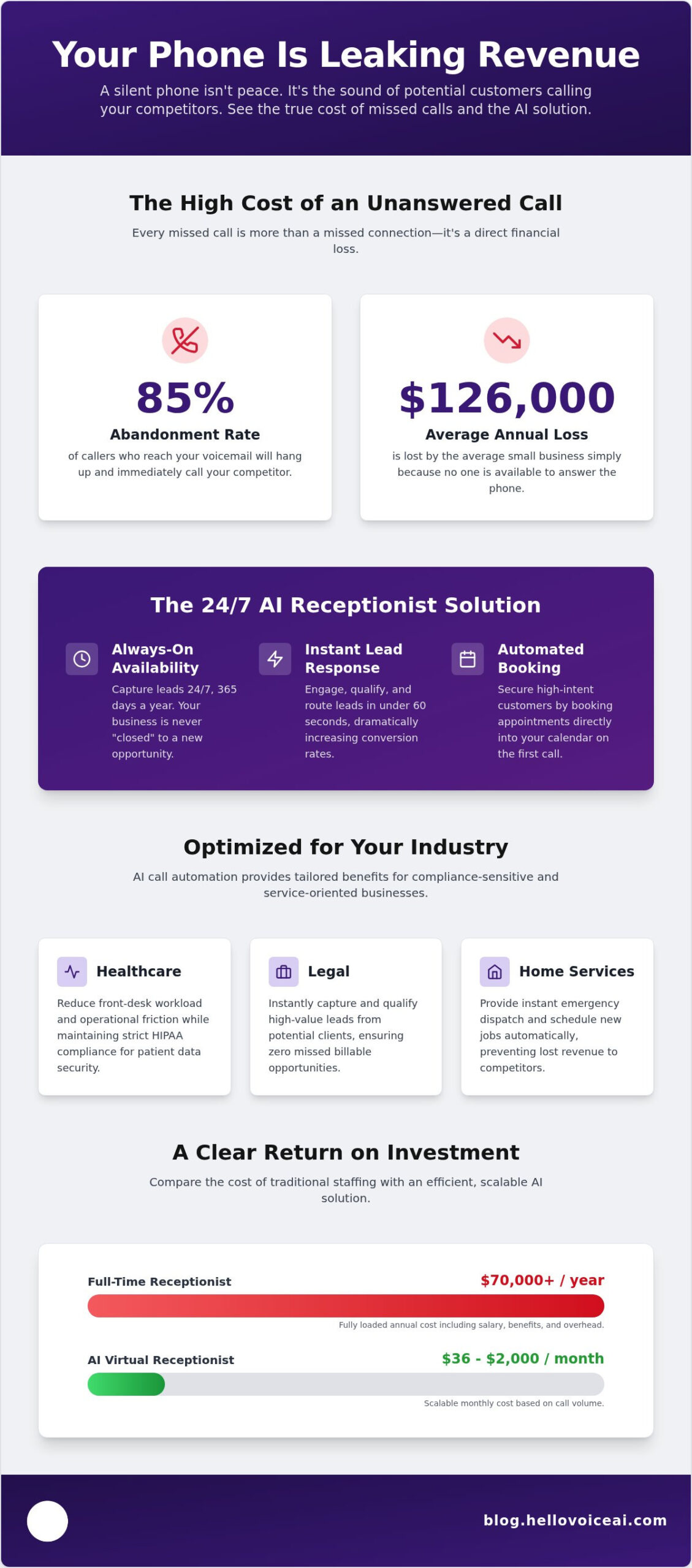
- Market pricing for automation ranges from $36 to $2,000 monthly depending on volume.
- Automation is not recommended for high-empathy crisis management or emotionally charged customer complaints.
- Deploy automated appointment booking to capture high-intent leads and maintain a sub-60-second response standard.
- Small businesses lose an average of $126,000 annually to missed calls according to article data.
Around 85% of callers who reach voicemail hang up and contact a competitor, which creates an average annual loss of $126,000 for small businesses. Revenue leaks shrink when automated phone systems deliver instant responses and continuous 24/7 coverage. The decision questions are straightforward: which model fits your call volume, what will you pay, and where does human cover still win? Answering those secures incoming leads while lowering support costs.
Match call volume to the right automation model before revenue leaks
Matching call automation setups to operational size prevents immediate revenue loss. Small teams often waste resources on complex systems designed for massive operations, and a poor match damages customer trust while inflating operational friction.
Typical situations and concrete moves:
- Low call volume: use basic call flow mapping (phone menus) so callers still reach the right path without overspending on unused capacity.
- Mid-sized load: deploy agentic AI (customer service automation) for routine tasks so you avoid adding headcount.
- High volume: require invisible scalability (handling more calls at once) so abandonment rate (missed calls) stays down; growing brands also need instant CRM integration (syncing with my software).
Using an answering service (AI receptionist) supports a sub‑60‑second response standard (getting back to people fast). You can follow the Hello Voice AI Blog, Never Miss a Call with Our 24/7 availability strategy to capture leads instantly without tricky setup steps.
Speech recognition and intent detection turn menus into responsive channels
Smart algorithms transform basic phone menus (call flow mapping) into responsive channels that capture caller intent instantly.
Modern customer service automation (agentic AI) relies on speech recognition and intent detection to process complex requests. As detailed in Wikipedia’s 2024 AI customer experience overview, algorithms analyze real-time voice data to route calls and automate workflows efficiently. Connecting this system to syncing with my software (CRM integration) ensures every record updates immediately without manual data entry.
You protect your pipeline from missed calls (abandonment rate) when routing, recognition, and CRM updates work as one stack. Learn how to use Hello Voice AI Blog, Page 2, Never Miss a Call with Our software to capture every inbound lead automatically.
Although early automation left a bad taste because callers felt tricked by synthetic voices, answering service technology now manages high call volumes when interaction models stay transparent. That approach fits growing teams that need reliable scale without deceptive tactics.
Cut abandonment and staff overhead with always-on AI coverage
Implementing customer service automation ensures immediate answers for every caller. Clear communication still matters: callers should know when they reach an answering service rather than a person. Modern platforms provide 24/7 availability so revenue opportunities are not left on hold overnight.
Legacy phone systems create unnecessary operational friction by forcing callers into long queues. Upgrading provides handling more calls at once (invisible scalability) without increasing staff overhead. Hello Voice AI offers 99.9% uptime to keep your front desk reachable under load.
Situation: unanswered calls drain revenue. Solution: automated appointment booking (booking appointments) catches high-intent buyers as they call. Result: you stop treating each missed ring as a write-off and instead log the lead in real time. Read the Hello Voice AI Blog, Page 3, Never Miss a Call with Our guide for operational strategies you can copy into your own stack.
Tip: To eliminate the busy signal hurdle, maintain round-the-clock lead capture using 99.9% uptime architectures.
Industry ROI spans $36–$2,000 monthly with clear cost impact
Deploying customer service automation delivers returns by reducing labor costs and stopping revenue leaks from an unhandled abandonment rate. From direct practitioner observation, setting up automated appointment booking yields a strong return when mapped directly to high-value leads. Transparency about the automated channel remains essential so callers trust the path.
Comparing financial impact across key industries:
| Industry | Primary Financial Benefit | Cost Impact |
|---|---|---|
| Healthcare | Reduced front-desk intake labor | Lower operational friction |
| Legal | Instant intake of high-value leads | Zero missed billable calls |
| Home Services | Instant emergency dispatch | Saved lost job revenue |
The market price band spans from 36 to 2,000 dollars monthly with a median of 500 dollars, based on current market rates across top vendors. Calculate your potential return by estimating saved staff hours, then weigh that against the $36–$2,000 band. Read the Hello Voice AI Blog, Page 4, Never Miss a Call with Our resources to see how instant capture changes your bottom line. Request a personalized quote for exact pricing.
5 Steps to integrate AI call agents with CRM
Connecting your answering service to software takes days, not months. Map authentic conversational paths during setup so callers hear a clear, honest flow.
Follow these steps for syncing with my software:
- Map workflows: Define how your call flow mapping routes data directly into database fields.
- Configure APIs: Connect secure endpoints to capture instant leads without operational friction.
- Set guardrails: Establish clear prompts to maintain compliance and conversational quality. As noted in a 2024 European Enterprise Network profile, customized conversational agents handle complex voice interactions while preserving context across transfers.
- Test calls: Run simulated scenarios to verify data transfers and trigger logic.
- Launch live: Enable real-time updates for every customer interaction.
Direct software integration provides handling more calls at once while reducing abandonment rate. Begin your technical setup when your workflow map and API endpoints are ready.
Track abandonment and first-contact resolution to lift experience
Tracking customer service automation success means measuring missed calls and first-contact resolution rates directly. Watch booking appointments (automated appointment booking) numbers so you know whether callers complete the task they called for.
Measure the time saved by phone menus against caller drop-off rates to reveal exact bottlenecks. High friction during automated setups leads directly to lost revenue; treat those drops like a leaking bucket and patch the step where people exit.
Answering service systems need ongoing monitoring so quality does not drift. Getting back to people fast (sub‑60‑second response standard) supports long-term loyalty. Handling more calls at once keeps your pipeline full during peak hours, and syncing with my software ensures every metric updates automatically.
Call center automation meets HIPAA when encryption is end-to-end
Yes, automated communication tools are legal and meet strict regulatory requirements when built on secure infrastructure. Security is a foundational component of modern automated communication platforms. Professional services employ end-to-end encryption and rigorous data protection protocols to safeguard sensitive records.
When configuring your customer service automation, protecting private details keeps operations inside regulatory lines. High privacy standards safeguard healthcare interactions and financial records like a digital vault. For sensitive data, HIPAA and data-security compliance provides end-to-end encryption and meets industry regulatory standards for sensitive information. Systems without total data locking leave your business exposed to large legal fines.
Pick platforms with verified encryption protocols before you route protected health or financial data through the channel.
Tip: Verify that your automated platform uses end-to-end encryption to meet HIPAA regulatory standards.
Leave crisis and high-empathy calls to human representatives
Human representatives must handle highly sensitive, emotionally charged situations where empathy and complex problem-solving are essential. Customer service automation struggles when furious clients need genuine human understanding rather than structured scripts.
In acute crisis management, automated systems are the wrong default: empathy cannot be coded into algorithms. Answering service setups also carry real risk on delicate cancellations or severe complaints, where a cold script damages trust.
When delicate relationships are at stake, direct human support fits best. High automation fits routine inquiries. Reserve your human team for high-stakes conversations.
What is customer service automation?
Customer service automation means using technology to handle inbound caller requests instantly without manual human effort. Imagine a front desk worker who never sleeps, handling phone menus and booking appointments simultaneously. Every missed call represents real revenue loss; swift, accurate responses keep prospective leads from moving to competitors.
Relying solely on human staff often leads to high missed calls. Setting up instant replies bridges that operational gap.
An answering service still has clear boundaries. Myth #5 notes that customers feel "tricked" by AI receptionists when systems mimic humans poorly. Present your automated system transparently to build trust while maintaining a sub‑60‑second response standard.
Frequently asked questions
How is AI used in customer service automation for call centers?
Answering services (AI receptionists) process incoming calls instantly by following set instructions to manage routine inquiries and capture leads. They lower your missed calls by taking messages and scheduling tasks around the clock.
What technologies power AI call center automation?
Modern call systems rely on advanced software that connects to your calendar for booking appointments. These tools use secure databases to ensure HIPAA and data security compliance through end-to-end encryption for sensitive business details.
What benefits does AI bring to call centers?
Automating calls helps you boost getting back to people fast while cutting hold times down to zero. The technology delivers 99.9% uptime, which gives your company handling more calls at once without adding extra staff.
What are common use cases for AI in call centers?
Companies use these systems for capturing leads, setting phone menus, and syncing with my software. Smart setups route complex issues to real people quickly when a script is not enough.
How can AI improve call center customer experience?
Smart customer service automation removes long wait times by offering 24/7 availability for every caller. Fast responses keep prospective clients engaged, which stops revenue leaks caused by unattended phone lines.
Take the next step toward better voice automation
Improving customer experience with call automation comes back to the same decisions you started with: fit the model to volume, know the $36–$2,000 monthly band, demand end-to-end encryption, and keep humans on crisis calls. Do that and you capture missed calls before leads walk away to competitors in 2026.
Instant response lifts caller satisfaction when coverage is continuous. The Hello Voice AI team provides automated voice solutions backed by guaranteed 24/7 availability along with HIPAA and data‑security compliance. Automated call flows let you focus on growing operations without dropping important inbound requests.
Contact our specialists to schedule your custom ROI projection and integration audit so you can protect revenue lines with numbers that match your call volume.