

Your front desk is leaking revenue. Every time a high-intent lead hits a voicemail or waits on hold for a human agent, your conversion rate takes a hit. It’s a systemic failure that traditional answering services can no longer fix. You likely already feel the strain of rising labor costs and the frustration of fragmented customer data. It’s a common operational puzzle, but the solution has shifted from hiring more heads to deploying more intelligence. As we move through 2026, the landscape of AI virtual receptionist providers has evolved from simple chatbots into sophisticated voice agents capable of handling complex logic.
This strategic guide identifies the ideal AI voice partner to eliminate missed-call revenue loss and modernize your front-desk operations once and for all. We’ll examine the top-tier providers capable of instant appointment booking and seamless CRM integration, giving you a clear path to a set-and-forget solution that treats every caller like a priority. You’ll learn how to transition from manual friction to an automated future-state that captures every opportunity, even after hours. We will analyze how these tools provide a measurable increase in lead conversion rates while positioning your business as a forward-thinking leader in your industry.
Key Takeaways
- Identify the critical technical benchmarks for Natural Language Understanding to ensure your voice agent delivers fluid, human-like interactions that build caller trust.
- Navigate the 2026 market of AI virtual receptionist providers by understanding the strategic trade-offs between no-code platforms and developer-first custom pipelines.
- Map your “Golden Path” call flow to transition from passive message-taking to proactive, automated appointment scheduling that integrates directly with your existing CRM.
- Eliminate the “silent revenue killer” of missed after-hours calls through a 24/7 deployment strategy designed to capture every high-intent lead without human intervention.
The 2026 Landscape of AI Virtual Receptionist Providers
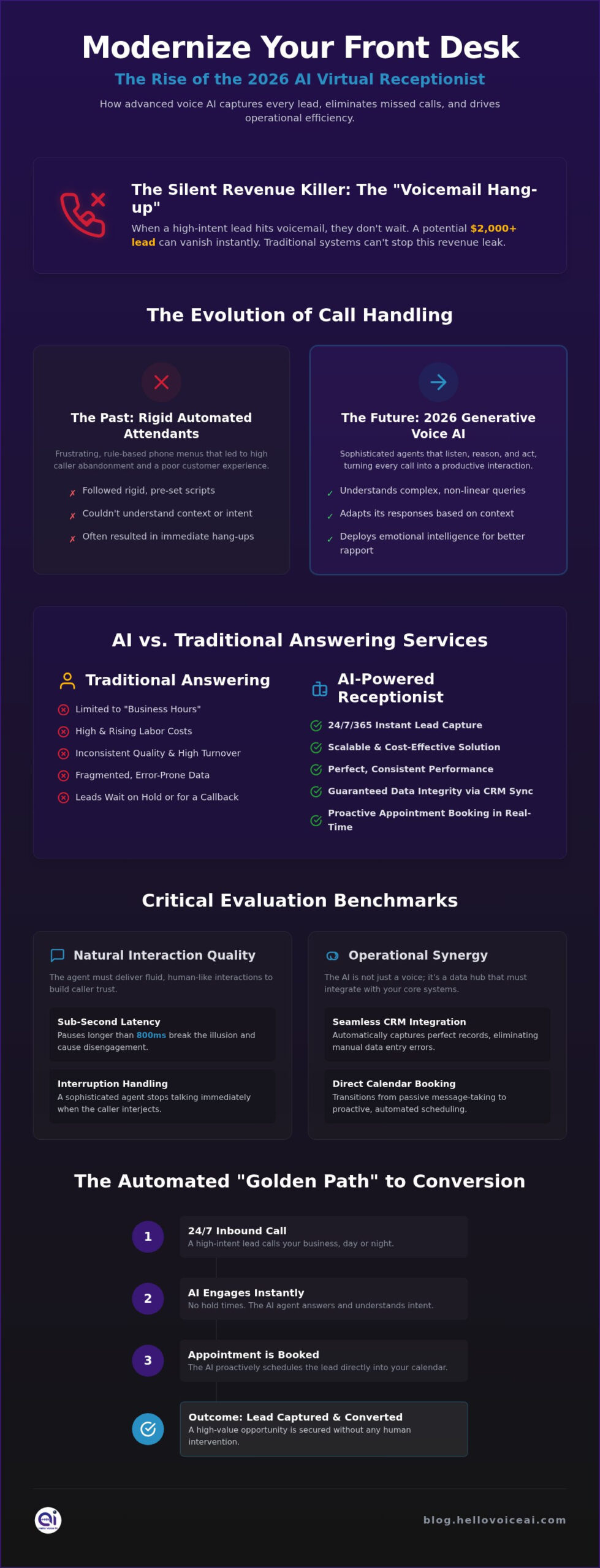
A phone rings at 7:00 PM. No one answers. The caller hangs up before the beep, and a $2,000 lead vanishes into the void. This is the “voicemail hang-up” epidemic. It’s a silent revenue killer that traditional systems simply can’t stop. In previous years, businesses relied on a basic Automated attendant to route calls. These systems were rigid, frustrating, and often led to immediate abandonment. By 2026, the landscape of AI virtual receptionist providers has shifted from these mechanical menus to generative agents that actually listen, reason, and close the loop. This is the tipping point where voice AI isn’t just a tool; it’s a strategic hire designed to plug systemic leaks.
The Evolution of Voice AI Technology
The leap from rule-based scripts to Large Language Model (LLM) reasoning has changed the fundamental nature of call handling. Modern AI doesn’t just follow a pre-set path; it understands intent and context. If a caller asks a complex question out of order, the agent doesn’t break. It adapts. Speed is the new currency of trust in professional services. Industry standards now dictate that sub-second latency is non-negotiable. If there’s a pause longer than 800ms, the illusion of a professional interaction shatters and the caller disengages. These 2026 agents also deploy emotional intelligence, identifying stress or urgency in a caller’s voice and adjusting their tone to match the situation. It’s the difference between a robotic prompt and a sophisticated business partner.
Market Trends: Why Businesses are Moving Away from Live Answering
Labor is expensive, inconsistent, and increasingly difficult to source. Human-operated answering services often struggle with high turnover and variable quality, leading to fragmented customer data. AI provides a level of scalability that human teams cannot match. You don’t have to worry about shift changes or “business hours” because the 24/7 expectation is now the baseline for modern commerce. Leading AI virtual receptionist providers offer a definitive fix to the staffing crisis by automating the front desk without sacrificing the personal touch. This shift is driven by the “hidden math” of growth:
- Instant Capture: Eliminating hold times ensures high-intent leads don’t dial a competitor.
- Data Integrity: Automated systems capture perfect records, removing the errors common in manual message taking.
- Operational Speed: Appointments are booked the moment the call happens, not hours later when a human follows up.
When you remove the friction of manual processes, your lead conversion rates climb because the system is always on and always accurate. The transition to automated future-states is no longer a luxury; it’s a requirement for staying competitive in a market that never sleeps.
Selection Criteria: How to Evaluate an AI Receptionist Solution
Choosing between AI virtual receptionist providers is no longer about comparing simple feature lists. It is about evaluating the underlying logic that governs a conversation. If you select a provider based on price alone, you risk trading one operational friction for another. A cheap, rigid system that fails to understand a caller’s intent is just a digital version of the “voicemail hang-up” problem we identified earlier. To ensure a positive return on investment, your evaluation must focus on the agent’s ability to handle the messy, non-linear nature of human speech while maintaining perfect data integrity.
The “Natural Interaction” Benchmark
An AI receptionist that cannot book an appointment is just an expensive answering machine. The real value lies in deep, real-time integration with your existing CRMs and scheduling tools. When a call ends, the data should already be in your system. This eliminates the “friction cost” of manual entry and ensures your sales team is working with fresh, accurate information. Look for providers that offer automated booking logic that respects your complex scheduling rules, such as buffer times or staff availability. If the system requires a human to “approve” every booking, you haven’t solved the efficiency puzzle; you’ve just moved the bottleneck.
Security and compliance are the final pillars of a strategic choice. With 2026 regulations focusing heavily on AI transparency and data privacy, your provider must demonstrate robust encryption and clear crisis protocols. Whether you are handling sensitive medical information or legal inquiries, the agent must be configured to protect caller data at every touchpoint. Balancing this level of security with the need for speed is how you identify a truly future-ready partner. If you are ready to start modernizing your front-desk operations, prioritize these technical benchmarks over generic marketing promises. The goal is a set-and-forget solution that treats every caller as a priority while giving you the freedom to focus on growth.
The Best AI Virtual Receptionist Providers: A Comparative Analysis
The market for AI virtual receptionist providers has reached a state of high-velocity fragmentation. Choosing the right partner requires more than a simple feature comparison; it requires an understanding of where your business sits on the technical spectrum. Some providers focus on raw flexibility for developers, while others prioritize immediate, strategic outcomes for business owners. Identifying which category fits your operational goals is the first step in plugging your revenue leaks and modernizing your front desk.
Advanced voice APIs like Vapi represent the technical vanguard. These platforms are developer-first, offering the building blocks for custom voice pipelines. If you have an in-house engineering team capable of managing API integrations and fine-tuning conversational logic, these tools provide unmatched control. However, for most businesses, this technical debt creates a new form of operational friction. Smith.ai offers a different path through a hybrid model. By combining AI with human-AI handoffs, they provide a safety net for complex queries, though this often introduces higher costs and variable response times compared to pure automation.
Hello Voice AI stands out as the strategic choice for businesses focused on 24/7 revenue capture. It is built specifically to solve the “Silent Revenue Killer” problem by ensuring no lead ever hits a voicemail. Unlike developer-centric tools, it is a turnkey solution that prioritizes direct ROI through automated appointment scheduling and perfect message capture.
Top End-to-End Solutions for Small to Mid-Sized Businesses
For SMBs, speed to deployment is critical. Providers like Goodcall and Thoughtly offer no-code environments that allow for rapid setup. These are excellent for basic call routing, but they often lack the deep reasoning required to handle high-intent leads effectively. Hello Voice AI leads this segment by focusing on strategic lead response. It doesn’t just route calls; it closes the loop by populating your calendar in real time. When evaluating your options, it’s essential to compare the virtual receptionist cost for small business across different tiers. A lower monthly fee might seem attractive, but if the system fails to book a single high-value appointment, the savings vanish instantly.
Enterprise-Grade Platforms for High-Volume Call Centers
At the enterprise level, the requirements shift toward massive concurrency and brand-specific identity. Platforms like PolyAI are designed to scale for thousands of simultaneous calls, making them suitable for global organizations. These AI virtual receptionist providers often require custom training to ensure the agent speaks with a specific brand voice and adheres to strict corporate protocols. Security standards are also higher in this tier, with a focus on SOC2 compliance and advanced encryption to protect sensitive caller data at scale. For the enterprise, the goal is total front-desk automation that feels like a seamless extension of the existing brand experience.
Implementation Strategy: Moving from Selection to Deployment
Selection is only half the battle. Deployment determines if you actually stop the silent revenue killer: the cost of missed calls. To ensure a successful transition, you must map the “Golden Path.” This is the specific sequence of interactions that leads a caller from an initial inquiry to a confirmed booking or a resolved ticket. Without this strategic map, even the most advanced AI virtual receptionist providers will struggle to deliver a cohesive experience. It’s a logical puzzle that requires you to trace the negative outcomes of current call failures and replace them with automated, high-conversion steps.
Training your AI is a methodical process. It’s not about uploading a generic company handbook and hoping for the best. You must feed the knowledge base specific, actionable data: your service list, your complex scheduling rules, and your direct CRM integration points. During the first 30 days of deployment, treat the AI like a high-stakes hire. Monitor the call logs. Identify where the conversational logic stalled or where a caller became confused. This iterative approach is what transforms a basic voice tool into a sophisticated business partner that actually grows your bottom line.
Designing the Conversational Experience
While selecting a provider is a key step, the broader challenge involves integrating these agents into your overall business strategy. If you’re looking for expert guidance on synthetic workforce development, learn more about Navo Inc. and their specialized GenAI coaching.
Start with the low-hanging fruit by automating your most common FAQs immediately. If callers frequently ask about your location, pricing, or specific certifications, the AI should handle these queries without a second thought. Then, set clear escalation boundaries. You must define exactly when the AI should forward a call to a human team member. High-stakes emergencies or complex grievances require a personal touch, and the AI should be intelligent enough to recognize these triggers. Consistency is the final piece of the puzzle. Your brand voice must remain steady across every interaction, ensuring the automated experience feels like a natural extension of your professional identity.
Measuring Success: KPIs for Your New AI Hire
You can’t manage what you don’t measure. Establish a baseline by comparing your new lead capture rates against your previous voicemail benchmarks. If you’ve moved to a 24/7 model, calculate the specific ROI of calls captured after 5:00 PM. These are leads that previously would have been lost to a competitor. Analyze call duration and resolution efficiency to ensure the AI is providing value quickly rather than keeping callers in circles. When you see a measurable increase in conversion rates and a decrease in front-desk friction, you’ll know the system is optimized. If you are ready to see how these metrics can transform your business, you can explore our implementation framework to start your deployment today.
Why Hello Voice AI is the Strategic Choice for Scalable Growth
The leak stops here. Choosing from the vast field of AI virtual receptionist providers is ultimately a decision about which partner will protect your bottom line with the most precision. Many platforms offer technical novelty, but few understand the high stakes of a missed connection. Hello Voice AI is built on the premise that every unanswered call is a tactical failure. By providing a 24/7 AI Voice Receptionist, we ensure that your business never sleeps, even when your team does. This is not just about answering the phone; it is about deploying a sophisticated, future-ready agent that identifies high-intent leads and secures them before they can dial a competitor.
Our system moves beyond simple message taking to provide a seamless, automated future-state for your front desk. If a caller is ready to book, the AI handles the scheduling logic immediately, populating your calendar and syncing data to your CRM in real time. This level of operational speed eliminates the friction that typically kills conversion rates. The voice itself is engineered to be both authoritative and empathetic, sounding like your most dedicated employee rather than a cold, robotic script. We solve the underlying business problem of revenue loss through a strategic partnership that prioritizes your financial health over mere technical connectivity.
The Hello Voice AI Advantage
Speed to lead is your most significant competitive edge in 2026. If you wait hours to return a message, the lead has already moved on. Our platform specifically targets the “missed call” revenue leak by providing instant, intelligent responses at any hour of the day. This proactive approach transforms your front desk from a cost center into a growth engine. To understand how this fits into the broader market shift, you can read our strategic guide to AI voice receptionists for a deeper dive into the technology. We focus on the “hidden math” of business success, ensuring that your investment in automation yields a direct, measurable ROI through captured opportunities that would otherwise vanish.
Ready to Modernize Your Front Desk?
The transition from legacy systems to a modern Virtual Receptionist Service is simpler than most business owners anticipate. We have refined the deployment process to minimize downtime, allowing you to move from manual friction to automated efficiency in a matter of days. Our case study highlights consistently show that businesses focusing on 24/7 availability see a significant rise in lead retention and a corresponding drop in operational stress. It’s time to stop letting “business hours” dictate your growth potential. Start capturing every opportunity today and position your company as a bold, innovation-led leader in your industry.
Securing Your Competitive Edge in a 24/7 Market
The landscape of modern commerce doesn’t wait for business hours. We’ve identified that the shift toward automated front-desk operations is no longer a technical experiment but a strategic necessity for survival. By evaluating AI virtual receptionist providers based on conversational depth and operational synergy, you move from a state of reactive firefighting to proactive growth. You’ve seen how the right partner eliminates the “silent revenue killer” of missed calls by ensuring every high-intent lead is met with an authoritative and empathetic response. It’s the definitive fix for a systemic leak that has likely cost your business significant opportunities in the past.
Implementing these systems requires a methodical approach to call-flow mapping and data integration. Success is measured by the leads you capture after hours and the friction you remove from your daily operations. With 24/7 automated call handling and instant CRM and calendar sync, you can finally focus on the big-picture goals of your business. It’s time to stop the leak and modernize your approach. Stop losing leads and start growing with Hello Voice AI to transform your front desk into a high-conversion asset. The path to a future-ready operation is clear, and the tools to build it are ready when you are.
Frequently Asked Questions
How do AI virtual receptionist providers differ from traditional IVR systems?
Traditional IVR relies on rigid “Press 1” logic and complex menu trees that often frustrate callers. Modern AI virtual receptionist providers use Natural Language Understanding (NLU) to process full sentences and understand intent. Instead of forcing a caller through a mechanical hurdle, the AI listens and responds with generative reasoning. This transforms the interaction into a fluid, human-like conversation that captures high-intent leads rather than pushing them toward a competitor.
Can an AI receptionist actually book appointments in my specific calendar software?
Yes, leading platforms offer deep, real-time integration with standard tools like Google Calendar, Outlook, and specialized industry scheduling software. The AI doesn’t just take a request; it checks live availability and secures the slot instantly. This creates a set-and-forget workflow for your front desk. By populating your calendar directly, the system removes the manual friction of back-and-forth emails, ensuring your sales team starts every day with a confirmed agenda.
Will my customers know they are talking to an AI, and does it matter?
Transparency is the new standard for professional trust in 2026. Most professional services disclose the agent’s nature to comply with evolving regulations and maintain brand integrity. However, the quality of the interaction is what truly matters to the caller. If the agent resolves their issue or books their appointment with sub-second latency, the AI label becomes secondary to the value provided. Callers value speed and accuracy over the specific biological nature of the voice.
What is the typical setup time for a professional AI receptionist service?
Turnkey solutions can be deployed in as little as 24 to 48 hours for standard business operations. This timeframe includes mapping your core call flows and uploading your basic knowledge base for initial testing. More complex enterprise configurations with custom LLM training or deep CRM integrations typically take between one and two weeks. The focus is on a methodical rollout that ensures the conversational logic is watertight before the first live call hits your front desk.
How much can a small business expect to save by switching to AI reception?
Small businesses often see a reduction in front-desk costs of approximately 60% compared to traditional staffing models. Beyond the direct payroll savings, the real value lies in captured revenue that was previously lost to voicemail. If your current system misses just two high-value leads per month, the AI pays for itself multiple times over. It replaces variable labor expenses with a predictable SaaS subscription, allowing you to scale without increasing your overhead.
Is my data safe with an AI virtual receptionist provider?
Security is a primary pillar for top-tier AI virtual receptionist providers. Modern platforms utilize SOC2-compliant data centers and end-to-end encryption for every interaction. Your caller data and internal knowledge bases are partitioned to ensure total privacy. Choosing a partner that adheres to 2026 transparency and data protection standards is essential. This ensures that sensitive business logic remains your intellectual property while protecting the personal information of your high-intent leads at every touchpoint.
Can the AI handle complex call routing for multiple departments?
Advanced agents excel at managing departmental logic that would confuse a standard automated attendant. The AI identifies the caller’s specific need through context and intent before routing the call to the appropriate team. It can handle several routing scenarios:
- Emergency escalation based on keyword triggers.
- Routing by service type or geographic location.
- Forwarding to specific staff members after an appointment is booked.
This ensures every caller reaches the right expert without a frustrating transfer process.
What happens if the AI receptionist cannot answer a caller’s question?
A sophisticated system is designed with clear escalation boundaries to prevent logic loops. If the AI encounters a query outside its knowledge base, it gracefully transitions the caller to a human team member or a specialized department. This prevents the frustration common in older bots. The agent can also capture a detailed message and create a high-priority ticket in your CRM, ensuring your team has the full context needed for a follow-up.