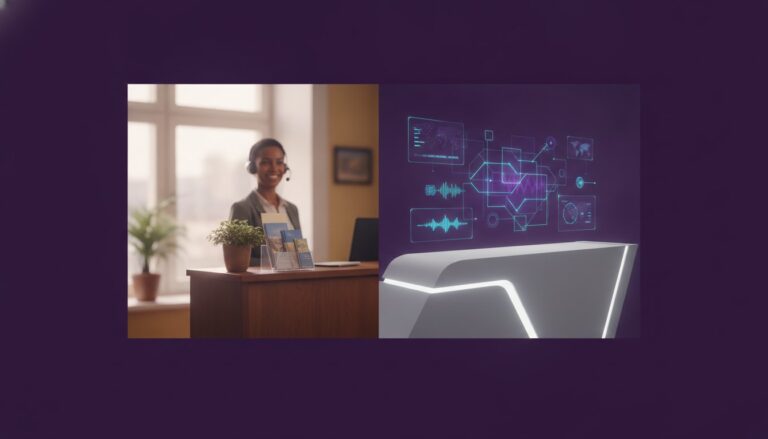

It is 5:15 PM on a Tuesday. A prospective client with a potential $50,000 personal injury case just dialed your office, but your front desk is empty. Research indicates that solo and small law firms often lose 40% to 60% of inbound calls to voicemail. This isn’t just a missed connection. It’s a structural leak in your firm’s revenue. Implementing a modern ai receptionist for law firms is no longer a futuristic experiment. It’s the new strategic standard for firms that refuse to let high-value leads slip to competitors.
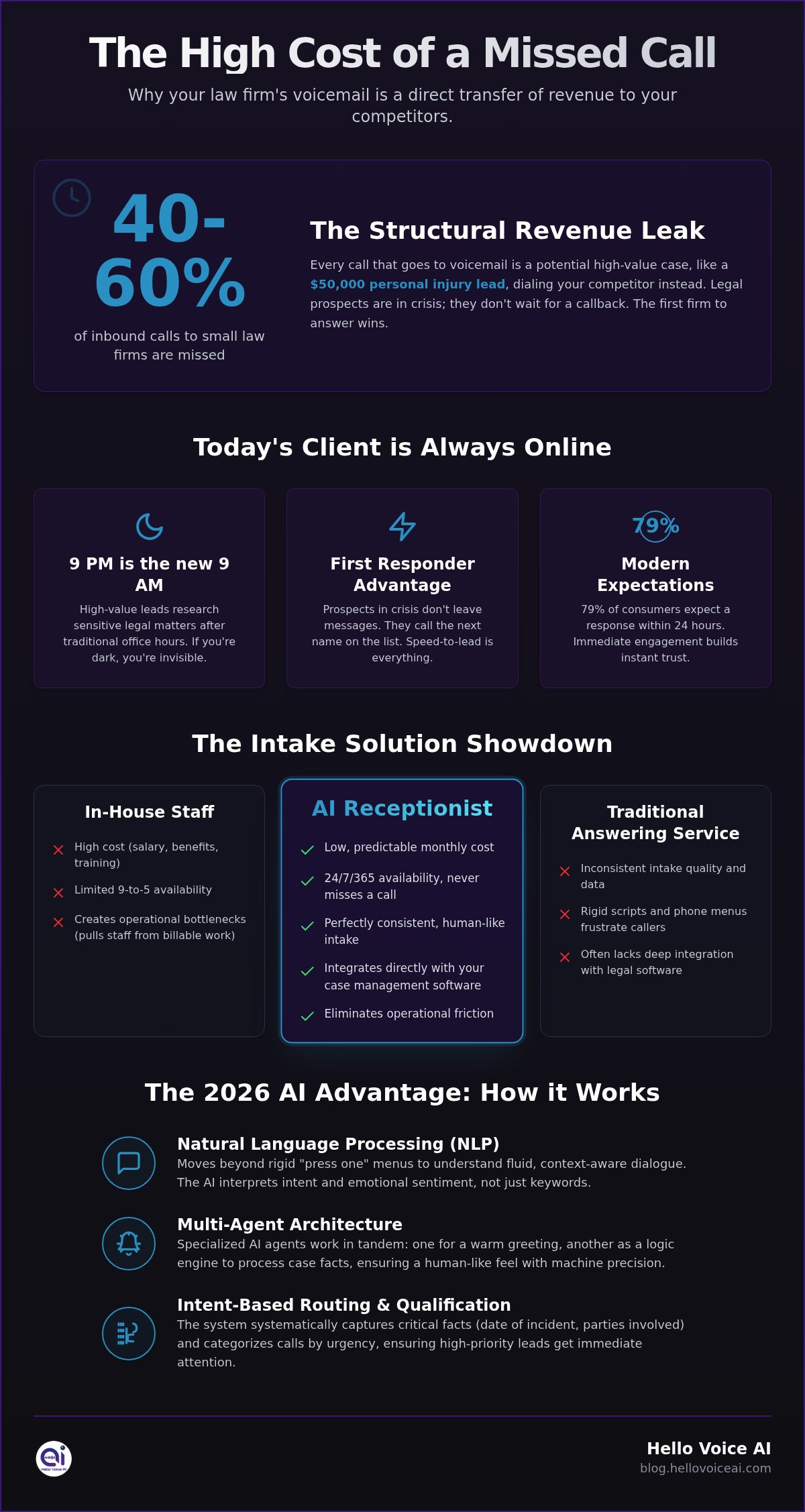
You likely recognize that responsiveness is the primary driver of client trust, especially when 79% of consumers expect a response within 24 hours. Still, the high cost of 24/7 human staffing often feels like a logical dead end. Traditional answering services frequently deliver inconsistent intake quality that leaves callers cold and frustrated. You’ll discover how modern AI voice technology captures leads that others miss while significantly lowering your operational overhead. We will explore how these systems provide human-grade intake, integrate with your current case management software, and ensure your firm remains competitive in the 2026 legal market.
Key Takeaways
- Analyze the structural revenue leaks caused by missed calls and understand why immediate responsiveness is the primary driver of modern legal client acquisition.
- Explore how an ai receptionist for law firms leverages sophisticated natural language processing to provide a fluid, human-like intake experience that outperforms rigid phone menus.
- Evaluate the logical case for AI over traditional virtual receptionists, focusing on data consistency, 24/7 reliability, and the elimination of human staffing friction.
- Determine the essential technical integrations that allow your front desk to sync lead data instantly with your existing case management tools.
The Hidden Cost of the Missed Legal Lead: Why “Good Enough” Isn’t
Your marketing budget is a leaky bucket. You spend thousands on SEO and PPC to drive high-intent traffic, yet those leads often evaporate in a silent voicemail box. In the legal industry, a missed call isn’t just a minor administrative lapse; it is a direct transfer of wealth to your closest competitor. Legal prospects are frequently in crisis. They don’t leave messages; they dial the next name on the search results page. The first firm to answer the phone almost always wins the case. This “first responder” advantage is the foundation of modern client acquisition.
Consumer behavior has shifted dramatically. The traditional 9-to-5 office hour is an obsolete concept. For many prospects, 9 PM is the new 9 AM for legal research. This is when they have the privacy and time to address sensitive personal injury or criminal defense matters. If your firm remains dark after sunset, you’re forfeiting the highest-value leads of the day. The evolution of customer-facing legal AI applications has moved beyond simple text bots to sophisticated voice agents. An ai receptionist for law firms ensures that every caller meets a professional, empathetic, and capable intake agent, regardless of the hour.
The Math of Missed Opportunities
Precision in your “Speed to Lead” metric is the difference between growth and stagnation. A lead’s interest decays exponentially within minutes of their initial search. If you capture just one additional high-value case per month that would have otherwise gone to voicemail, the ROI is undeniable. Consider the lifetime value of a single retained client against the flat monthly cost of an automated system. While a human staff member requires benefits, breaks, and sleep, an ai receptionist for law firms maintains peak performance 168 hours a week. It eliminates the financial friction of 24/7 human staffing while ensuring no five-figure retainer ever hits your answering machine.
Operational Friction in the Traditional Law Office
Manual call handling creates a systemic bottleneck that drains your most expensive resources. When senior paralegals or junior associates are forced to manage basic intake, your firm loses billable momentum. This operational friction often leads to “phone tag,” a process that erodes prospect trust before the first consultation even begins. Every unreturned call or delayed response signals a lack of capacity. To understand how to bridge this gap, read our pillar article on The 24/7 Front Desk: A Strategic Guide to AI Voice Receptionists in 2026. By automating the initial touchpoint, you free your team to focus on high-level legal strategy while the AI handles the logistical heavy lifting.
Beyond the Menu: How 2026 Voice AI Handles Legal Intake
The era of the rigid “press one for family law” menu is over. Static IVR systems are relics that frustrate prospects and signal a lack of modern sophistication. In 2026, an ai receptionist for law firms utilizes Natural Language Processing (NLP) to engage in fluid, context-aware dialogue. It doesn’t just recognize keywords; it interprets intent and emotional sentiment. If a caller describes a multi-car collision with audible distress, the AI recognizes the urgency. It bypasses standard scripts to offer immediate professional empathy and prioritized routing. This shift from “input-response” to “understanding-action” is what separates growing firms from those clinging to legacy hardware.
Achieving this level of performance requires a “Multi-Agent” architecture. Instead of one generalist bot, specialized agents work in tandem. One agent focuses on the warmth and professional cadence of the greeting, ensuring the firm avoids the “uncanny valley” of robotic speech. Another agent acts as a logic engine, processing case facts against your firm’s specific intake criteria. This specialized approach ensures that the caller feels heard while the firm receives perfectly structured data. It’s a methodical fix for the inconsistent quality often found in traditional answering services.
Qualifying Leads Without Human Intervention
Traditional intake is a slow, manual process. Junior staff often miss critical details like the date of the incident or potential conflict-of-interest parties. A sophisticated AI agent captures these facts systematically during the first interaction. It uses “Intent-Based Routing” to categorize the call based on the severity of the legal matter. A frantic criminal defense inquiry might trigger an immediate transfer to a partner’s mobile line, while a routine inquiry about estate planning can be managed by an “Archivist” agent. You can explore these modern intake solutions to see how they refine lead quality before your team even picks up the phone.
Seamless Appointment Scheduling
Friction kills conversions. If a prospect has to wait for a callback to book a consultation, they’ll likely keep dialing other firms. Modern AI integrates directly with your firm’s calendar to provide real-time booking. It handles complex linguistic logic, such as “I can do next Tuesday after 3 PM or any time Friday morning,” far better than a static web form. By securing the appointment instantly, the AI eliminates the “no-show” risk associated with delayed manual follow-ups. The result is a calendar populated with qualified consultations, booked while you were in court or after hours.
Comparing Solutions: AI vs. Live Virtual Receptionists vs. In-House Staff
Recruiting is a gamble. Training is a drain. Every law firm eventually reaches a crossroads where the front desk becomes an operational bottleneck. Hiring an in-house receptionist requires weeks of onboarding and significant overhead in benefits and office space. To further optimize your firm’s footprint and professional standing, you can find out more about establishing a prestigious legal headquarters. Traditional live virtual receptionists offer a stop-gap, but they often lack the technical precision required for complex legal intake. An ai receptionist for law firms represents the third path. It isn’t merely a software tool; it is a strategic hire that is “trained” in minutes and never experiences the fatigue that leads to human error.
Positioning AI as a team member allows you to measure its value through long-term firm growth rather than just monthly savings. While in-house salaries create high fixed costs, an ai receptionist for law firms operates on a predictable, scalable model that grows with your caseload. You can analyze the specific financial implications in our Virtual Receptionist Cost: 2026 Small Business Price Guide. For small to mid-sized firms, the ability to activate a 24/7 intake department instantly provides a definitive competitive advantage over firms stuck in the manual hiring cycle.
Consistency and Compliance
Compliance is a non-negotiable requirement for legal practitioners. Human operators, even those at specialized services, are prone to “legal advice slips” when attempting to be helpful. AI is strictly bounded by your firm’s logic. It ensures every caller receives the exact same professional greeting and follows the precise screening questions you approve. This level of standardization is a sophisticated, modern path forward for risk management.
- Automatic call transcription provides a perfect record for professional liability and case files.
- Instant logging to your case management system eliminates the “lost sticky note” syndrome common in busy offices.
- AI remains immune to the emotional burnout that typically degrades human intake quality during high-stress periods.
Evaluating Features: What Your Firm Needs for Compliance and Conversion
Selection isn’t just about utility. It’s about strategic alignment. A generic voice bot might answer a phone, but a specialized ai receptionist for law firms acts as a conversion engine that respects the rigid ethical boundaries of the legal profession. To move beyond a simple answering service, your firm requires a feature set that prioritizes 24/7 availability, instant routing, and deep CRM synchronization. These aren’t luxury add-ons. They are the infrastructure of a modern, responsive practice.
Practice-area nuances dictate your AI’s configuration. A personal injury firm requires an agent capable of medical coordination and gathering accident specifics. Conversely, a family law practice needs an agent that can handle delicate retainer discussions with professional poise. This requires a high degree of “Emotional Intelligence” in the AI’s vocal cadence. Callers in distress need to feel heard, not processed. If your automated systems sound clinical and cold, you’ve already lost the prospect’s trust. Secure, encrypted data handling is equally paramount to protect client confidentiality and maintain professional standards.
Integrating with the Legal Tech Stack
Efficiency depends on how well your data flows. A “closed-loop” system ensures that every call automatically populates your Case Management System (CMS), removing the risk of manual entry errors. This level of automation provides accurate ROI tracking for every marketing dollar spent. We see similar shifts in adjacent fields, as detailed in The Strategic Hire: Why Healthcare Virtual Receptionists Are Moving to AI in 2026. For the legal sector, this integration is the definitive fix for operational friction. You can optimize your firm’s intake workflow today by deploying these advanced integrations.
Ethical Guardrails and Professional Responsibility
Compliance is a logical puzzle that must be solved before the first call. Every AI interaction must include a clear disclosure that the caller is speaking with an automated assistant. This prevents the unauthorized practice of law (UPL) and manages client expectations from the start. Human oversight remains a critical component of this strategy. Methodical firms use call sampling and quality assurance reviews to refine their AI’s responses and ensure adherence to data privacy standards. Secure, encrypted data handling isn’t just a best practice. It’s a professional obligation. By treating your AI as a supervised non-lawyer assistant, you maintain control while gaining the speed of automation.
Hello Voice AI: Your Firm’s 24/7 Strategic Intake Partner
The architectural failure of the missed call is no longer a necessary tax on your firm’s growth. Hello Voice AI provides the definitive, modern path forward by transforming your front desk from a point of friction into a high-performance intake engine. As a dedicated ai receptionist for law firms, our system operates with the methodical precision of a strategic hire who never sleeps, never forgets a detail, and never misses a high-value lead. It is the sophisticated fix for the systemic leaks that currently drain your marketing ROI.
Efficiency is found in the transition from manual, inconsistent processes to streamlined automation. Hello Voice AI delivers instant response times, ensuring your firm captures the “Speed to Lead” advantage that is so critical in the 2026 legal market. By automating complex scheduling and message capture, you eliminate the administrative burden that slows down your internal team. The result is a perfect lead capture system that feels human and professional, ensuring every prospect receives a high-tier experience from the first ring.
Implementation doesn’t require a months-long technical overhaul. Our process moves from initial discovery to full production in just a few days. We act as your methodical efficiency expert, configuring the AI to mirror your firm’s specific intake logic and emotional cadence. This rapid deployment allows you to stop the revenue bleed almost immediately, providing a future-ready infrastructure that scales without the traditional overhead of human staffing.
The Future-Ready Law Firm
Attorneys who adopt a 24/7 intake model gain an immediate competitive edge in a market still largely tethered to 9-to-5 operations. When you offload the logistical heavy lifting of intake to Hello Voice AI, your team is free to focus on high-level litigation and client strategy. This shift doesn’t just improve your bottom line; it elevates your firm’s reputation for responsiveness and professionalism. Client satisfaction metrics rise when prospects feel their needs are addressed instantly, regardless of the hour.
Taking the First Step Toward Automation
The math of missed opportunities is simple but sobering. If your firm is losing even two qualified leads a month to voicemail, you are likely leaving six figures of potential revenue on the table. It is time to treat these missed calls as the solvable logical puzzles they are. You can begin by evaluating your current intake volume and identifying where your lead-to-client conversion rates are faltering. Experience the future of legal intake with Hello Voice AI and secure the strategic advantage your practice needs to lead the market in 2026.
Securing Your Firm’s Future in a 24/7 Legal Market
Growth isn’t just about finding new leads; it’s about refusing to lose the ones you’ve already worked to attract. The structural failure of the missed call is a solvable logical puzzle, and the solution lies in the transition from manual, legacy processes to streamlined automation. An ai receptionist for law firms provides the 24/7 responsiveness that modern clients demand while removing the high overhead of traditional human staffing. This isn’t just a technical upgrade; it’s a strategic mandate for firms that intend to lead the market in 2026.
By implementing a system that handles intake with human-level warmth and professional precision, you ensure that every prospect is captured, qualified, and scheduled without delay. This methodical approach to front-desk efficiency allows you to focus on high-level litigation while your automated systems manage the logistical heavy lifting. It’s time to stop the revenue bleed and position your practice as a leader in an increasingly competitive landscape.
Capture every lead 24/7 with Hello Voice AI to eliminate missed-call revenue loss instantly and benefit from 24/7 automated intake and scheduling with seamless CRM integration. Your firm’s future is built on the responsiveness you provide today.
Frequently Asked Questions
Does an AI receptionist sound like a robot to my clients?
Modern voice technology has moved far beyond the mechanical synthesizers of the past. In 2026, an ai receptionist for law firms utilizes advanced Natural Language Processing to mimic human-level warmth and professional cadence. It identifies emotional sentiment and adjusts its tone accordingly. If a caller is in distress, the system responds with empathy rather than clinical scripts. This ensures a seamless experience that preserves your firm’s reputation for high-tier service.
Can the AI receptionist schedule consultations directly into my calendar?
Real-time synchronization with your firm’s calendar is a core functionality. The AI handles complex time logic, such as “next Tuesday after 3 PM,” and books the consultation instantly. This eliminates the “no-show” risk associated with delayed callbacks. By the time you check your dashboard, the lead is already qualified and the meeting is secured. It’s a methodical fix for the administrative friction that typically slows down your intake department.
Is it ethical for a law firm to use an AI receptionist for intake?
Compliance is maintained through strict configuration and clear disclosures. Your firm must ensure the AI identifies itself as an automated assistant to avoid the unauthorized practice of law. Under ABA Model Rules 5.1 and 5.3, attorneys are responsible for supervising non-lawyer assistance. When used as a screening and routing tool rather than a source of counsel, it serves as a highly efficient, ethical extension of your staff.
How does the AI handle urgent calls that need an attorney immediately?
Critical matters are managed through sophisticated intent-based routing. If the AI identifies an urgent criminal defense or personal injury matter, it can bypass standard intake and route the call directly to a partner’s mobile line. You define the specific criteria for what constitutes an “emergency.” This ensures that high-value leads are never lost to a voicemail box during high-stakes scenarios, providing a strategic advantage in a competitive market.
Will the AI receptionist integrate with my existing legal CRM?
Seamless data flow is essential for accurate ROI tracking. An ai receptionist for law firms integrates directly with your existing Case Management System or CRM. It logs every interaction, captures party names, and transcribes the conversation automatically. This closed-loop automation removes the risk of manual entry errors. Your team spends less time on data entry and more time on high-level litigation and client strategy.
What happens if a caller asks for legal advice?
The AI is strictly bounded by your firm’s logic and ethical guardrails. If a caller asks for legal advice, the system is programmed to politely decline and state that it is not an attorney. It then pivots back to gathering facts for your review or scheduling a consultation with a lawyer. This standardization prevents the “legal advice slips” that often occur with untrained third-party human operators at traditional answering services.
How much does an AI receptionist for law firms cost compared to a human service?
Operational overhead is drastically reduced when you move away from 24/7 human staffing. While a human receptionist requires salary, benefits, and office space, an AI model provides 168 hours of coverage for a fraction of the cost. You eliminate the expenses associated with recruiting and turnover. This transition from high fixed costs to a scalable automated model allows for greater financial health and more predictable performance metrics. For firms managing complex financial disputes, partnering with experts like Whole King Company Limited provides a similarly methodical approach to commercial debt recovery.
Customization is a fundamental part of the implementation process. You control the specific greeting, the screening questions, and the overall emotional cadence to match your firm’s unique brand personality. Whether you require a formal, authoritative tone or a more empathetic approach for sensitive matters, the AI adapts to your requirements. This ensures that every interaction feels like a natural extension of your firm’s existing culture and professional standards.