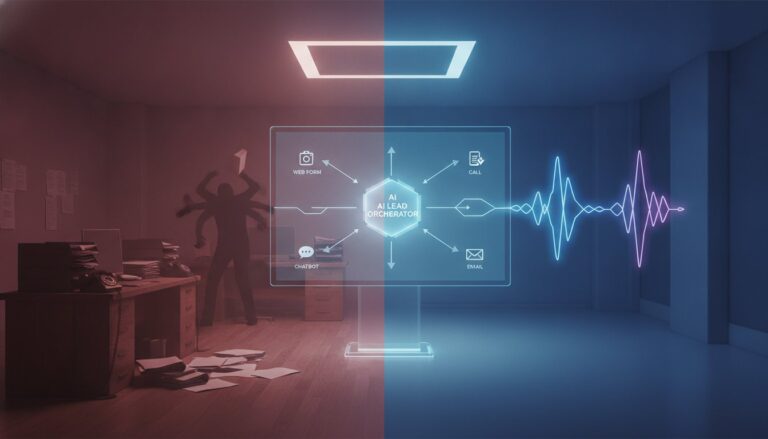

The phone rings at 6:15 PM. Your office is closed. That caller isn’t just a missed notification; they’re a new patient who will likely be booked with your competitor by 6:20 PM. What if the primary leak in your practice’s revenue isn’t your billing cycle, but your dial tone? For most clinics, the traditional front-desk model is fracturing under the weight of staff burnout and complex scheduling errors that human operators simply can’t outpace.
You recognize that patient access is the heartbeat of your growth, yet the cost of scaling a human team to handle 24/7 volume is often prohibitive. This is why the most critical move for 2026 isn’t hiring more staff, but deploying a sophisticated healthcare virtual receptionist. It needs to be a strategic asset. In this guide, we’ll demonstrate how AI-powered receptionists are eliminating missed calls and integrating directly with EHRs to automate the patient journey. Through a data-driven case study, you’ll discover how to solve the access crisis, ensure a 100% answer rate, and significantly reduce overhead costs compared to live agents.
Key Takeaways
- Identify the specific “leaky bucket” scenarios where your practice is losing thousands in monthly revenue to unanswered after-hours calls.
- Understand how a modern healthcare virtual receptionist uses AI to interpret complex medical intent and integrate directly with your EHR scheduling logic.
- Evaluate the fiscal advantages of scalable SaaS models compared to the high overhead and limited capacity of traditional live-agent services.
- Learn a structured implementation roadmap to audit your call volume and successfully digitize your specialty protocols.
- Discover how to transition your front-office operations from a reactive cost center into a proactive, future-ready strategic asset.
The Patient Access Crisis: Why Traditional Front Desks Are Failing
The phone rings. Nobody answers. The revenue vanishes. This simple sequence is the quiet crisis facing modern medical practices. Patient expectations have shifted dramatically in the last few years. They no longer accept “office hours” as a valid reason for a delayed response. If a potential patient cannot reach a human or a helpful system immediately, they don’t wait until Monday morning; they simply click the next result on their search page. The role of the healthcare virtual receptionist has evolved; it is now a strategic layer between the patient and the provider that ensures your practice is never truly “closed.”
While the concept of remote call handling began as a basic automated attendant that routed calls to extensions, modern AI has transformed this into a sophisticated decision-making tool. We are seeing a transition from reactive answering to proactive patient management. If your front desk is the bottleneck, your growth is capped. The psychological impact of long hold times or unreturned messages creates a sense of neglect before the patient even meets the doctor. This friction doesn’t just hurt your reputation; it actively erodes your bottom line.
The Math of a Missed Call
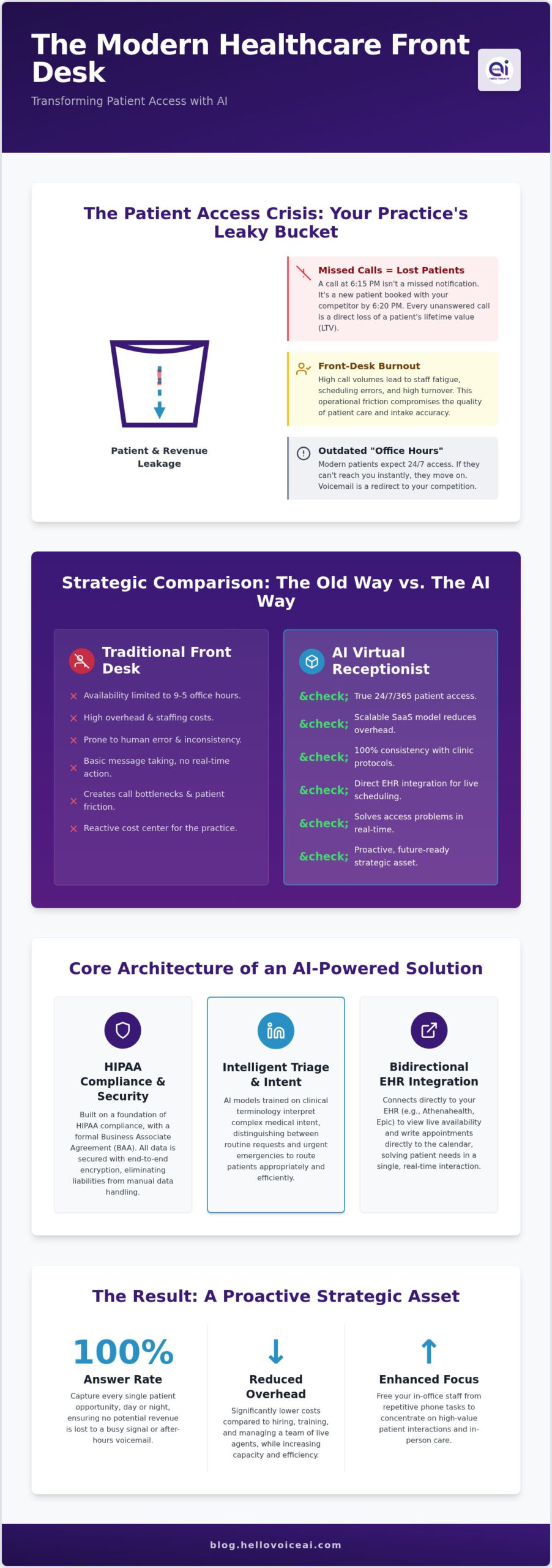
Every missed call is a “leaky bucket” scenario. To understand the stakes, you must consider the lifetime value (LTV) of a new patient. Between the initial consultation, follow-up procedures, and potential family referrals, a single patient represents significant long-term revenue. Losing that caller because of a busy signal or an after-hours voicemail isn’t just a minor inconvenience. Patient Leakage is the primary metric for practice health. It measures the percentage of potential patients who drop out of your care funnel because of operational friction. When you rely on traditional voicemail, you’re effectively providing a redirection to your nearest competitor who might have a more responsive system in place. This same missed-call crisis extends well beyond healthcare — as explored in research on how an AI receptionist for law firms captures high-value leads that traditional front desks routinely lose to voicemail.
Front-Desk Burnout and Operational Friction
Technology has moved beyond the static menu. A modern healthcare virtual receptionist functions as a digital nervous system for your practice. It doesn’t just listen; it interprets. By utilizing models specifically tuned for clinical terminology, these agents identify the subtle difference between a patient requesting a routine cleaning and one describing an acute dental emergency. This understanding of medical intent is the foundation of a truly automated front desk. It transforms a simple phone call into a structured data event that your practice can actually use to drive growth.
HIPAA Compliance and Data Security
Security is non-negotiable. When you deploy an AI Voice Receptionist, the architecture must be built on a foundation of HIPAA compliance. This starts with a formal Business Associate Agreement (BAA) that governs how Protected Health Information (PHI) is handled. Unlike traditional answering services where messages might sit in an unencrypted inbox, modern AI systems use end-to-end encryption for every call log and data packet. This ensures that the transition to automation doesn’t create a liability. It actually strengthens your practice’s data integrity by removing the human error associated with manual data entry and unsecure message transmission.
Automated Scheduling and Triage Logic
The real performance gains happen through bidirectional EHR integration. Your healthcare virtual receptionist shouldn’t just take a message; it should solve the patient’s problem in real-time. By connecting directly with platforms like Athenahealth, Epic, or Zocdoc, the AI views your live availability and writes appointments directly to the schedule. These protocol engines are trained on specific clinical logic. If a patient mentions symptoms that match your high-priority criteria, the AI can immediately escalate the call or provide specific instructions based on your practice’s unique guidelines. This ensures that urgent cases aren’t buried in a stack of routine messages.
This level of automation also extends to post-call workflows. The system can trigger intelligent confirmation calls to reduce “no-shows,” ensuring your providers’ time is maximized and your revenue remains stable. If you’re looking to audit your current tech stack for these capabilities, exploring modern integration strategies is a logical first step. By moving from a reactive “answering” mindset to a proactive scheduling model, you eliminate the friction that typically slows down patient intake.
Strategic Comparison: Live Virtual Receptionists vs. AI-Powered Solutions
Capacity is the ceiling of your growth. If you rely on a live healthcare virtual receptionist, you’re tethered to the physical limitations of a human operator. A single person can answer exactly one call at a time. During a morning surge or a seasonal peak, this creates a queue. Queues lead to hold times, and hold times lead to hang-ups. When you move to an AI-powered solution, that ceiling disappears. Whether your practice receives one call or one hundred simultaneous inquiries, the response remains instant and the quality of interaction never degrades.
The ROI of Instant Response
Speed to lead is the most reliable predictor of patient acquisition. If a prospective patient has to wait on hold for three minutes, they’ve already started searching for your competitor. AI captures these after-hours and overflow leads without hesitation. This creates an “Instant ROI” by securing revenue that would otherwise be lost to a voicemail graveyard. For a detailed breakdown of how these efficiencies impact your bottom line, consult our Virtual Receptionist Cost: 2026 Small Business Price Guide. You’ll find that the predictable SaaS subscription model typically offers a much higher margin than volatile hourly live-agent rates.
Accuracy is another critical differentiator. Human operators are prone to “scribal error,” especially when transcribing complex medical terminology or insurance details under pressure. AI doesn’t get distracted. It captures every phoneme with precision and maps it directly to your digital records. While some argue that patients prefer “small talk” with a human, modern data suggests a shift toward efficiency. Patients in 2026 value an instant, accurate resolution over a polite but slow conversation that ends with “someone will call you back.”
Consistency and Brand Voice
Your practice has a unique personality. Maintaining that tone across a rotating team of live agents is nearly impossible. One agent might be empathetic, while another is rushed. An AI healthcare virtual receptionist provides a “never-tired” advantage. It delivers the same authoritative and calm greeting at 3:00 AM as it does at 10:00 AM. You can customize the AI’s personality to match your specific brand tone, ensuring that every patient interaction feels like a direct extension of your clinical values. This level of consistency builds a foundation of trust that human-operated services simply cannot replicate at scale.
Implementation Roadmap: Integrating AI into Your Clinical Workflow
Five steps. One objective. Integrating a healthcare virtual receptionist isn’t a months-long technical overhaul; it’s a methodical sequence designed to plug systemic leaks in your patient access funnel. If you treat implementation as a simple software install, you’ll miss the strategic advantage. The goal is to create a digital front door that feels like a natural extension of your physical office. This process moves from high-level data analysis to granular protocol training.
- Step 1: Audit your volume. Identify the specific hours and days where “leakage” is highest. This typically includes lunch hours, after-hours, and Monday morning surges.
- Step 2: Map your logic. Document your specialty protocols and scheduling rules. If a patient requires a specific diagnostic test, the AI needs to know which providers handle that procedure.
- Step 3: Establish API connections. Connect the AI to your EHR or CRM. This ensures that when an appointment is booked, it’s written to your schedule in real-time without human intervention.
- Step 4: Configure the voice brand. Select a voice profile and greeting script that matches your practice’s professional identity.
- Step 5: Launch and iterate. Use real-time call analytics to refine how the AI handles complex inquiries.
Mapping the Patient Journey
Every interaction should follow a “Happy Path.” This is the most efficient route from a patient’s initial inquiry to a confirmed appointment on your calendar. While the objective is automation, you must also define clear escalation paths for emergency clinical needs. If the AI detects high-priority symptoms based on your triage logic, it triggers a warm handoff to your on-call staff. You can also pre-load responses for frequent FAQs regarding insurance, office locations, and pre-procedure instructions to keep the lines clear for clinical discussions.
Training the AI on Your Practice
Personalization is what separates a generic tool from a strategic hire. You’ll need to upload specific provider preferences and live availability to ensure the AI doesn’t just book a slot, but the correct slot for the specific medical need. Modern systems refine their understanding through call transcripts, learning to navigate patient slang or regional accents with increasing precision. This continuous automated QA ensures that your healthcare virtual receptionist improves with every conversation. To begin your transition, you can schedule a workflow audit to see exactly where your practice is losing leads.
The Hello Voice AI Advantage: Your Next Strategic Hire
Hello Voice AI isn’t a mere tool; it’s the definitive fix for the operational friction that stalls clinical growth. While traditional methods struggle to keep pace with modern patient expectations, this AI Voice Receptionist acts as a strategic partner that understands the high stakes of your practice. It moves you from a state of reactive answering to a model of proactive patient management. The peace of mind that comes with a 24/7 front desk is invaluable. It never calls in sick. It never burns out. It ensures that your digital front door is always open, regardless of the hour or volume of inquiries.
Case study results highlight the profound impact of this transition. A typical practice adopting this technology has seen a 98% reduction in missed calls. This isn’t just a marginal gain; it’s a total reclamation of lost revenue. By capturing every inquiry, these practices have transformed their “leaky bucket” into a streamlined engine for new patient acquisition. This is what it means to be a “future-ready” practice. You aren’t just surviving the patient access crisis; you’re solving it through a data-driven, scalable architecture.
Scaling Without the Overhead
Expansion often brings a heavy administrative burden. If you’re managing a multi-site practice, adding new locations or providers traditionally requires a corresponding increase in administrative headcount. Hello Voice AI breaks this cycle. It allows you to scale your operations across multiple sites without inflating your payroll. For a broader perspective on this evolution, read The 24/7 Front Desk: A Strategic Guide to AI Voice Receptionists in 2026. This platform ensures that whether you have one location or twenty, the patient experience remains consistently high-quality and authoritative.
Next Steps: Securing Your Practice’s Growth
The move toward a healthcare virtual receptionist is about more than just technology; it’s about competitive positioning. If your competitors are still relying on voicemail, your ability to provide instant resolution becomes a significant market advantage. We invite you to a personalized “Hidden Math” revenue audit. We’ll analyze your current call patterns and identify exactly how much revenue is slipping through the cracks. You can start a trial without any disruption to your existing phone system. It’s a low-risk path to a high-impact solution. Secure your practice’s future by adopting an infrastructure that supports, rather than hinders, your clinical excellence. Your next healthcare virtual receptionist is ready to start today.
Securing Your Clinical Growth in a Digital-First Market
The shift toward automated patient access isn’t just a trend; it’s a necessary evolution for practices that intend to thrive in 2026. By deploying a sophisticated healthcare virtual receptionist, you effectively eliminate 100% of missed calls while maintaining a HIPAA-compliant secure architecture. This isn’t just about answering phones. It’s about full EHR and calendar integration that allows your practice to book patients while your human staff focuses on in-office care. You’ve seen the “hidden math” of missed revenue. Now, you have the architecture to capture it.
The transition from a reactive front desk to a proactive, automated intake system is the single most impactful move you can make for your operational ROI. Don’t let another new patient inquiry go to voicemail. Take the first step toward a more efficient, future-ready clinical workflow. Start your 24/7 AI Receptionist trial today and experience the peace of mind that comes with a front desk that never sleeps. Your patients deserve an instant response, and your practice deserves the growth that comes with it.
Frequently Asked Questions
Is an AI healthcare virtual receptionist HIPAA compliant?
Yes, a modern AI-powered healthcare virtual receptionist is built on a foundation of strict HIPAA compliance. This security is maintained through a mandatory Business Associate Agreement (BAA) and end-to-end data encryption for every interaction. Unlike traditional systems that might leak Protected Health Information (PHI) through unencrypted emails, these AI agents process data within a secure environment. This ensures that every scheduling event adheres to 2026 federal standards for healthcare data privacy.
Will my patients be frustrated talking to an AI instead of a person?
Most patients prioritize instant resolution over lengthy small talk. While some practitioners fear a loss of empathy, the reality is that long hold times and unreturned voicemails cause far more frustration than an efficient AI agent. By providing an immediate response and accurate scheduling, you respect the patient’s time. Modern voice synthesis is sophisticated enough to maintain a professional, empathetic tone that feels like a natural extension of your practice.
How does the AI integrate with my existing EHR system?
Integration occurs through secure, bidirectional API connections with platforms like Athenahealth, Epic, or Epic. The AI doesn’t just record a request; it views your live availability and writes appointments directly into your schedule. This eliminates the need for manual data entry by your front-office staff. Because the connection is real-time, there is no risk of double-booking, ensuring that your digital and physical workflows remain perfectly synchronized at all times.
Can the AI handle emergency calls or medical triage?
Yes, the system utilizes specialty-trained protocol engines to identify clinical urgency. If a caller describes symptoms that match your predefined emergency criteria, the AI immediately initiates a warm handoff to your on-call staff or instructs the patient to dial 911. This triage logic ensures that life-threatening situations are never buried in a queue, providing a level of safety and responsiveness that traditional voicemail or human-operated answering services simply cannot match. For patients who require constant safety assurance at home, clinicians often recommend a proof of life check in app to ensure that any lack of activity triggers an immediate family notification.
What is the cost difference between a live virtual receptionist and AI?
The cost difference is substantial and predictable. While live agents require hourly rates, benefits, and management overhead, an AI healthcare virtual receptionist operates on a scalable SaaS subscription model. You avoid the “hidden math” of paying for idle time between calls. Additionally, the AI can handle 100 simultaneous calls for the same base cost, whereas scaling a live team requires a linear and expensive increase in your administrative headcount.
How long does it take to set up a healthcare virtual receptionist?
Implementation is a structured process that typically takes days rather than months. Once you audit your call patterns and map your scheduling logic, the technical setup involves connecting the API to your EHR and configuring your voice brand. Because the platform is built for healthcare, the underlying medical terminology is already trained. This allows your practice to transition from a reactive model to a proactive, automated front desk with minimal disruption.
Can the AI speak multiple languages for my bilingual patient base?
Yes, the AI supports multilingual interactions to serve diverse patient populations. It can detect the caller’s language in real-time or offer a menu-driven selection to ensure clear communication. This capability is vital for practices in bilingual markets where language barriers often lead to patient leakage. By providing support in multiple languages, you ensure that every patient receives the same high-quality intake experience regardless of their primary tongue.
What happens if the AI doesn’t know the answer to a patient’s question?
If a patient asks a question outside the AI’s training, the system executes a graceful escalation. It captures the specific inquiry as a structured message and notifies your staff for a follow-up, or it can route the call to a designated human team member during office hours. This ensures that the patient never hits a dead end. The system then uses these transcripts to refine its future responses, continuously improving its clinical knowledge base.